












Oxidation, defunctionalization and catalyst life cycle of carbon nanotubes: a Raman spectroscopy view
Literature Information
Publication Date
2016-12-12
DOI
10.1039/C6CP04657F
Impact Factor
3.676
Authors
Anton S. Ivanov, Konstantin I. Maslakov, Alexander V. Egorov, Zexiang Shen
View Original
Abstract
Pristine, oxidized and defunctionalized carbon nanotubes (CNTs) were studied by Raman spectroscopy, X-ray diffraction, transmission electron microscopy and low temperature nitrogen adsorption. The Raman spectra of the studied samples in the range of 900–1800 cm−1 were deconvoluted into five components to reveal the CNT oxidation mechanism. It was found that the oxidation resulted in the reduction of graphite components and ordering of both the structured and defect part of CNTs. Acid treatment also led to different types of disorders in the surface layers of CNTs. Polyene-type, polyphenylene-type and turbostratic fragments were detected as a result of partial exfoliation. Investigation of defunctionalized CNTs showed the ordering of edge carbon atoms as well as the invariability of the total amount of defects. The study of CNTs as supports for Co-based catalysts revealed a simultaneous decrease in the number of defect fragments and increase in the number of edge carbon atoms during catalyst preparation and reduction.
Related Literature
Theoretical study of the binding profile of an allosteric modulator NS-1738 with a chimera structure of the α7 nicotinic acetylcholine receptor
Guanglin Kuang, Xu Wang, Christer Halldin, Agneta Nordberg, Bengt Långström, Hans Ågren, Yaoquan Tu
2016-09-12
Paper
DOI: 10.1039/C6CP02278B
Raman excess spectroscopy vs. principal component analysis: probing the intermolecular interactions between chiral molecules and imidazolium-based ionic liquids
H. Koch, K. Noack, S. Will
2016-09-20
Paper
DOI: 10.1039/C6CP04372K
Ultrafast excited states dynamics of [Ru(bpy)3]2+ dissolved in ionic liquids
Mario Borgwardt, Martin Wilke, Igor Yu. Kiyan
2016-09-23
Paper
DOI: 10.1039/C6CP05655E
Understanding the role of silica nanospheres with their light scattering and energy barrier properties in enhancing the photovoltaic performance of ZnO based solar cells
Avishek Banik, Mohammad Shaad Ansari, Tushar Kanta Sahu, Mohammad Qureshi
2016-09-14
Paper
DOI: 10.1039/C6CP05544C
N2 activation on Al metal clusters: catalyzing role of BN-doped graphene support
Deepak Kumar, Sourav Pal, Sailaja Krishnamurty
2016-09-21
Communication
DOI: 10.1039/C6CP03342C
A detailed Raman and X-ray study of UO2+x oxides and related structure transitions
J. M. Elorrieta, L. J. Bonales, N. Rodríguez-Villagra, V. G. Baonza, J. Cobos
2016-10-03
Paper
DOI: 10.1039/C6CP03800J
Control of calcium accessibility over hydroxyapatite by post-precipitation steps: influence on the catalytic reactivity toward alcohols
Manel Ben Osman, Sarah Diallo Garcia, Jean-Marc Krafft, Christophe Methivier, Juliette Blanchard, Tetsuya Yoshioka, Jun Kubo, Guylène Costentin
2016-09-13
Paper
DOI: 10.1039/C6CP05294K
Nuclear spin hyperpolarization with ansa-aminoboranes: a metal-free perspective for parahydrogen-induced polarization
Kristina Sorochkina, Konstantin Chernichenko, Bianka Kótai, Tamás Földes, Imre Pápai, Ville-Veikko Telkki, Timo Repo
2016-09-06
Paper
DOI: 10.1039/C6CP05211H
Physical chemistry of hybrid perovskite solar cells
Aron Walsh, Nitin P. Padure, Sang Il Seok
2016-09-02
Editorial
DOI: 10.1039/C6CP90212J
You might also like
Compound Q&A
Is 2-(2-chloroacetamido)-3-phenylpropanoic acid (CAS: 7765-11-9) safe?
2-(2-Chloroacetamido)-3-phenylpropanoic acid (CAS: 7765-11-9) is generally consi...
7765-11-92-(2-chloroacetamido...
Compound Q&A
Is 2-(Benzyloxy)-5-bromobenzoic acid (CAS: 62176-31-2) safe?
2-(Benzyloxy)-5-bromobenzoic acid can be handled safely if appropriate precautio...
62176-31-22-(Benzyloxy)-5-brom...
Compound Q&A
What is (4-Methyl-1,2,5-oxadiazol-3-yl)methanamine hydrochloride (CAS: 1159825-48-5)?
(4-Methyl-1,2,5-oxadiazol-3-yl)methanamine hydrochloride is a chemical compound ...
1159825-48-5(4-Methyl-1,2,5-oxad...
Compound Q&A
What is 2-(5-Hexylthiophen-2-yl)-4,4,5,5-tetramethyl-1,3,2-dioxaborolane (CAS: 917985-54-7)?
2-(5-Hexylthiophen-2-yl)-4,4,5,5-tetramethyl-1,3,2-dioxaborolane (CAS: 917985-54...
917985-54-72-(5-Hexylthiophen-2...
Compound Q&A
Are there alternatives to 4-(8-Methyl-9H-1,3-dioxolo[4,5-h][2,3]benzodiazepin-5-yl)benzenamine (CAS: 102771-26-6) in synthesis?
While 4-(8-Methyl-9H-1,3-dioxolo[4,5-h][2,3]benzodiazepin-5-yl)benzenamine (CAS:...
102771-26-64-(8-Methyl-9H-1,3-d...
Compound Q&A
What is the market or research trend for tert-butyl 3-hydroxy-4,5,7,8-tetrahydro-2H-pyrazolo[3,4-d]azepine-6-carboxylate (CAS: 851376-80-2)?
The market for tert-butyl 3-hydroxy-4,5,7,8-tetrahydro-2H-pyrazolo[3,4-d]azepine...
851376-80-2tert-butyl 3-hydroxy...
Compound Q&A
How should waste containing 3,5-Diamino-1H-pyrazole-4-carbonitrile (CAS: 6844-58-2) be handled?
Waste containing 3,5-Diamino-1H-pyrazole-4-carbonitrile (CAS: 6844-58-2) should ...
6844-58-23,5-Diamino-1H-pyraz...
Compound Q&A
How is (6-Fluoro-3-pyridinyl)boronic acid (CAS: 351019-18-6) typically synthesized?
(6-Fluoro-3-pyridinyl)boronic acid can be synthesized through the reaction of 6-...
351019-18-6(6-Fluoro-3-pyridiny...
Compound Q&A
What industries use Dibenzyl carbonimidoylbiscarbamate (CAS: 10065-79-9)?
Dibenzyl carbonimidoylbiscarbamate (CAS: 10065-79-9) finds applications in vario...
10065-79-9Dibenzyl carbonimido...
Compound Q&A
What is the market or research trend for (beta,beta,2,3,4,5,6-~2~H_7_)Phenylalanine (CAS: 74228-83-4)?
The market for (beta,beta,2,3,4,5,6-~2~H_7_)Phenylalanine (CAS: 74228-83-4) is g...
74228-83-4(beta,beta,2,3,4,5,6...
Source Journal
Physical Chemistry Chemical Physics

CiteScore:
5.5
Self-citation Rate:
10.3%
Articles per Year:
3036
Physical Chemistry Chemical Physics (PCCP) is an international journal co-owned by 19 physical chemistry and physics societies from around the world. This journal publishes original, cutting-edge research in physical chemistry, chemical physics and biophysical chemistry. To be suitable for publication in PCCP, articles must include significant innovation and/or insight into physical chemistry; this is the most important criterion that reviewers and Editors will judge against when evaluating submissions. The journal has a broad scope and welcomes contributions spanning experiment, theory, computation and data science. Topical coverage includes spectroscopy, dynamics, kinetics, statistical mechanics, thermodynamics, electrochemistry, catalysis, surface science, quantum mechanics, quantum computing and machine learning. Interdisciplinary research areas such as polymers and soft matter, materials, nanoscience, energy, surfaces/interfaces, and biophysical chemistry are welcomed if they demonstrate significant innovation and/or insight into physical chemistry. Joined experimental/theoretical studies are particularly appreciated when complementary and based on up-to-date approaches.
Recommended Compounds

![(3S,4aS,8aS)-2-[(2R,3S)-3-Amino-2-hydroxy-4-phenylbutyl]-N-(2-methyl-2-propanyl)decahydro-3-isoquinolinecarboxamide structure](https://static.chemtradehub.com/structs/136/136522-17-3-4d77.webp "(3S,4aS,8aS)-2-[(2R,3S)-3-Amino-2-hydroxy-4-phenylbutyl]-N-(2-methyl-2-propanyl)decahydro-3-isoquinolinecarboxamide structure")
(3S,4aS,8aS)-2-[(2R,3S)-3-Amino-2-hydroxy-4-phenylbutyl]-N-(2-methyl-2-propanyl)decahydro-3-isoquinolinecarboxamide
CAS Number:
136522-17-3
Molecular Formula:
C24H39N3O2
![19-[Chloro(dideuterio)methyl]-19-deuterio-20,20-dideuteriooxyoctatriacontane-18,21-dione structure](https://static.chemtradehub.com/structs/124/1246818-85-8-6244.webp "19-[Chloro(dideuterio)methyl]-19-deuterio-20,20-dideuteriooxyoctatriacontane-18,21-dione structure")
19-[Chloro(dideuterio)methyl]-19-deuterio-20,20-dideuteriooxyoctatriacontane-18,21-dione
CAS Number:
1246818-85-8
Molecular Formula:
C39H75ClO4
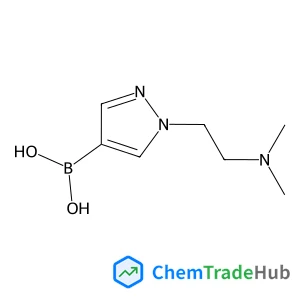
(1-(2-(Dimethylamino)ethyl)-1H-pyrazol-4-yl)boronic acid
CAS Number:
1086063-73-1
Molecular Formula:
C7H14BN3O2
Recommended Suppliers




Disclaimer
This page provides academic journal information for reference and research purposes only. We are not affiliated with any journal publishers and do not handle publication submissions. For publication-related inquiries, please contact the respective journal publishers directly.
If you notice any inaccuracies in the information displayed, please contact us at support@chemtradehub.com. We will promptly review and address your concerns.