












N-ethyl-N-methylpyrrolidinium bis(fluorosulfonyl)imide-electrospun polyvinylidene fluoride composite electrolytes: characterization and lithium cell studies
Literature Information
Publication Date
2016-12-19
DOI
10.1039/C6CP07415D
Impact Factor
3.676
Authors
Yundong Zhou, Xiaoen Wang, Haijin Zhu, Michel Armand, Maria Forsyth, George W. Greene, Jennifer M. Pringle, Patrick C. Howlett
View Original
Abstract
Using the organic ionic plastic crystal N-ethyl-N-methylpyrrolidinium bis(fluorosulfonyl)imide ([C2mpyr][FSI]) with electrospun nanofibers, LiFSI doped [C2mpyr][FSI]–PVdF composites were developed as solid state, self-standing electrolyte membranes. Different lithium salt concentration were investigated, with 10 mol% LiFSI found to be optimal amongst those assessed. Composites with different weight ratios of plastic crystal and polymer were prepared and 10 wt% polymer gave the highest conductivity. In addition, the effects of PVdF incorporation on the morphological, thermal, and structural properties of the organic ionic plastic crystal were investigated. Ion mobilities were also studied using solid-state nuclear magnetic resonance techniques. The electrolytes were then assembled into lithium symmetric cells and cycled galvanostatically at 0.13 mA cm−2 at both ambient temperature and at 50 °C, for more than 500 cycles.
Related Literature
N2 activation on Al metal clusters: catalyzing role of BN-doped graphene support
Deepak Kumar, Sourav Pal, Sailaja Krishnamurty
2016-09-21
Communication
DOI: 10.1039/C6CP03342C
How photon pump fluence changes the charge carrier relaxation mechanism in an organic–inorganic hybrid lead triiodide perovskite
Piotr Piatkowski, Boiko Cohen, Samrana Kazim, Shahzada Ahmad, Abderrazzak Douhal
2016-06-10
Paper
DOI: 10.1039/C6CP02682F
How to regulate energy levels and hole mobility of spiro-type hole transport materials in perovskite solar cells
Wei-Jie Chi, Ping-Ping Sun, Ze-Sheng Li
2016-07-07
Communication
DOI: 10.1039/C6CP03316D
Dynamic disorder, phonon lifetimes, and the assignment of modes to the vibrational spectra of methylammonium lead halide perovskites
Aurélien M. A. Leguy, Jarvist M. Frost, Jonathan Skelton, Federico Brivio, Xabier Rodríguez-Martínez, Oliver J. Weber, Anuradha Pallipurath, M. Isabel Alonso, Mariano Campoy-Quiles, Mark T. Weller, Aron Walsh, Piers R. F. Barnes
2016-06-17
Communication
DOI: 10.1039/C6CP03474H
Black-box determination of temperature-dependent susceptibilities for crystalline organic radicals with complex magnetic topologies
Steffen Eusterwiemann, David R. Matuschek, Constantin G. Daniliuc, Oliver Janka, Rainer Pöttgen, Armido Studer
2016-10-03
Paper
DOI: 10.1039/C6CP05875B
Excited-state dynamics of the medicinal pigment curcumin in a hydrogel
Takaaki Harada, Stephen F. Lincoln, Tak W. Kee
2016-09-23
Paper
DOI: 10.1039/C6CP05648B
Gate-tunable diode-like current rectification and ambipolar transport in multilayer van der Waals ReSe2/WS2 p–n heterojunctions
Shengxue Yang, Wenqi Xiong, Congxin Xia, Hui Cai, Bin Chen, Xiaoting Wang, Xinzheng Zhang, Zhongming Wei, Sefaattin Tongay, Jingbo Li
2016-09-02
Communication
DOI: 10.1039/C6CP04752A
Modelling the structure of Zr-rich Pb(Zr1−xTix)O3, x = 0.4 by a multiphase approach‡
2016-09-19
Paper
DOI: 10.1039/C6CP04976A
Gd(iii) and Mn(ii) complexes for dynamic nuclear polarization: small molecular chelate polarizing agents and applications with site-directed spin labeling of proteins
Thach V. Can, Marc A. Caporini, Albert A. Smith, Robert G. Griffin
2016-08-12
Paper
DOI: 10.1039/C6CP04623A
Multivalent bonds in self-assembled bundles of ultrathin gold nanowires
B. Reiser, D. Gerstner, L. Gonzalez-Garcia, J. H. M. Maurer, I. Kanelidis, T. Kraus
2016-08-30
Communication
DOI: 10.1039/C6CP05181B
You might also like
Compound Q&A
Is 2-(2-chloroacetamido)-3-phenylpropanoic acid (CAS: 7765-11-9) safe?
2-(2-Chloroacetamido)-3-phenylpropanoic acid (CAS: 7765-11-9) is generally consi...
7765-11-92-(2-chloroacetamido...
Compound Q&A
Is 2-(Benzyloxy)-5-bromobenzoic acid (CAS: 62176-31-2) safe?
2-(Benzyloxy)-5-bromobenzoic acid can be handled safely if appropriate precautio...
62176-31-22-(Benzyloxy)-5-brom...
Compound Q&A
What is (4-Methyl-1,2,5-oxadiazol-3-yl)methanamine hydrochloride (CAS: 1159825-48-5)?
(4-Methyl-1,2,5-oxadiazol-3-yl)methanamine hydrochloride is a chemical compound ...
1159825-48-5(4-Methyl-1,2,5-oxad...
Compound Q&A
What is 2-(5-Hexylthiophen-2-yl)-4,4,5,5-tetramethyl-1,3,2-dioxaborolane (CAS: 917985-54-7)?
2-(5-Hexylthiophen-2-yl)-4,4,5,5-tetramethyl-1,3,2-dioxaborolane (CAS: 917985-54...
917985-54-72-(5-Hexylthiophen-2...
Compound Q&A
Are there alternatives to 4-(8-Methyl-9H-1,3-dioxolo[4,5-h][2,3]benzodiazepin-5-yl)benzenamine (CAS: 102771-26-6) in synthesis?
While 4-(8-Methyl-9H-1,3-dioxolo[4,5-h][2,3]benzodiazepin-5-yl)benzenamine (CAS:...
102771-26-64-(8-Methyl-9H-1,3-d...
Compound Q&A
What is the market or research trend for tert-butyl 3-hydroxy-4,5,7,8-tetrahydro-2H-pyrazolo[3,4-d]azepine-6-carboxylate (CAS: 851376-80-2)?
The market for tert-butyl 3-hydroxy-4,5,7,8-tetrahydro-2H-pyrazolo[3,4-d]azepine...
851376-80-2tert-butyl 3-hydroxy...
Compound Q&A
How should waste containing 3,5-Diamino-1H-pyrazole-4-carbonitrile (CAS: 6844-58-2) be handled?
Waste containing 3,5-Diamino-1H-pyrazole-4-carbonitrile (CAS: 6844-58-2) should ...
6844-58-23,5-Diamino-1H-pyraz...
Compound Q&A
How is (6-Fluoro-3-pyridinyl)boronic acid (CAS: 351019-18-6) typically synthesized?
(6-Fluoro-3-pyridinyl)boronic acid can be synthesized through the reaction of 6-...
351019-18-6(6-Fluoro-3-pyridiny...
Compound Q&A
What industries use Dibenzyl carbonimidoylbiscarbamate (CAS: 10065-79-9)?
Dibenzyl carbonimidoylbiscarbamate (CAS: 10065-79-9) finds applications in vario...
10065-79-9Dibenzyl carbonimido...
Compound Q&A
What is the market or research trend for (beta,beta,2,3,4,5,6-~2~H_7_)Phenylalanine (CAS: 74228-83-4)?
The market for (beta,beta,2,3,4,5,6-~2~H_7_)Phenylalanine (CAS: 74228-83-4) is g...
74228-83-4(beta,beta,2,3,4,5,6...
Source Journal
Physical Chemistry Chemical Physics

CiteScore:
5.5
Self-citation Rate:
10.3%
Articles per Year:
3036
Physical Chemistry Chemical Physics (PCCP) is an international journal co-owned by 19 physical chemistry and physics societies from around the world. This journal publishes original, cutting-edge research in physical chemistry, chemical physics and biophysical chemistry. To be suitable for publication in PCCP, articles must include significant innovation and/or insight into physical chemistry; this is the most important criterion that reviewers and Editors will judge against when evaluating submissions. The journal has a broad scope and welcomes contributions spanning experiment, theory, computation and data science. Topical coverage includes spectroscopy, dynamics, kinetics, statistical mechanics, thermodynamics, electrochemistry, catalysis, surface science, quantum mechanics, quantum computing and machine learning. Interdisciplinary research areas such as polymers and soft matter, materials, nanoscience, energy, surfaces/interfaces, and biophysical chemistry are welcomed if they demonstrate significant innovation and/or insight into physical chemistry. Joined experimental/theoretical studies are particularly appreciated when complementary and based on up-to-date approaches.
Recommended Compounds
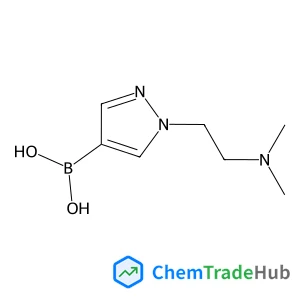
(1-(2-(Dimethylamino)ethyl)-1H-pyrazol-4-yl)boronic acid
CAS Number:
1086063-73-1
Molecular Formula:
C7H14BN3O2
![{3-[Bis(4-hydroxyphenyl)methyl]-1-[2-(dimethylamino)ethyl]-1H-indol-2-yl}[4-(2-chlorophenyl)-1-piperazinyl]methanone structure](https://static.chemtradehub.com/structs/170/170365-25-0-e4d7.webp "{3-[Bis(4-hydroxyphenyl)methyl]-1-[2-(dimethylamino)ethyl]-1H-indol-2-yl}[4-(2-chlorophenyl)-1-piperazinyl]methanone structure")
{3-[Bis(4-hydroxyphenyl)methyl]-1-[2-(dimethylamino)ethyl]-1H-indol-2-yl}[4-(2-chlorophenyl)-1-piperazinyl]methanone
CAS Number:
170365-25-0
Molecular Formula:
C36H37ClN4O3
Recommended Suppliers






Disclaimer
This page provides academic journal information for reference and research purposes only. We are not affiliated with any journal publishers and do not handle publication submissions. For publication-related inquiries, please contact the respective journal publishers directly.
If you notice any inaccuracies in the information displayed, please contact us at support@chemtradehub.com. We will promptly review and address your concerns.