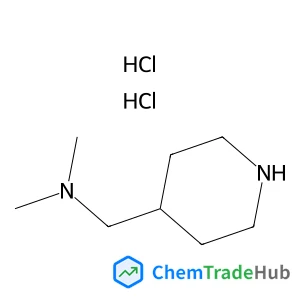
N,N-dimethyl(piperidin-4-yl)methanamine hydrochloride
CAS Number:
172281-72-0
Molecular Formula:
C8H20Cl2N2
Fabio Capuano, Luigi Paduano, Gerardino D'Errico, Gaetano Mangiapia, Roberto Sartorio
The mutual diffusion coefficients for two aqueous ternary systems, both containing a protein, human serum albumin (HSA, component 1), were measured. The first system contained a neutral polymer, polyethylene glycol (PEG, component 2), and the second an “organic solvent”, 2-methyl-2,4-pentanediol (MPD, component 3). Both PEG and MPD are used as co-precipitants in HSA crystallization protocols. Measurements were performed at constant protein concentration, with increasing precipitant content. The results obtained for the two systems were discussed and compared. In both cases, the two main diffusion coefficients, relative to the motion of the protein and of the precipitant under their own concentration gradient, can be interpreted in terms of non-specific volume interactions between the solutes. Particularly, it was showed that any possible direct HSA–MPD interaction may not have a significant effect on the values of these two diffusion coefficients. Differences arise between the cross precipitant's diffusion coefficients, relative to the motion of the precipitant under the protein concentration gradient, Di1 with i = 2, 3. In the case of PEG, the D21 trend vs. c2 can be simply interpreted in terms of an “exclude volume” effect. In contrast, in the case of MPD, the D31vs. c3 trend seems to indicate a more complex mechanism of transport. Because the cross precipitant's diffusion coefficient plays an important role in the crystallization process, the implication of the observed difference on the crystallization procedure was also discussed.

Chemistry Education Research and Practice

Journal of Natural Medicines

Journal of Peptide Science

Russian Journal of General Chemistry

Russian Journal of Applied Chemistry

Acta Materialia

Current Opinion in Colloid & Interface Science

Current Opinion in Solid State & Materials Science

Organic Process Research & Development

Chemical Communications
Artur P. Durajski, Kamil M. Skoczylas, Radosław Szczęśniak
DOI: 10.1039/D0CP05984F
Shan-Shan Wang, Wencong Sun, Shuai Dong
DOI: 10.1039/D0CP05374K
Alain Moissette, Isabelle Batonneau-Gener, Matthieu Hureau, Ludovic Pinard, Hervé Vezin, Michel Perdicakis, Alain Walcarius
DOI: 10.1039/D0CP06148D
Herbert Früchtl, Tanja van Mourik
DOI: 10.1039/D0CP06250B
Saddam Al-Hammadi, Gabriel da Silva
DOI: 10.1039/D0CP05523A
Silviya Ninova, Osman Barış Malcıoğlu, Philipp Auburger, Matthias Franke, Ole Lytken, Hans-Peter Steinrück
DOI: 10.1039/D0CP04859C
Elena F. Belogolova, Sergey A. Shlykov, Alexey V. Eroshin, Evgeniya P. Doronina, Valery F. Sidorkin
DOI: 10.1039/D0CP05872F
Yiming Mi
DOI: 10.1039/D0CP05622G
Bernadeta Jasiok, Mirosław Chorążewski, Eugene B. Postnikov, Claude Millot
DOI: 10.1039/D0CP06458K
Matthew T. O. Okenyi, Laura E. Ratcliff
DOI: 10.1039/D0CP04236F
Ethyl 4-chlorothieno[2,3-b]pyridine-5-carboxylate (CAS: 59713-58-5) can be synth...
5-Methyl-1H-indole-3-carbaldehyde (CAS: 52562-50-2) is subject to various regula...
(1,3-Dimethyl-2,4-dioxo-1,2,3,4-tetrahydro-5-pyrimidinyl)boronic acid is a white...
Waste containing Sulfocostunolide A (CAS: 1016983-51-9) should be handled with c...
When handling Murraxocin (CAS: 88478-44-8), ensure proper personal protective eq...
Formvar (CAS: 63148-64-1) is an alkyd resin characterized by a high molecular we...
(S)-4-benzyl-2-((benzyloxy)methyl)morpholine is generally safe when handled with...
Methyl 1-(5-bromo-2-pyrimidinyl)cyclopropanecarboxylate (CAS: 1447607-69-3) is p...
2-Methyl-1-phenyl-1-propanamine hydrochloride (CAS: 24290-47-9) is generally con...
3-(4-Bromophenyl)-2-methylpropanoic acid is synthesized through a multi-step pro...

Physical Chemistry Chemical Physics (PCCP) is an international journal co-owned by 19 physical chemistry and physics societies from around the world. This journal publishes original, cutting-edge research in physical chemistry, chemical physics and biophysical chemistry. To be suitable for publication in PCCP, articles must include significant innovation and/or insight into physical chemistry; this is the most important criterion that reviewers and Editors will judge against when evaluating submissions. The journal has a broad scope and welcomes contributions spanning experiment, theory, computation and data science. Topical coverage includes spectroscopy, dynamics, kinetics, statistical mechanics, thermodynamics, electrochemistry, catalysis, surface science, quantum mechanics, quantum computing and machine learning. Interdisciplinary research areas such as polymers and soft matter, materials, nanoscience, energy, surfaces/interfaces, and biophysical chemistry are welcomed if they demonstrate significant innovation and/or insight into physical chemistry. Joined experimental/theoretical studies are particularly appreciated when complementary and based on up-to-date approaches.