












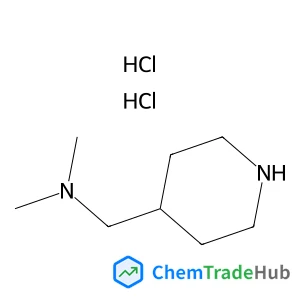
N,N-dimethyl(piperidin-4-yl)methanamine hydrochloride
CAS Number:
172281-72-0
Molecular Formula:
C8H20Cl2N2
Elena F. Belogolova, Sergey A. Shlykov, Alexey V. Eroshin, Evgeniya P. Doronina, Valery F. Sidorkin
In the series of silatranes XSi(OCH2CH2)3N, 1 (X = Me, 1a; H, 1b; F, 1c) with the known gas electron diffraction (GED) structures, the problematic geometry of 1-methylsilatrane 1a has been revised. In particular, the new value of the Si⋯N distance (dSiN) in 1a turned out to be ∼0.06 Å longer than the generally accepted one. This dSiN resolves the long-standing contradiction between the data of the structural and spectral experiments regarding the sensitivity of 1 to the medium effect. We also performed the ab initio and DFT study of the combined series of silatranes 1a–c, silylalkylamines H3Si(CH2)3NMe2 (2a) and F3SiCH2NMe2 (2b), silylhydrazines F3SiN(Me)NMe2 (2c) and F3SiN(SiMe3)NMe2 (2d), and silyloxyamines ClH2SiONMe2 (2e,f), (F3C)F2SiONMe2 (2g,h) and F3SiONMe2 (2i), in which the GED dSiN values are in a wide range of 2–3 Å. None of the involved quantum chemical methods has succeeded in reproducing all the experimental gas-phase dSiN values in 1a–c, 2a–i with an acceptable accuracy (0.01–0.03 Å). The problems of the used methods, primarily CCSD with the Pople basis sets, are caused by four molecules with the geminal SiNN and SiON fragments (2d,f–i) and dSiN < 2.3 Å. A reasonable hierarchy of computationally accessible theory levels for studying the physicochemical manifestation of the non-covalent intramolecular Si⋯N interactions can be constructed only at dSiN > 2.3 Å: MP2 < PBE0 ∼ B3PW91 ∼ SCS-MP2 < CCSD < CCSD(T).
Thomas Stey, Julian Henn, Dietmar Stalke
DOI: 10.1039/B612247G
Masami Sakamoto, Hiroya Kawanishi, Takashi Mino, Yoshio Kasashima, Tsutomu Fujita
DOI: 10.1039/B608513J
Jia Wang, Johan C. Groen, Wenbo Yue, Wuzong Zhou
DOI: 10.1039/B708822A
Jean-Marie Lehn
DOI: 10.1039/B712454F
Aurélia Charlot, Sabine Gabriel, Christophe Detrembleur, Robert Jérôme, Christine Jérôme
DOI: 10.1039/B712130J
M. Khurram N. Qureshi, Martin D. Smith
DOI: 10.1039/B611882H
Tomoki Ogoshi, Tada-aki Yamagishi, Yoshiaki Nakamoto
DOI: 10.1039/B711800G
Oliver C. Presly, Michael Green, John C. Jeffery, Eva Leiner, Martin Murray, Christopher A. Russell, Manfred Scheer, Ulf Vogel
DOI: 10.1039/B611484A
Jesús García López, Ignacio Fernández, Manuel Serrano Ruiz, Fernando López Ortiz
DOI: 10.1039/B707320H
Ramon Pericet-Camara, Brian P. Cahill, Georg Papastavrou, Michal Borkovec
DOI: 10.1039/B612249C
Ethyl 4-chlorothieno[2,3-b]pyridine-5-carboxylate (CAS: 59713-58-5) can be synth...
5-Methyl-1H-indole-3-carbaldehyde (CAS: 52562-50-2) is subject to various regula...
(1,3-Dimethyl-2,4-dioxo-1,2,3,4-tetrahydro-5-pyrimidinyl)boronic acid is a white...
Waste containing Sulfocostunolide A (CAS: 1016983-51-9) should be handled with c...
When handling Murraxocin (CAS: 88478-44-8), ensure proper personal protective eq...
Formvar (CAS: 63148-64-1) is an alkyd resin characterized by a high molecular we...
(S)-4-benzyl-2-((benzyloxy)methyl)morpholine is generally safe when handled with...
Methyl 1-(5-bromo-2-pyrimidinyl)cyclopropanecarboxylate (CAS: 1447607-69-3) is p...
2-Methyl-1-phenyl-1-propanamine hydrochloride (CAS: 24290-47-9) is generally con...
3-(4-Bromophenyl)-2-methylpropanoic acid is synthesized through a multi-step pro...

Physical Chemistry Chemical Physics (PCCP) is an international journal co-owned by 19 physical chemistry and physics societies from around the world. This journal publishes original, cutting-edge research in physical chemistry, chemical physics and biophysical chemistry. To be suitable for publication in PCCP, articles must include significant innovation and/or insight into physical chemistry; this is the most important criterion that reviewers and Editors will judge against when evaluating submissions. The journal has a broad scope and welcomes contributions spanning experiment, theory, computation and data science. Topical coverage includes spectroscopy, dynamics, kinetics, statistical mechanics, thermodynamics, electrochemistry, catalysis, surface science, quantum mechanics, quantum computing and machine learning. Interdisciplinary research areas such as polymers and soft matter, materials, nanoscience, energy, surfaces/interfaces, and biophysical chemistry are welcomed if they demonstrate significant innovation and/or insight into physical chemistry. Joined experimental/theoretical studies are particularly appreciated when complementary and based on up-to-date approaches.
![9H-Fluoren-9-ylmethyl [(2S)-1-hydroxy-3-(1H-indol-3-yl)-2-propanyl]carbamate structure](https://static.chemtradehub.com/structs/153/153815-60-2-a67d.webp "9H-Fluoren-9-ylmethyl [(2S)-1-hydroxy-3-(1H-indol-3-yl)-2-propanyl]carbamate structure")



