












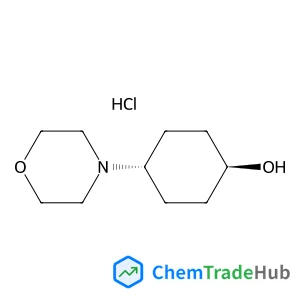
trans-4-(4-Morpholinyl)cyclohexanol hydrochloride (1:1)
CAS Number:
1588441-09-1
Molecular Formula:
C10H20ClNO2
Shan-Shan Wang, Wencong Sun, Shuai Dong
Two-dimensional topological materials attracted intense interest in condensed matter physics due to their topologically protected edge states and potential applications in electronic devices. Here, based on first-principles calculations, we found that a two-dimensional CX3 (X = Sb, Bi) monolayer is a quantum spin Hall insulator with a large band gap. With the strong spin–orbit coupling effect, CX3 exhibits noticeable bulk band gaps up to 470 meV, sufficiently large for realizing the quantum spin Hall effect at room temperature. The topological characteristic is confirmed by the Z2 invariant since the system preserves time-reversal symmetry. Particularly, the CSb3 monolayer displays unique topologically entangled Rashba-splitting edge states, resembling nearly free-electron quadratic dispersion. Such topologically entangled Rashba-like edge states derive from the spin–orbit coupling effect and inversion symmetry breaking on the edges. Moreover, we demonstrate that the topological properties are perfectly preserved in the CX3 monolayer even with a h-BN substrate. The nontrivial quantum spin Hall state in the CX3 monolayer will provide possibilities for studying a novel phenomenon of edge states and potential applications in low-dissipation electronic devices.
Hjalte V. Kiefer, Elie Lattouf, Natascha W. Persen, Lars H. Andersen
DOI: 10.1039/C5CP02764K
Chao Zhang, Jingyang Wang, Xiaohui Wang
DOI: 10.1039/C6CP01699E
Gustavo A. Pino, Géraldine Feraud, Claude Dedonder, Christophe Jouvet
DOI: 10.1039/C6CP01345G
Liyang Luo, Ram B. Ambre, Sandeep B. Mane, Eric Wei-Guang Diau, Chen-Hsiung Hung
DOI: 10.1039/C5CP02367J
Yuanyuan Cui, Lanli Chen, Yanfeng Gao
DOI: 10.1039/C5CP03267A
Kathleen A. Schwarz, Ravishankar Sundararaman, Thomas P. Moffat, Thomas C. Allison
DOI: 10.1039/C5CP03045E
Jeffrey L. Bada, John H. Chalmers
DOI: 10.1039/C6CP03290G
Miao-Miao Li, Jin-Feng Li, Hongcun Bai, Yin-Yin Sun, Jian-Li Li, Bing Yin
DOI: 10.1039/C5CP03155A
Bolong Huang, Jianfu Li, Zhenyi Jiang, Bo Wang, Zhigang Wang, Rui-Qin Zhang
DOI: 10.1039/C5CP02598B
Md Mehboob Alam, Varun Kundi, Pompozhi Protasis Thankachan
DOI: 10.1039/C6CP02732F
1-(2,4,6-Trifluorophenyl)ethanol is an organic compound with the CAS number 1250...
1-(2,4-Dimethoxybenzyl)-4-(hydroxymethyl)-2-pyrrolidinone (CAS: 919111-34-5) is ...
(7S,15R)-6β,15-Diacetoxy-7α,20-epoxy-7-hydroxykaura-2,16-dien-1-one is a crystal...
The compound rac-ethyl (1r,4r)-4-hydroxycyclohexane-1-carboxylate, trans (CAS: 3...
The market for 2-(2,4-Difluorophenoxy)-3-nitropyridine (CAS: 175135-62-3) is cur...
The main uses of 6-Diazo-5-oxo-L-norleucine (CAS: 157-03-9) include research in ...
When handling 2-Aminoethyl-mono-amide-DOTA-tris(tBu ester) (CAS: 173308-19-5), i...
5-Methylimidazo[1,2-a]pyridine-3-carbaldehyde (CAS: 178488-37-4) can be synthesi...
There are alternative reagents that can be used in the synthesis of 2,4,6-Trihyd...
(2Z)-3-(5-Fluoro-1H-indol-3-yl)-2-sulfanylacrylic acid is a chemical compound wi...

Physical Chemistry Chemical Physics (PCCP) is an international journal co-owned by 19 physical chemistry and physics societies from around the world. This journal publishes original, cutting-edge research in physical chemistry, chemical physics and biophysical chemistry. To be suitable for publication in PCCP, articles must include significant innovation and/or insight into physical chemistry; this is the most important criterion that reviewers and Editors will judge against when evaluating submissions. The journal has a broad scope and welcomes contributions spanning experiment, theory, computation and data science. Topical coverage includes spectroscopy, dynamics, kinetics, statistical mechanics, thermodynamics, electrochemistry, catalysis, surface science, quantum mechanics, quantum computing and machine learning. Interdisciplinary research areas such as polymers and soft matter, materials, nanoscience, energy, surfaces/interfaces, and biophysical chemistry are welcomed if they demonstrate significant innovation and/or insight into physical chemistry. Joined experimental/theoretical studies are particularly appreciated when complementary and based on up-to-date approaches.
![Imidazo[1,5-a]pyrazine structure](https://static.chemtradehub.com/structs/274/274-49-7-d749.webp "Imidazo[1,5-a]pyrazine structure")





