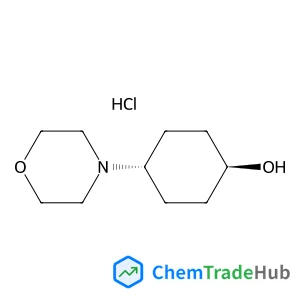
trans-4-(4-Morpholinyl)cyclohexanol hydrochloride (1:1)
CAS Number:
1588441-09-1
Molecular Formula:
C10H20ClNO2
Silviya Ninova, Osman Barış Malcıoğlu, Philipp Auburger, Matthias Franke, Ole Lytken, Hans-Peter Steinrück
Porphyrins are key elements in organic–inorganic hybrid systems for a wide range of applications. Understanding their interaction with the substrate gives a handle on structural and electronic device properties. Here we investigate a single transition-metal porphyrin, namely Co(II)-tetraphenylporphyrin (CoTPP), on the MgO(100) surface and the effect of multilayer film formation within hybrid density-functional theory and many-body perturbation theory. We focus on the relevant adsorption sites, simulate their photoemission spectra as a key fingerprint and compare with experiments on MgO(100) films on Ag(100). While we find only weak interaction between the cobalt centre and terrace sites on the MgO(100) surface, a strong interaction manifests itself with the low-coordinated sites. This leads to distinct features in both the valence and core-level regions of the electronic structure, as observed in the ultraviolet and X-ray photoemission spectra, corroborated by simulated spectra and calculated cobalt core-level shifts. Our work thus demonstrates the relevance of morphology-related low-coordinated sites and their properties in the adsorption of CoTPP on the MgO(100) surface.
Harshal P. Mungse, Raghuvir Singh, Hiroyuki Sugimura, N. Kumar, Om P. Khatri
DOI: 10.1039/C5CP02313K
Dong-Kwan Kim, Yoon Jo Hwang, Cheolho Yoon, Hye-On Yoon, Ki Soo Chang, Gi-Ra Yi
DOI: 10.1039/C5CP02968F
Jeffrey L. Bada, John H. Chalmers
DOI: 10.1039/C6CP03290G
Shan Yu, Yun-Qian Zhong, Bao-Quan Yu, Shi-Yi Cai, Li-Zhu Wu
DOI: 10.1039/C6CP02561G
Andranik Kazaryan, Rutger van Santen, Evert Jan Baerends
DOI: 10.1039/C5CP01812A
Aditi Bhattacherjee, Sanjay Wategaonkar
DOI: 10.1039/C5CP02422F
Guanjie Wei, Zhenguo Gao, Zengfu Wei, Xinzhuang Fan, Jianguo Liu, Chuanwei Yan
DOI: 10.1039/C5CP02952J
Marco Lorenz, Daniele Pullini, Mauro Sgroi
DOI: 10.1039/C6CP02101H
Ren-hui Zheng, Wen-mei Wei, Qiang Shi
DOI: 10.1039/C5CP02136G
1-(2,4,6-Trifluorophenyl)ethanol is an organic compound with the CAS number 1250...
1-(2,4-Dimethoxybenzyl)-4-(hydroxymethyl)-2-pyrrolidinone (CAS: 919111-34-5) is ...
(7S,15R)-6β,15-Diacetoxy-7α,20-epoxy-7-hydroxykaura-2,16-dien-1-one is a crystal...
The compound rac-ethyl (1r,4r)-4-hydroxycyclohexane-1-carboxylate, trans (CAS: 3...
The market for 2-(2,4-Difluorophenoxy)-3-nitropyridine (CAS: 175135-62-3) is cur...
The main uses of 6-Diazo-5-oxo-L-norleucine (CAS: 157-03-9) include research in ...
When handling 2-Aminoethyl-mono-amide-DOTA-tris(tBu ester) (CAS: 173308-19-5), i...
5-Methylimidazo[1,2-a]pyridine-3-carbaldehyde (CAS: 178488-37-4) can be synthesi...
There are alternative reagents that can be used in the synthesis of 2,4,6-Trihyd...
(2Z)-3-(5-Fluoro-1H-indol-3-yl)-2-sulfanylacrylic acid is a chemical compound wi...

Physical Chemistry Chemical Physics (PCCP) is an international journal co-owned by 19 physical chemistry and physics societies from around the world. This journal publishes original, cutting-edge research in physical chemistry, chemical physics and biophysical chemistry. To be suitable for publication in PCCP, articles must include significant innovation and/or insight into physical chemistry; this is the most important criterion that reviewers and Editors will judge against when evaluating submissions. The journal has a broad scope and welcomes contributions spanning experiment, theory, computation and data science. Topical coverage includes spectroscopy, dynamics, kinetics, statistical mechanics, thermodynamics, electrochemistry, catalysis, surface science, quantum mechanics, quantum computing and machine learning. Interdisciplinary research areas such as polymers and soft matter, materials, nanoscience, energy, surfaces/interfaces, and biophysical chemistry are welcomed if they demonstrate significant innovation and/or insight into physical chemistry. Joined experimental/theoretical studies are particularly appreciated when complementary and based on up-to-date approaches.
![2-Methyl-2-propanyl 1,6-diazaspiro[3.4]octane-6-carboxylate structure](https://static.chemtradehub.com/structs/115/1158749-79-1-81ee.webp "2-Methyl-2-propanyl 1,6-diazaspiro[3.4]octane-6-carboxylate structure")