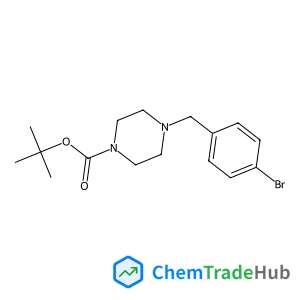
2-Methyl-2-propanyl 4-(4-bromobenzyl)-1-piperazinecarboxylate
CAS Number:
844891-10-7
Molecular Formula:
C16H23BrN2O2
Susumu Yamamoto, Avishek Ghosh, Han-Kwang Nienhuys, Mischa Bonn
We present experimental results on femtosecond time-resolved surface vibrational spectroscopy aimed at elucidating the sub-picosecond reorientational dynamics of surface molecules. The approach, which relies on polarization- and time-resolved surface sum frequency generation (SFG), provides a general means to monitor interfacial reorientational dynamics through vibrations inherent in surface molecules in their electronic ground state. The technique requires an anisotropic vibrational excitation of surface molecules using orthogonally polarized infrared excitation light. The decay of the resulting anisotropy is followed in real-time. We employ the technique to reveal the reorientational dynamics of vibrational transition dipoles of long-chain primary alcohols on the water surface, and of water molecules at the water–air interface. The results demonstrate that, in addition to reorientational motion of specific molecules or molecular groups at the interface, inter- and intramolecular energy transfer processes can serve to scramble the initial anisotropy very efficiently. In the two exemplary cases demonstrated here, energy transfer occurs much faster than reorientational motion of interfacial molecules. This has important implications for the interpretation of static SFG spectra. Finally, we suggest experimental schemes and strategies to decouple effects resulting from energy transfer from those associated with surface molecular motion.
Baagi T. Mmereki, D. J. Donaldson
DOI: 10.1039/B204754C
J. Dobkowski, W. Rettig, J. Waluk
DOI: 10.1039/B204749G
DOI: 10.1039/B205281B
Nanrong Zhao
DOI: 10.1039/B201564C
Robert J. Deeth, David L. Foulis
DOI: 10.1039/B203815C
J.-P. Simonin, O. Bernard, W. Kunz
DOI: 10.1039/B204841H
N. Al-Rubaiey, R. Becerra, R. Walsh
DOI: 10.1039/B204508G
Martina Kieninger, Oscar N. Ventura
DOI: 10.1039/B204643A
Nicholas T. Wilson, Roy L. Johnston
DOI: 10.1039/B204460A
Waste containing 2-Ethyl-4-Methyl-1H-Imidazole-5-Carbaldehyde (CAS: 88634-80-4) ...
Triethoxy(octyl)silane (CAS: 1385031-14-0) is widely used in the pharmaceuticals...
Several alternatives to 3-iodo-7-nitro-1H-indazole (CAS: 864724-64-1) exist in t...
Yes, there are alternatives to Benzene, bis[(trimethoxysilyl)ethyl] (CAS: 266317...
Isothiazole-3-carbonitrile (CAS: 1452-17-1) is generally considered safe when us...
(3-Chlorophenyl)methanol (CAS: 873-63-2) is considered low to moderately toxic. ...
(2S,3S)-2-Hydroxy-3-({[(2-methyl-2-propanyl)oxy]carbonyl}amino)-3-(2-naphthyl)pr...
Proper handling of methyl 2-(bromomethyl)-5-methoxybenzoate requires the use of ...
6,8-Dibromoimidazo[1,2-a]pyridine-2-carboxylic acid (CAS: 904805-36-3) is an aro...
3-Amino-5-bromo-2-pyridinecarbonitrile is considered safe when handled under pro...

Physical Chemistry Chemical Physics (PCCP) is an international journal co-owned by 19 physical chemistry and physics societies from around the world. This journal publishes original, cutting-edge research in physical chemistry, chemical physics and biophysical chemistry. To be suitable for publication in PCCP, articles must include significant innovation and/or insight into physical chemistry; this is the most important criterion that reviewers and Editors will judge against when evaluating submissions. The journal has a broad scope and welcomes contributions spanning experiment, theory, computation and data science. Topical coverage includes spectroscopy, dynamics, kinetics, statistical mechanics, thermodynamics, electrochemistry, catalysis, surface science, quantum mechanics, quantum computing and machine learning. Interdisciplinary research areas such as polymers and soft matter, materials, nanoscience, energy, surfaces/interfaces, and biophysical chemistry are welcomed if they demonstrate significant innovation and/or insight into physical chemistry. Joined experimental/theoretical studies are particularly appreciated when complementary and based on up-to-date approaches.