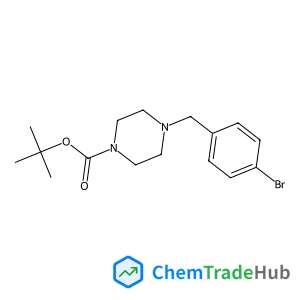
2-Methyl-2-propanyl 4-(4-bromobenzyl)-1-piperazinecarboxylate
CAS Number:
844891-10-7
Molecular Formula:
C16H23BrN2O2
The binary mutual diffusion coefficient (D) for a dilute solution of a self-associating solute and the solute intradiffusion coefficient (D*) are related by D = D* + (dD*/dC), where C is the total solute concentration. This relation is extended to multicomponent systems. For solutions of two associating solutes, the ternary mutual diffusion coefficients D11, D12, D21, D22 and the solute intradiffusion coefficients D*1, D*2 are found to be related by D11 = D1* + C1∂D*1/∂C1, D12 = C1∂D*1/∂C2, D21 = C2∂D*2/∂C1, and D22 = D2* + C2∂D*2/∂C2. These results are used to interpret coupled diffusion in water + AOT (sodium bis(2-ethylhexyl)sulfosuccinate) + n-heptane (water-in-oil) microemulsions. Although the water(1) and AOT(2) components associate and intradiffuse together through the heptane–continuous solvent as AOT-coated water droplets, and hence D*1 ≈ D*2, the mutual diffusion of AOT is more rapid than that of water (D22 > D11), and there are counter-current coupled flows of AOT (D21 < 0) and large co-current coupled flows of water (D12 > 0). This behavior can be understood by noting that added water reduces the Brownian motion of the droplets by swelling the water cores (∂D*i/∂C1 < 0), whereas added AOT reduces the droplet size (∂D*i/∂C2 > 0) by providing more surfactant to coat the water. The predicted water and AOT intradiffusion coefficients are the eigenvalues of the mutual diffusion coefficient matrix.

Nature

European Journal of Wood and Wood Products

Journal of Organometallic Chemistry

Molecular Pharmacology

Journal of Medicinal Chemistry

Israel Journal of Chemistry

Journal of Physics and Chemistry of Solids

Science Progress

Fibre Chemistry

Proceedings of the National Academy of Sciences of the United States of America
Atsushi Nagai, Bungo Ochiai, Takeshi Endo
DOI: 10.1039/B310735C
Paul H. J. Kouwer, Jahan Pourzand, Georg H. Mehl
DOI: 10.1039/B311919J
Jen-Chieh Hsieh, Dinesh Kumar Rayabarapu, Chien-Hong Cheng
DOI: 10.1039/B315795D
Concepción López, Amparo Caubet, Sonia Pérez, Xavier Solans, Mercè Font-Bardía
DOI: 10.1039/B315157C
Arindam Mukherjee, Manas K. Saha, Munirathinam Nethaji, Akhil R. Chakravarty
DOI: 10.1039/B316275C
Dae-Hwan Jung, Young Koan Ko, Seung Joo Seo, Hee-Tae Jung
DOI: 10.1039/B315348G
Colin D. Abernethy
DOI: 10.1039/B314558A
Takahiko Kojima, Yoshitaka Ishioka, Yoshihisa Matsuda
DOI: 10.1039/B308892H
Qun Tang, Wenjia Zhou, Jianmin Shen, Wu Zhang, Lingfen Kong
DOI: 10.1039/B313387G
Judith J. van Gorp, Jef A. J. M. Vekemans, E. W. Meijer
DOI: 10.1039/B312407J
Waste containing 2-Ethyl-4-Methyl-1H-Imidazole-5-Carbaldehyde (CAS: 88634-80-4) ...
Triethoxy(octyl)silane (CAS: 1385031-14-0) is widely used in the pharmaceuticals...
Several alternatives to 3-iodo-7-nitro-1H-indazole (CAS: 864724-64-1) exist in t...
Yes, there are alternatives to Benzene, bis[(trimethoxysilyl)ethyl] (CAS: 266317...
Isothiazole-3-carbonitrile (CAS: 1452-17-1) is generally considered safe when us...
(3-Chlorophenyl)methanol (CAS: 873-63-2) is considered low to moderately toxic. ...
(2S,3S)-2-Hydroxy-3-({[(2-methyl-2-propanyl)oxy]carbonyl}amino)-3-(2-naphthyl)pr...
Proper handling of methyl 2-(bromomethyl)-5-methoxybenzoate requires the use of ...
6,8-Dibromoimidazo[1,2-a]pyridine-2-carboxylic acid (CAS: 904805-36-3) is an aro...
3-Amino-5-bromo-2-pyridinecarbonitrile is considered safe when handled under pro...

Physical Chemistry Chemical Physics (PCCP) is an international journal co-owned by 19 physical chemistry and physics societies from around the world. This journal publishes original, cutting-edge research in physical chemistry, chemical physics and biophysical chemistry. To be suitable for publication in PCCP, articles must include significant innovation and/or insight into physical chemistry; this is the most important criterion that reviewers and Editors will judge against when evaluating submissions. The journal has a broad scope and welcomes contributions spanning experiment, theory, computation and data science. Topical coverage includes spectroscopy, dynamics, kinetics, statistical mechanics, thermodynamics, electrochemistry, catalysis, surface science, quantum mechanics, quantum computing and machine learning. Interdisciplinary research areas such as polymers and soft matter, materials, nanoscience, energy, surfaces/interfaces, and biophysical chemistry are welcomed if they demonstrate significant innovation and/or insight into physical chemistry. Joined experimental/theoretical studies are particularly appreciated when complementary and based on up-to-date approaches.
![4-Nitrophenyl N-{[(2-methyl-2-propanyl)oxy]carbonyl}-L-isoleucinate structure](https://static.chemtradehub.com/structs/169/16948-38-2-c88f.webp "4-Nitrophenyl N-{[(2-methyl-2-propanyl)oxy]carbonyl}-L-isoleucinate structure")