












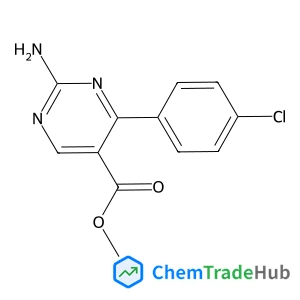
Methyl 2-amino-4-(4-chlorophenyl)-5-pyrimidinecarboxylate
CAS Number:
1133115-56-6
Molecular Formula:
C12H10ClN3O2
Shigeru Ikeda, Takayuki Nakamura, Takashi Harada, Michio Matsumura
A series of mixed crystals composed of Cu2ZnSnS4, Ag2ZnSnS4 and ZnS was prepared by co-precipitation of the corresponding metal ions in aqueous sodium sulfide followed by annealing in a sulfur atmosphere. Ideal solid solutions of Cu2ZnSnS4 and Ag2ZnSnS4 with a kesterite structure ((CuxAg1−x)2ZnSnS4 (0 ≤ x ≤ 1)) were successfully obtained by this procedure, as confirmed by their X-ray diffraction (XRD) patterns and energy-diffuse X-ray (EDX) analyses. On the other hand, the solubility of ZnS in these kesterite compounds was found to be limited: the upper limit of the ratio of ZnS to (CuxAg1−x)2ZnSnS4 was less than 0.1, regardless of the Cu–Ag ratio in (CuxAg1−x)2ZnSnS4. Based on the results for dependence of their photoabsorption properties on atomic compositions, a plausible band structure is discussed. Evaluation of the photocatalytic activity for H2 evolution of these mixed crystals from an aqueous solution containing S2− and SO32− ions upon loading Ru catalysts under simulated solar radiation (AM 1.5) revealed that active compounds for this reaction should contain both dissolved ZnS and Ag components. The dissolved ZnS in (CuxAg1−x)2ZnSnS4 gave upward shifts of their conduction band edges. Moreover, the presence of Ag in the solid solution provided n-type conductivity, leading to efficient migration of photogenerated electrons to the surface to induce water reduction into H2.
Biyun Wang, Xianghu Zhao, Qingyun Liu, Song Cao
DOI: 10.1039/C8OB02322K
Xiaodong Yan, Yuri Lvov, Hai-Feng Ji, Alok Singh, Thomas Thundat
DOI: 10.1039/B209944F
Lian-Hua Li, Zhi-Jie Niu, Yong-Min Liang
DOI: 10.1039/C8OB02094A
Qi Sun, Xin Li, Qiuhan Lin, Ming Lu
DOI: 10.1039/C8OB02155D
Anjali Dahiya, Wajid Ali, Tipu Alam, Bhisma K. Patel
DOI: 10.1039/C8OB02293C
Masato Suzuki, Tomofumi Shimazaki
DOI: 10.1039/B210122J
Tapan Kumar Kuilya, Subhendu Das, Dhiman Saha, Rajib Kumar Goswami
DOI: 10.1039/C8OB01754A
Yuji Yamazaki, Yukiko Nambu, Masashi Ohmae, Manabu Sugai, Shunsaku Kimura
DOI: 10.1039/C8OB01955J
Minoru Ishikura, Atsushi Murakami, Nobuya Katagiri
DOI: 10.1039/B210963H
2-Methylbenzene-1,4-diamine dihydrochloride (CAS: 615-45-2) should be stored in ...
(1S,4S)-2,5-Diazabicyclo[2.2.1]heptane dihydrobromide is generally considered sa...
(6-Chloropyridazin-3-YL)methanamine finds applications in the pharmaceutical ind...
2-Fluoro-3-methylphenol is primarily used in the synthesis of pharmaceuticals, p...
When handling 3-Methoxy-4-nitrobenzonitrile, it is important to wear appropriate...
When handling 1,3-Oxazolo[4,5-b]pyridine-2(3H)-thione (CAS: 211949-57-4), it is ...
4-Ethynylbenzamide (CAS: 90347-86-7) falls under various regulatory guidelines i...
3-(2-Ethylphenyl)-2-thioxo-4-imidazolidinone is primarily used as an intermediat...
(2-Fluoro-6-methoxyphenyl)acetic acid, also known as 4-fluoro-3-methoxybenzoic a...
Market trends for 2-[4-(Hydroxymethyl)phenoxy]ethanol (CAS: 102196-18-9) indicat...

Physical Chemistry Chemical Physics (PCCP) is an international journal co-owned by 19 physical chemistry and physics societies from around the world. This journal publishes original, cutting-edge research in physical chemistry, chemical physics and biophysical chemistry. To be suitable for publication in PCCP, articles must include significant innovation and/or insight into physical chemistry; this is the most important criterion that reviewers and Editors will judge against when evaluating submissions. The journal has a broad scope and welcomes contributions spanning experiment, theory, computation and data science. Topical coverage includes spectroscopy, dynamics, kinetics, statistical mechanics, thermodynamics, electrochemistry, catalysis, surface science, quantum mechanics, quantum computing and machine learning. Interdisciplinary research areas such as polymers and soft matter, materials, nanoscience, energy, surfaces/interfaces, and biophysical chemistry are welcomed if they demonstrate significant innovation and/or insight into physical chemistry. Joined experimental/theoretical studies are particularly appreciated when complementary and based on up-to-date approaches.
![3-[(3R,4R)-3-[(6-aminopyrimidin-4-yl)-methyl-amino]-4-methyl-1-piperidyl]-3-oxo-propanenitrile structure](https://static.chemtradehub.com/structs/164/1640971-60-3-83a4.webp "3-[(3R,4R)-3-[(6-aminopyrimidin-4-yl)-methyl-amino]-4-methyl-1-piperidyl]-3-oxo-propanenitrile structure")
![Methyl 2-[5-(3-Phenoxyphenyl)-2H-tetrazol-2-yl]acetate structure](https://static.chemtradehub.com/structs/130/1305320-60-8-84b4.webp "Methyl 2-[5-(3-Phenoxyphenyl)-2H-tetrazol-2-yl]acetate structure")
![(3R,4aR,7aS,9aR,10S,11R,13aR,13bS,15aS,15bR)-3,11-Dihydroxy-10-(hydroxymethyl)-4,4,7a,10,13a,15b-hexamethyl-1,2,3,4,4a,7,7a,8,9,9a,10,11,12,13,13a,13b,14,15,15a,15b-icosahydro-5H-naphtho[2',1':4,5]cyc
lohepta[1,2-a]naphthalen-5-one structure](https://static.chemtradehub.com/structs/538/53800-21-8-9f18.webp "(3R,4aR,7aS,9aR,10S,11R,13aR,13bS,15aS,15bR)-3,11-Dihydroxy-10-(hydroxymethyl)-4,4,7a,10,13a,15b-hexamethyl-1,2,3,4,4a,7,7a,8,9,9a,10,11,12,13,13a,13b,14,15,15a,15b-icosahydro-5H-naphtho[2',1':4,5]cyc
lohepta[1,2-a]naphthalen-5-one structure")


