












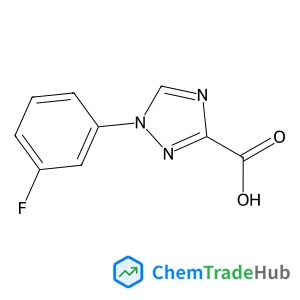
1-(3-Fluorophenyl)-1H-1,2,4-triazole-3-carboxylic acid
CAS Number:
1292369-51-7
Molecular Formula:
C9H6FN3O2
Haiying He, Yesukhei Jagvaral
In this study, we have investigated the use of single metal atoms supported on defective graphene as catalysts for the electrochemical reduction of CO2 using the first-principles approach and the computational hydrogen electrode model. Reaction pathways to produce a variety of C1 products CO, HCOOH, HCHO, CH3OH and CH4 have been studied in detail for five representative transition metals Ag, Cu, Pd, Pt, and Co. Different pathways were revealed in contrast to those found for metallic crystalline surfaces and nanoparticles. These single atom catalysts have demonstrated a general improvement in rate limiting potentials to generate C1 hydrocarbons. They also show distinct differences in terms of their efficiency and selectivity in CO2 reduction, which can be correlated with their elemental properties as a function of their group number in the periodic table. Six best candidates for CH4 production are identified by conducting computational screening of 28 d-block transition metals. Ag has the lowest overpotential (0.73 V), and is followed by Zn, Ni, Pd, Pt and Ru with overpotentials all below 1 V. Cu in the supported single atom form shows a strong preference towards producing CH3OH with an overpotential of 0.68 V well below the value of 1.04 V for producing CH4.
Yungang Zhou, Chengfei Yang, Xia Xiang, Xiaotao Zu
DOI: 10.1039/C3CP51518D
Ming Cheng, Xichuan Yang, Cheng Chen, Jianghua Zhao, Fuguo Zhang
DOI: 10.1039/C3CP51980E
Cristina Greco, Geoffrey R. Luckhurst, Alberta Ferrarini
DOI: 10.1039/C3CP52222A
Richard H. Heyn, Ivan Saldan, Magnus H. Sørby, Christoph Frommen, Bjørnar Arstad, Aud M. Bougza, Helmer Fjellvåg, Bjørn C. Hauback
DOI: 10.1039/C3CP52070F
Franziska Buchner, Hans-Hermann Ritze, Jan Lahl, Andrea Lübcke
DOI: 10.1039/C3CP51057C
Daniel R. Albert, H. Floyd Davis
DOI: 10.1039/C3CP51930A
Wei Guo, Xiaochuan Duan, Yan Shen, Kezhen Qi, Caiying Wei, Wenjun Zheng
DOI: 10.1039/C3CP51663F
Robert P. Lynch, Nathan Quill, Shohei Nakahara, D. Noel Buckley
DOI: 10.1039/C3CP52253A
Anita Gollmer, Johannes Regensburger, Tim Maisch, Wolfgang Bäumler
DOI: 10.1039/C3CP50841B
Andrej Grubisic, Volker Schweikhard, Thomas A. Baker, David J. Nesbitt
DOI: 10.1039/C3CP44385J
Waste containing N-Methoxy-N-methyl-1,3-thiazole-5-carboxamide (CAS: 898825-89-3...
N-(4-Biphenylyl)dibenzo[b,d]furan-4-amine should be stored in a tightly sealed c...
The market for 3-Acetamido-5-amino-2,4,6-triiodobenzoic acid (CAS: 1713-07-1) is...
Benzyl 2-O-acetyl-3,4,6-tri-O-benzyl-beta-D-galactopyranoside (CAS: 61820-03-9) ...
2-Ethylpiperazine dihydrochloride (CAS: 438050-52-3) is regulated under the Glob...
1,1'-[1,3-Phenylenebis(methylene)]bis(3-methyl-1H-pyrrole-2,5-dione) (CAS: 11946...
Several alternatives can be used in the synthesis of 5-Fluoro-2-(1-pyrrolidinyl)...
Proper personal protective equipment (PPE) must be worn when handling this compo...
When handling 6-Bromoimidazo[1,2-a]pyridin-8-amine, it is important to wear appr...
Alternatives to (2S,4R)-4-(4-Nitrobenzyl)pyrrolidine-2-carboxylic acid hydrochlo...

Physical Chemistry Chemical Physics (PCCP) is an international journal co-owned by 19 physical chemistry and physics societies from around the world. This journal publishes original, cutting-edge research in physical chemistry, chemical physics and biophysical chemistry. To be suitable for publication in PCCP, articles must include significant innovation and/or insight into physical chemistry; this is the most important criterion that reviewers and Editors will judge against when evaluating submissions. The journal has a broad scope and welcomes contributions spanning experiment, theory, computation and data science. Topical coverage includes spectroscopy, dynamics, kinetics, statistical mechanics, thermodynamics, electrochemistry, catalysis, surface science, quantum mechanics, quantum computing and machine learning. Interdisciplinary research areas such as polymers and soft matter, materials, nanoscience, energy, surfaces/interfaces, and biophysical chemistry are welcomed if they demonstrate significant innovation and/or insight into physical chemistry. Joined experimental/theoretical studies are particularly appreciated when complementary and based on up-to-date approaches.

![4-[(2-{2-[2-(2-Aminoethoxy)ethoxy]ethoxy}ethyl)amino]-2-(2,6-dioxo-3-piperidinyl)-1H-isoindole-1,3(2H)-dione structure](https://static.chemtradehub.com/structs/209/2093416-31-8-3162.webp "4-[(2-{2-[2-(2-Aminoethoxy)ethoxy]ethoxy}ethyl)amino]-2-(2,6-dioxo-3-piperidinyl)-1H-isoindole-1,3(2H)-dione structure")


