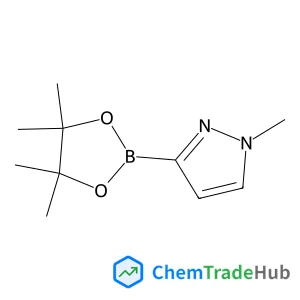
1-Methyl-3-(4,4,5,5-tetramethyl-1,3,2-dioxaborolan-2-yl)-1H-pyrazole
CAS Number:
1020174-04-2
Molecular Formula:
C10H17BN2O2
Frédéric Aitken, Ferdinand Volino, Luis Guillermo Mendoza-Luna, Klaus von Haeften, Jussi Eloranta
Electron mobility in superfluid helium is modeled between 0.1 and 2.2 K by a van der Waals-type thermodynamic equation of state, which relates the free volume of solvated electrons to temperature, density, and phase dependent internal pressure. The model is first calibrated against known electron mobility reference data along the saturated vapor pressure line and then validated to reproduce the existing mobility literature values as a function of pressure and temperature with at least 10% accuracy. Four different electron mobility regimes are identified: (1) Landau critical velocity limit (T ≈ 0), (2) mobility limited by thermal phonons (T < 0.6 K), (3) thermal phonon and discrete roton scattering (“roton gas”) limited mobility (0.6 K < T < 1.2 K), and (4) the viscous liquid (“roton continuum”) limit (T > 1.2 K) where the ion solvation structure directly determines the mobility. In the latter regime, the Stokes equation can be used to estimate the hydrodynamic radius of the solvated electron based on its mobility and fluid viscosity. To account for the non-continuum behavior appearing below 1.2 K, the temperature and density dependent Millikan–Cunningham factor is introduced. The hydrodynamic electron bubble radii predicted by the present model appear generally larger than the solvation cavity interface barycenter values obtained from density functional theory (DFT) calculations. Based on the classical Stokes law, this difference can arise from the variation of viscosity and flow characteristics around the electron. The calculated DFT liquid density profiles show distinct oscillations at the vacuum/liquid interface, which increase the interface rigidity.
Imre Bakó, Ákos Bencsura, Kersti Hermannson, Szabolcs Bálint, Tamás Grósz, Julianna Oláh
DOI: 10.1039/C3CP52271G
DOI: 10.1039/C3CP51650D
DOI: 10.1039/C3CP50191D
Muruganathan Ramanathan, Lok Kumar Shrestha, Qingmin Ji
DOI: 10.1039/C3CP50620G
Jukka Jokisaari, Juha Vaara
DOI: 10.1039/C3CP50625H
Pyosang Kim, Sujin Ham, Juwon Oh, Hiroki Uoyama, Hajime Watanabe, Kazunari Tagawa, Hidemitsu Uno, Dongho Kim
DOI: 10.1039/C3CP50166C
Cristina Greco, Geoffrey R. Luckhurst, Alberta Ferrarini
DOI: 10.1039/C3CP52222A
Satheesh Sambandam, Javier Parrondo, Vijay Ramani
DOI: 10.1039/C3CP51450A
Harry L. Tuller, Melanie Kuhn, Guido Ciampi, William Higgins, Kanai S. Shah
DOI: 10.1039/C3CP51043C
Waste containing N-Methoxy-N-methyl-1,3-thiazole-5-carboxamide (CAS: 898825-89-3...
N-(4-Biphenylyl)dibenzo[b,d]furan-4-amine should be stored in a tightly sealed c...
The market for 3-Acetamido-5-amino-2,4,6-triiodobenzoic acid (CAS: 1713-07-1) is...
Benzyl 2-O-acetyl-3,4,6-tri-O-benzyl-beta-D-galactopyranoside (CAS: 61820-03-9) ...
2-Ethylpiperazine dihydrochloride (CAS: 438050-52-3) is regulated under the Glob...
1,1'-[1,3-Phenylenebis(methylene)]bis(3-methyl-1H-pyrrole-2,5-dione) (CAS: 11946...
Several alternatives can be used in the synthesis of 5-Fluoro-2-(1-pyrrolidinyl)...
Proper personal protective equipment (PPE) must be worn when handling this compo...
When handling 6-Bromoimidazo[1,2-a]pyridin-8-amine, it is important to wear appr...
Alternatives to (2S,4R)-4-(4-Nitrobenzyl)pyrrolidine-2-carboxylic acid hydrochlo...

Physical Chemistry Chemical Physics (PCCP) is an international journal co-owned by 19 physical chemistry and physics societies from around the world. This journal publishes original, cutting-edge research in physical chemistry, chemical physics and biophysical chemistry. To be suitable for publication in PCCP, articles must include significant innovation and/or insight into physical chemistry; this is the most important criterion that reviewers and Editors will judge against when evaluating submissions. The journal has a broad scope and welcomes contributions spanning experiment, theory, computation and data science. Topical coverage includes spectroscopy, dynamics, kinetics, statistical mechanics, thermodynamics, electrochemistry, catalysis, surface science, quantum mechanics, quantum computing and machine learning. Interdisciplinary research areas such as polymers and soft matter, materials, nanoscience, energy, surfaces/interfaces, and biophysical chemistry are welcomed if they demonstrate significant innovation and/or insight into physical chemistry. Joined experimental/theoretical studies are particularly appreciated when complementary and based on up-to-date approaches.
![[4-(Heptyloxy)phenyl]boronic acid structure](https://static.chemtradehub.com/structs/136/136370-19-9-ad33.webp "[4-(Heptyloxy)phenyl]boronic acid structure")