











Voltammetric behaviour of biological macromolecules at arrays of aqueous|organogel micro-interfaces
Literature Information
Publication Date
2010-06-10
DOI
10.1039/C003323E
Impact Factor
3.676
Authors
Micheál D. Scanlon, Jörg Strutwolf, Damien W. M. Arrigan
View Original
Abstract
The behaviour of two biological macromolecules, bovine pancreatic insulin and hen-egg-white lysozyme (HEWL), at aqueous–organogel interfaces confined within an array of solid-state membrane micropores was investigated via cyclic voltammetry (CV). The behaviour observed is discussed in terms of possible charge transferring species and mass transport in the interfacial reaction. Comparison of CV results for HEWL, insulin, and the well-characterised model ion tetraethylammonium cation (TEA+) revealed that the biomacromolecules undergo an interfacial reaction comprising biomacromolecular adsorption and facilitated transfer of electrolyte anions from the organic phase to a protein layer on the aqueous side of the interface, whereas TEA+ undergoes a simple ion transfer process. Evidence for biomacromolecular adsorption on the aqueous side of the micro-interfaces is provided by comparison of the CVs for TEA+ ion transfer in the presence and absence of the biomacromolecules. Similar experiments in the presence of the low generation polypropylenimine tetraamine dendrimer, (DAB-AM-4), a smaller synthetic molecule, revealed it to be non-adsorbing. The behaviour of biological macromolecules at miniaturised aqueous–organogel interfaces involves adsorption on the aqueous side of the interface and transfer of organic phase electrolyte anions across the interface to associate with the adsorbed biomacromolecule. The data presented support the previously suggested mechanism for biomacromolecular voltammetry at liquid–liquid interfaces, involving adsorption and facilitated ion-transfer of organic electrolyte anions.
Related Literature
Zwitterionic π-radical involving EDT-TTF-imidazole and F4TCNQ: redox properties and self-assembled structure by hydrogen-bonds and multiple S⋯S interactions
Tsuyoshi Murata, Yumi Yakiyama, Yoshie Nishimura, Tomoaki Ise, Daisuke Shiomi, Kazunobu Sato, Takeji Takui
2007-07-25
Communication
DOI: 10.1039/B707113B
A 3D chiral Zn(ii) coordination polymer with triple Zn–oba–Zn helical chains (oba = 4,4′-oxybis(benzoate))
Yi Ma, Zhengbo Han, Yongke He, Liguo Yang
2007-07-30
Communication
DOI: 10.1039/B708479J
Solid-phase based synthesis of jasplakinolide analogs by intramolecular azide–alkyne cycloadditions
2007-08-14
Communication
DOI: 10.1039/B710650E
Microwave-assisted preparations of dihydropyrroles from alkenone O-phenyl oximes
Fernando Portela-Cubillo, Jackie S. Scott, John C. Walton
2007-09-11
Communication
DOI: 10.1039/B712582H
Large fullerenes stabilized by encapsulation of metallic clusters
Ramón Valencia, Antonio Rodríguez-Fortea, Josep M. Poblet
2007-08-06
Communication
DOI: 10.1039/B709548A
Self-assembling of nanoscopic molecular rectangles, extended helicates and porous-like materials based on macrocyclic dicopper building blocks under fine supramolecular control
Laura Gómez, Anna Company, Xavier Fontrodona, Xavi Ribas, Miquel Costas
2007-08-14
Communication
DOI: 10.1039/B707508A
Cyclometallated iridium(iii) complexes with substituted 1,10-phenanthrolines: a new class of highly active organometallic second order NLO-phores with excellent transparency with respect to second harmonic emission
Claudia Dragonetti, Stefania Righetto, Renato Ugo, Adriana Valore, Simona Fantacci, Antonio Sgamellotti, Filippo De Angelis
2007-08-02
Communication
DOI: 10.1039/B708073E
Consecutive palladium-catalyzed Hiyama–Heck reactions in aqueous media under ligand-free conditions
Álvaro Gordillo, Ernesto de Jesús, Carmen López-Mardomingo
2007-07-25
Communication
DOI: 10.1039/B707583A
You might also like
Compound Q&A
How should waste containing 2-Ethyl-4-Methyl-1H-Imidazole-5-Carbaldehyde (CAS: 88634-80-4) be handled?
Waste containing 2-Ethyl-4-Methyl-1H-Imidazole-5-Carbaldehyde (CAS: 88634-80-4) ...
88634-80-42-Ethyl-4-Methyl-1H-...
Compound Q&A
What industries use Triethoxy(octyl)silane (CAS: 1385031-14-0)?
Triethoxy(octyl)silane (CAS: 1385031-14-0) is widely used in the pharmaceuticals...
1385031-14-0Triethoxy(octyl)sila...
Compound Q&A
Are there alternatives to 3-iodo-7-nitro-1H-indazole (CAS: 864724-64-1) in synthesis?
Several alternatives to 3-iodo-7-nitro-1H-indazole (CAS: 864724-64-1) exist in t...
864724-64-13-iodo-7-nitro-1H-in...
Compound Q&A
Are there alternatives to Benzene, bis[(trimethoxysilyl)ethyl] (CAS: 266317-71-9) in synthesis?
Yes, there are alternatives to Benzene, bis[(trimethoxysilyl)ethyl] (CAS: 266317...
266317-71-9Benzene, bis[(trimet...
Compound Q&A
Is Isothiazole-3-carbonitrile (CAS: 1452-17-1) safe?
Isothiazole-3-carbonitrile (CAS: 1452-17-1) is generally considered safe when us...
1452-17-1Isothiazole-3-carbon...
Compound Q&A
Is (3-Chlorophenyl)methanol (CAS: 873-63-2) safe?
(3-Chlorophenyl)methanol (CAS: 873-63-2) is considered low to moderately toxic. ...
873-63-2(3-Chlorophenyl)meth...
Compound Q&A
How is (2S,3S)-2-Hydroxy-3-({[(2-methyl-2-propanyl)oxy]carbonyl}amino)-3-(2-naphthyl)propanoic acid (CAS: 959583-98-3) typically synthesized?
(2S,3S)-2-Hydroxy-3-({[(2-methyl-2-propanyl)oxy]carbonyl}amino)-3-(2-naphthyl)pr...
959583-98-3(2S,3S)-2-Hydroxy-3-...
Compound Q&A
What precautions should be taken when handling Methyl 2-(bromomethyl)-5-methoxybenzoate (CAS: 788081-99-2)?
Proper handling of methyl 2-(bromomethyl)-5-methoxybenzoate requires the use of ...
788081-99-2Methyl 2-(bromomethy...
Compound Q&A
What is 6,8-Dibromoimidazo[1,2-a]pyridine-2-carboxylic acid (CAS: 904805-36-3)?
6,8-Dibromoimidazo[1,2-a]pyridine-2-carboxylic acid (CAS: 904805-36-3) is an aro...
904805-36-36,8-Dibromoimidazo[1...
Compound Q&A
Is 3-Amino-5-bromo-2-pyridinecarbonitrile (CAS: 573675-27-1) safe?
3-Amino-5-bromo-2-pyridinecarbonitrile is considered safe when handled under pro...
573675-27-13-Amino-5-bromo-2-py...
Source Journal
Physical Chemistry Chemical Physics

CiteScore:
5.5
Self-citation Rate:
10.3%
Articles per Year:
3036
Physical Chemistry Chemical Physics (PCCP) is an international journal co-owned by 19 physical chemistry and physics societies from around the world. This journal publishes original, cutting-edge research in physical chemistry, chemical physics and biophysical chemistry. To be suitable for publication in PCCP, articles must include significant innovation and/or insight into physical chemistry; this is the most important criterion that reviewers and Editors will judge against when evaluating submissions. The journal has a broad scope and welcomes contributions spanning experiment, theory, computation and data science. Topical coverage includes spectroscopy, dynamics, kinetics, statistical mechanics, thermodynamics, electrochemistry, catalysis, surface science, quantum mechanics, quantum computing and machine learning. Interdisciplinary research areas such as polymers and soft matter, materials, nanoscience, energy, surfaces/interfaces, and biophysical chemistry are welcomed if they demonstrate significant innovation and/or insight into physical chemistry. Joined experimental/theoretical studies are particularly appreciated when complementary and based on up-to-date approaches.
Recommended Compounds
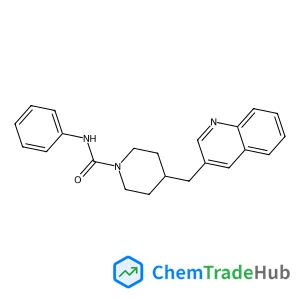
N-phenyl-4-(quinolin-3-ylmethyl)piperidine-1-carboxamide
CAS Number:
959151-50-9
Molecular Formula:
C22H23N3O
Recommended Suppliers




Disclaimer
This page provides academic journal information for reference and research purposes only. We are not affiliated with any journal publishers and do not handle publication submissions. For publication-related inquiries, please contact the respective journal publishers directly.
If you notice any inaccuracies in the information displayed, please contact us at support@chemtradehub.com. We will promptly review and address your concerns.