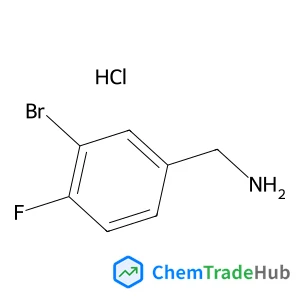
1-(3-Bromo-4-fluorophenyl)methanamine hydrochloride (1:1)
CAS Number:
202865-68-7
Molecular Formula:
C7H8BrClFN
Ayman Karam, João Carlos Alonso, Tsvetelina Ivanova Gerganova, Paula Ferreira, Nicolas Bion, Joël Barrault, François Jérôme
Here we report that sulfonated crystal-like benzene–silica is much more robust and active than conventionally used periodic mesoporous silica for catalyzing aqueous organic reactions.
Minjin Kim, Tae Kyung Lee, In Woo Choi, Hye Won Choi, Yimhyun Jo, Jiyun Lee, Gi-Hwan Kim, Sang Kyu Kwak, Dong Suk Kim
DOI: 10.1039/D0SE00382D
Xingxing Zhu, Ruikun Zhao, Kin Liao, Vincent Chan
DOI: 10.1039/D0SE00448K
Oindrila Gupta, Sagar Roy, Somenath Mitra
DOI: 10.1039/D0SE00461H
DOI: 10.1039/AN8992400201
Fernanda dos Santos Depoi, Tiago Charão de Oliveira, Diogo Pompéu de Moraes, Dirce Pozebon
DOI: 10.1039/C1AY05246B
Dowon Bae, Gerrit M. Faasse
DOI: 10.1039/D0SE00348D
Krishnan Giribabu, Murugavel Kathiresan, Kyusik Yun
DOI: 10.1039/D0SE00580K
(1R,3S)-1,3-Cyclopentanediol finds applications in various industries. In the ph...
When handling N'-[4-(Dimethylamino)phenyl]-N,N-dimethyl-1,4-benzenediamine, it i...
There are several alternatives to 5-(2,4-Difluorophenyl)-2-methoxypyrimidine in ...
1-(3-Methoxyphenoxy)propan-2-ol (CAS: 382141-68-6) must comply with the Globally...
Tetrodotoxin Citrate is extremely dangerous and should be handled with extreme c...
2-Methyl-2-propanyl [(1R,3S)-3-hydroxycyclopentyl]carbamate (CAS: 225641-84-9) i...
Waste containing 4-(2-Hydroxyhexafluoroisopropyl)Benzoic Acid (CAS: 16261-80-6) ...
2-Methyl-2-proanyl {(2S)-1-[(benzyloxy)amino]-3-hydroxy-3-methyl-1-oxo-2-butanyl...
Benzeneethanamine, α-ethyl-, hydrochloride (1:1) is an organic compound with the...
In the synthesis of compounds similar to 3-{(E)-[4-(Dimethylamino)phenyl]diazeny...

ChemComm publishes urgent research which is of outstanding significance and interest to experts in the field, while also appealing to the journal’s broad chemistry readership. Our communication format is ideally suited to short, urgent studies that are of such importance that they require accelerated publication. Our scope covers all topics in chemistry, and research at the interface of chemistry and other disciplines (such as materials science, nanoscience, physics, engineering and biology) where there is a significant novelty in the chemistry aspects. Major topic areas covered include: Analytical Chemistry Catalysis Chemical Biology and medicinal chemistry Computational Chemistry and Machine Learning Energy and sustainable chemistry Environmental Chemistry Green Chemistry Inorganic Chemistry Materials Chemistry Nanoscience Organic Chemistry Physical Chemistry Polymer Chemistry Supramolecular Chemistry