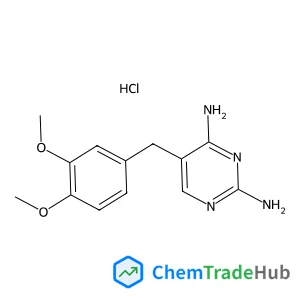
5-(3,4-Dimethoxybenzyl)-2,4-pyrimidinediamine hydrochloride (1:1)
CAS Number:
2507-23-5
Molecular Formula:
C13H17ClN4O2
Krishnan Giribabu, Murugavel Kathiresan, Kyusik Yun
Development of a highly efficient electrocatalyst for the water-splitting reaction is essential and in this regard, the use of earth-abundant metal catalysts offers several advantages such as improved performance, cost-efficiency, etc. Recent studies have shown that the fabrication of transition metal/metal oxide nanoparticle supported carbon materials exhibit similar performances to that of bare metal/metal oxide nanoparticles. Herein, we report the preparation of an ethylenediamine interconnected triazine based porous organic polymer (EPOP) modified with Co2+ (Co-EPOP) and Co nanoparticles (Co-EPOP-300, Co-EPOP-500 and Co-EPOP-HT) via anchoring under different conditions. The amine groups on the EPOP polymer were used as ligands and as stabilizers for Co2+ and Co nanoparticles respectively. XRD and TEM analysis indicated that the Co-NPs covered a homogeneous polymer matrix. The electrocatalytic activities of Co2+/CoNP modified POPs were evaluated under standard OER and HER conditions and were compared with that of Co-NPs without polymer support. Amongst the electrocatalysts, the Co-EPOP (Co2+ anchored EPOP) sample exhibited bifunctional activity towards both the OER and HER with onset potentials of 1.638 and −0.173 V respectively. Further, the Co-EPOP catalyst showed lower Tafel slope values compared to other catalysts. Both OER and HER performances are comparable with those of reported Co based nanocatalytic systems.
Jieni Hu, Chuanhao Sun, Siqi Li, Yuan Yuan
DOI: 10.1039/D1PY00703C
Jiaxin Shi, Tianze Zheng, Yao Zhang, Baohua Guo, Jun Xu
DOI: 10.1039/D1PY00157D
Neha Mulchandani, Kazunari Masutani, Sachin Kumar, Hideki Yamane, Yoshiharu Kimura, Vimal Katiyar
DOI: 10.1039/D1PY00429H
Gokhan Sagdic, Ozgun Daglar, Ufuk Saim Gunay, Emrah Cakmakci, Gurkan Hizal, Umit Tunca, Hakan Durmaz
DOI: 10.1039/D1PY00726B
Vajk Farkas, Gábor Turczel, János Deme, László Trif, Anvar Mirzaei, Dang Vu Hai, Sándor Kéki, Péter Huszthy, Róbert Tuba
DOI: 10.1039/D1PY00194A
R. R. Gibson, A. Fernyhough, O. M. Musa, S. P. Armes
DOI: 10.1039/D1PY00572C
(1R,3S)-1,3-Cyclopentanediol finds applications in various industries. In the ph...
When handling N'-[4-(Dimethylamino)phenyl]-N,N-dimethyl-1,4-benzenediamine, it i...
There are several alternatives to 5-(2,4-Difluorophenyl)-2-methoxypyrimidine in ...
1-(3-Methoxyphenoxy)propan-2-ol (CAS: 382141-68-6) must comply with the Globally...
Tetrodotoxin Citrate is extremely dangerous and should be handled with extreme c...
2-Methyl-2-propanyl [(1R,3S)-3-hydroxycyclopentyl]carbamate (CAS: 225641-84-9) i...
Waste containing 4-(2-Hydroxyhexafluoroisopropyl)Benzoic Acid (CAS: 16261-80-6) ...
2-Methyl-2-proanyl {(2S)-1-[(benzyloxy)amino]-3-hydroxy-3-methyl-1-oxo-2-butanyl...
Benzeneethanamine, α-ethyl-, hydrochloride (1:1) is an organic compound with the...
In the synthesis of compounds similar to 3-{(E)-[4-(Dimethylamino)phenyl]diazeny...