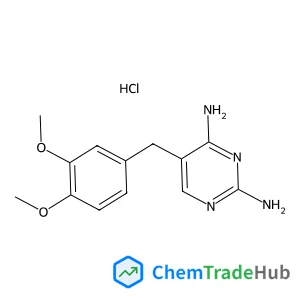
5-(3,4-Dimethoxybenzyl)-2,4-pyrimidinediamine hydrochloride (1:1)
CAS Number:
2507-23-5
Molecular Formula:
C13H17ClN4O2
Nathaniel K. Szymczak, Louise A. Berben, Jonas C. Peters
Pyridazine-templated dicobalt macrocycles reversibly support five oxidation states with unusually positive CoII/CoI redox couples, and are also active proton reduction electrocatalysts.
Ping Zhou, Bo Liu, Mingming Luan, Na Li, Bo Tang
DOI: 10.1039/D1BM00619C
DOI: 10.1039/D0SE00509F
Haifeng Xu, Zhong Jin
DOI: 10.1039/D0SE00494D
N. Angulakshmi, R. Baby Dhanalakshmi, Paulina Półrolniczak, Mariusz Walkowiak, Pengfei Xie, Xiaohui Tian, Yingke Zhou, A. Manuel Stephan
DOI: 10.1039/D0SE00594K
Cecilia Solís, María Balaguer, Julio Garcia-Fayos, Elena Palafox, José M. Serra
DOI: 10.1039/D0SE00324G
Fernanda dos Santos Depoi, Tiago Charão de Oliveira, Diogo Pompéu de Moraes, Dirce Pozebon
DOI: 10.1039/C1AY05246B
Junxiang Jiang, Yuanhao Tang, Lin Dong, Wenhao Zhang, Haobin Wu
DOI: 10.1039/D0SE00381F
Chi-You Liu, Elise Y. Li
DOI: 10.1039/C9SE01289C
(1R,3S)-1,3-Cyclopentanediol finds applications in various industries. In the ph...
When handling N'-[4-(Dimethylamino)phenyl]-N,N-dimethyl-1,4-benzenediamine, it i...
There are several alternatives to 5-(2,4-Difluorophenyl)-2-methoxypyrimidine in ...
1-(3-Methoxyphenoxy)propan-2-ol (CAS: 382141-68-6) must comply with the Globally...
Tetrodotoxin Citrate is extremely dangerous and should be handled with extreme c...
2-Methyl-2-propanyl [(1R,3S)-3-hydroxycyclopentyl]carbamate (CAS: 225641-84-9) i...
Waste containing 4-(2-Hydroxyhexafluoroisopropyl)Benzoic Acid (CAS: 16261-80-6) ...
2-Methyl-2-proanyl {(2S)-1-[(benzyloxy)amino]-3-hydroxy-3-methyl-1-oxo-2-butanyl...
Benzeneethanamine, α-ethyl-, hydrochloride (1:1) is an organic compound with the...
In the synthesis of compounds similar to 3-{(E)-[4-(Dimethylamino)phenyl]diazeny...

ChemComm publishes urgent research which is of outstanding significance and interest to experts in the field, while also appealing to the journal’s broad chemistry readership. Our communication format is ideally suited to short, urgent studies that are of such importance that they require accelerated publication. Our scope covers all topics in chemistry, and research at the interface of chemistry and other disciplines (such as materials science, nanoscience, physics, engineering and biology) where there is a significant novelty in the chemistry aspects. Major topic areas covered include: Analytical Chemistry Catalysis Chemical Biology and medicinal chemistry Computational Chemistry and Machine Learning Energy and sustainable chemistry Environmental Chemistry Green Chemistry Inorganic Chemistry Materials Chemistry Nanoscience Organic Chemistry Physical Chemistry Polymer Chemistry Supramolecular Chemistry