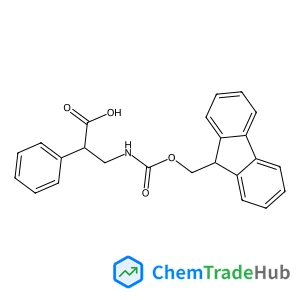
(S)-3-((((9H-Fluoren-9-yl)methoxy)carbonyl)amino)-2-phenylpropanoic acid
CAS Number:
1217663-60-9
Molecular Formula:
C24H21NO4
Haifeng Xu, Zhong Jin
The rational design of high-performance yet low-cost counter electrodes (CEs) with exceptional catalytic activity for the I−/I3− redox couple and excellent corrosion resistance is of great importance for dye-sensitized solar cells (DSSCs). Metal nickel-based CEs have super electrical conductivity for the oxidation of I−, but they lack the ability to restore I3−, leading to relatively poor photoelectric conversion efficiency (PCE). Herein, we propose the design and development of a novel nanostructured CE material composed of hierarchical porous Fe3O4 nanoflowers decorated with Ni nanoparticles and wrapped by N-doped reduced graphene oxide nanosheets (Fe3O4/Ni@N-RGO). The as-prepared multi-component electrode material was applied as a CE for DSSCs, attaining high efficiency and excellent stability. The PCE of Fe3O4/Ni@N-RGO based DSSCs reaches 8.96%, which is superior to those based on Fe3O4 (7.92%) or Pt (7.87%). Moreover, the Fe3O4/Ni@N-RGO electrode also displays ultrahigh corrosion resistance under complicated working conditions. The advantages of the Fe3O4/Ni@N-RGO electrode material indicate its good potential for application in DSSCs as a high-performance and inexpensive CE material.
Derrick L. J. Clive, Elia J. L. Stoffman
DOI: 10.1039/B704211F
DOI: 10.1039/B710033G
Keiji Okada, Shiori Beppu, Koichiro Tanaka, Masato Kuratsu, Kimiaki Furuichi, Masatoshi Kozaki, Shuichi Suzuki, Daisuke Shiomi, Kazunobu Sato, Takeji Takui, Yasutaka Kitagawa, Kizashi Yamaguchi
DOI: 10.1039/B618682C
Na Liu, Ai-Ling Cheng, Song Gao
DOI: 10.1039/B701840A
Joos Wahlen, Dirk De Vos, Walther Jary, Paul Alsters, Pierre Jacobs
DOI: 10.1039/B704238H
Claudia Höbartner, P. I. Pradeepkumar, Scott K. Silverman
DOI: 10.1039/B704507G
Masahiro Hasegawa, Atsushi Ueda
DOI: 10.1039/B703236F
Alois Fürstner, Bernhard Fasching, Gregory W. O'Neil, Michaël D. B. Fenster, Cédrickx Godbout, Julien Ceccon
DOI: 10.1039/B707835H
(1R,3S)-1,3-Cyclopentanediol finds applications in various industries. In the ph...
When handling N'-[4-(Dimethylamino)phenyl]-N,N-dimethyl-1,4-benzenediamine, it i...
There are several alternatives to 5-(2,4-Difluorophenyl)-2-methoxypyrimidine in ...
1-(3-Methoxyphenoxy)propan-2-ol (CAS: 382141-68-6) must comply with the Globally...
Tetrodotoxin Citrate is extremely dangerous and should be handled with extreme c...
2-Methyl-2-propanyl [(1R,3S)-3-hydroxycyclopentyl]carbamate (CAS: 225641-84-9) i...
Waste containing 4-(2-Hydroxyhexafluoroisopropyl)Benzoic Acid (CAS: 16261-80-6) ...
2-Methyl-2-proanyl {(2S)-1-[(benzyloxy)amino]-3-hydroxy-3-methyl-1-oxo-2-butanyl...
Benzeneethanamine, α-ethyl-, hydrochloride (1:1) is an organic compound with the...
In the synthesis of compounds similar to 3-{(E)-[4-(Dimethylamino)phenyl]diazeny...
![6-Bromo-2,3-dihydro-1H-pyrido[2,3-b][1,4]oxazine structure](https://static.chemtradehub.com/structs/120/1203499-17-5-b4d1.webp "6-Bromo-2,3-dihydro-1H-pyrido[2,3-b][1,4]oxazine structure")