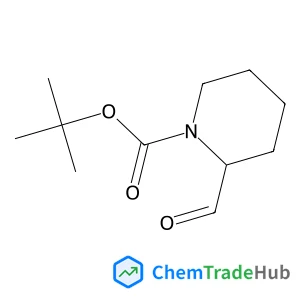
2-Methyl-2-propanyl (2R)-2-formyl-1-piperidinecarboxylate
CAS Number:
134526-69-5
Molecular Formula:
C11H19NO3
Pavel Chábera, Marcel Fuciman, Petr Hříbek
Effects of introducing a carbonyl group and its position in the conjugated system of carotenoids were studied by means of femtosecond time-resolved spectroscopy. We have compared four naturally occurring carotenoids with comparable structures, β-carotene, echinenone, canthaxanthin and rhodoxanthin, which differ in the number and position of conjugated carbonyl group(s). The S1 lifetime is systematically shorter upon increasing the number of the conjugated CO groups, yielding 9.3 ps (for β-carotene, no CO group), 6.2 ps (echinenone, one CO group), 4.5 ps (canthaxanthin, two CO groups), and 1.1 ps (rhodoxanthin, two CO groups in s-trans configuration). Except for slight polarity-induced broadening of absorption and transient absorption spectra, no other polarity effects, such as shortening of the S1 lifetimes or transient features attributable to intramolecular charge transfer (ICT) state bands, were observed. The absence of these polarity-induced features is explained as due to the long conjugated chain (no lifetime shortening), and the symmetrical position of the carbonyl groups (no ICT bands). On the other hand, all carotenoids exhibit the characteristic spectral band attributed to the S* state, and for the two longest carotenoids, canthaxanthin and rhodoxanthin, decay of the S* state is markedly longer than that of the S1 state. Moreover, it is shown that the S* state is preferentially populated for a specific subset of ground state conformations, underlining the importance of carotenoid conformation in S* state formation.

Lab on a Chip

Mini-Reviews in Medicinal Chemistry

Current Pharmaceutical Biotechnology

Faraday Discussions

Photochemical & Photobiological Sciences

European Journal of Organic Chemistry

Journal of Medical Biochemistry

Journal of Enzyme inhibition and Medicinal Chemistry

Nature Reviews Drug Discovery

Physical Chemistry Chemical Physics
Pawel Rejmak, Mariusz Mitoraj, Ewa Broclawik
DOI: 10.1039/B920551A
Rachel Edwards, Jillian Madine, Lee Fielding, David A. Middleton
DOI: 10.1039/C0CP00326C
Sergio Tosoni, Joachim Sauer
DOI: 10.1039/C0CP01261K
Orlando Omar Prieto Mahaney, Ryu Abe, Bunsho Ohtani
DOI: 10.1039/B917399D
Shon Glyn Jones, Hon Man Yau, Erika Davies, James M. Hook, Tristan G. A. Youngs, Jason B. Harper, Anna K. Croft
DOI: 10.1039/B919831H
Marcus C. Göbel, Giuliano Gregori, Joachim Maier
DOI: 10.1039/C0CP00385A
Evgeny A. Pidko, Rutger A. van Santen, Emiel J. M. Hensen
DOI: 10.1039/B815943B
Haiguang Zhao, Mohamed Chaker, Dongling Ma
DOI: 10.1039/C0CP01305F
Joana T. Carneiro, Ana R. Almeida, Jacob A. Moulijn, Guido Mul
DOI: 10.1039/B919886E
6-(3-Fluorophenyl)picolinic acid is generally considered safe for laboratory use...
(3R)-3-Pyrrolidinol is used in the pharmaceutical industry as a precursor for dr...
When handling (4R,5R)-4,5-Diethoxycarbonyl-2,2-dimethyldioxolane (CAS: 59779-75-...
1-(6-Chloroimidazo[1,2-b]pyridazin-3-yl)ethanone is often synthesized via a mult...
The market for N-Ethyl-3,4-dimethylbenzylamine (CAS: 39180-83-1) remains steady,...
Tert-butyl 3-(pyrrolidin-1-yl)azetidine-1-carboxylate is a chemical compound wit...
1-Bromo-3-chloro-2,4-dimethoxybenzene (CAS: 1228956-93-1) falls under the classi...
The safety of 8-Bromo-2-methyl-3,4-dihydroisoquinolin-1(2H)-one (CAS: 1368622-07...
Benzyl [(3S)-2,6-dioxo-3-piperidinyl]carbamate is generally safe when handled wi...
1-{[4-(4,4,5,5-Tetramethyl-1,3,2-dioxaborolan-2-yl)phenyl]sulfonyl}pyrrolidine s...
Physical Chemistry Chemical Physics (PCCP) is an international journal co-owned by 19 physical chemistry and physics societies from around the world. This journal publishes original, cutting-edge research in physical chemistry, chemical physics and biophysical chemistry. To be suitable for publication in PCCP, articles must include significant innovation and/or insight into physical chemistry; this is the most important criterion that reviewers and Editors will judge against when evaluating submissions. The journal has a broad scope and welcomes contributions spanning experiment, theory, computation and data science. Topical coverage includes spectroscopy, dynamics, kinetics, statistical mechanics, thermodynamics, electrochemistry, catalysis, surface science, quantum mechanics, quantum computing and machine learning. Interdisciplinary research areas such as polymers and soft matter, materials, nanoscience, energy, surfaces/interfaces, and biophysical chemistry are welcomed if they demonstrate significant innovation and/or insight into physical chemistry. Joined experimental/theoretical studies are particularly appreciated when complementary and based on up-to-date approaches.