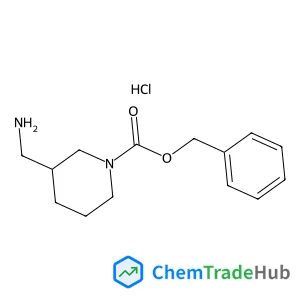
Benzyl 3-(aminomethyl)piperidine-1-carboxylate hydrochloride
CAS Number:
1186663-23-9
Molecular Formula:
C14H21ClN2O2
João Pina, J. Sérgio Seixas de Melo
The photophysics and spectroscopic properties of six naphthalene–oligothiophene derivatives, three oligothiophenes (n = 2, 3 and 4) end-capped with naphthalene chromophores and three additional oligomers derived from the former with additional thiophene and bithiophene units in their terminal positions, were investigated in solution at 293 and 77 K. Detailed results are presented on absorption, emission and triplet–triplet absorption spectra together with all relevant quantum yields (fluorescence, intersystem crossing, internal conversion and singlet oxygen formation), excited state lifetimes, singlet energies and the overall set of deactivation rate constants: kF, kIC and kISC. From these, three important conclusions could be drawn: (1) the main deactivation channel for the molecules in solution is the radiationless S1∼∼→ T1 intersystem crossing; (2) the incremental addition of thiophene units leads to an increment of the fluorescence at the expense of a decrease of the S1∼∼→ S0 internal conversion yield and (3) from time-resolved fluorescence experiments, in the picosecond time domain, the decays were found to be monoexponential, excluding decay processes involving energy transfer or conformational relaxation between the chromophoric units. This is explored, by comparison with recent studies on conjugated thiophene and para-phenylene-vinylene (PPV) copolymers and oligomers, to establish that with polythiophenes the energy transfer process is responsible for the fast (few ps) component(s) whereas with PPV polymers a relaxation of the first singlet excited state ought to be considered. DFT theoretical calculations (B3LYP/3-21G* level) support the S1 state of the compounds with a quinoidal-like structure (within the thiophene central moiety) with a degree of coupling with the terminal naphthalene rings. Singlet oxygen yields were determined and the triplet energy transfer to 3O2 to produce 1O2 was found to be highly efficient with values of SΔ (= ϕΔ/ϕT) varying from 0.61 to 0.75, thus revealing to be an important deactivation path for the triplet state of these compounds.
Thomas Fox, Klaus R. Liedl, Christofer S. Tautermann
DOI: 10.1039/C0CP00607F
K.-D. Becker, M. Schrader, H.-S. Kwon, H.-I. Yoo
DOI: 10.1039/B823174E
Jonathan Clayden, Ulrich Hennecke, Mark A. Vincent, Ian H. Hillier, Madeleine Helliwell
DOI: 10.1039/C0CP00571A
Minh-Huong Ha-Thi, Niloufar Shafizadeh, Lionel Poisson, Benoit Soep
DOI: 10.1039/C0CP00687D
G. D. Pirngruber, P. Raybaud, Y. Belmabkhout, Jiří Čejka, Arnošt Zukal
DOI: 10.1039/B927476F
Joana T. Carneiro, Ana R. Almeida, Jacob A. Moulijn, Guido Mul
DOI: 10.1039/B919886E
B. Ruprecht, M. Wilkening, A. Feldhoff, S. Steuernagel, P. Heitjans
DOI: 10.1039/B901293A
Anna Kaczmarek, Wojciech Bartkowiak
DOI: 10.1039/B819346K
Kyra Lunstroot, Kris Driesen, Peter Nockemann, Lydie Viau, P. Hubert Mutin, André Vioux, Koen Binnemans
DOI: 10.1039/B920145A
6-(3-Fluorophenyl)picolinic acid is generally considered safe for laboratory use...
(3R)-3-Pyrrolidinol is used in the pharmaceutical industry as a precursor for dr...
When handling (4R,5R)-4,5-Diethoxycarbonyl-2,2-dimethyldioxolane (CAS: 59779-75-...
1-(6-Chloroimidazo[1,2-b]pyridazin-3-yl)ethanone is often synthesized via a mult...
The market for N-Ethyl-3,4-dimethylbenzylamine (CAS: 39180-83-1) remains steady,...
Tert-butyl 3-(pyrrolidin-1-yl)azetidine-1-carboxylate is a chemical compound wit...
1-Bromo-3-chloro-2,4-dimethoxybenzene (CAS: 1228956-93-1) falls under the classi...
The safety of 8-Bromo-2-methyl-3,4-dihydroisoquinolin-1(2H)-one (CAS: 1368622-07...
Benzyl [(3S)-2,6-dioxo-3-piperidinyl]carbamate is generally safe when handled wi...
1-{[4-(4,4,5,5-Tetramethyl-1,3,2-dioxaborolan-2-yl)phenyl]sulfonyl}pyrrolidine s...

Physical Chemistry Chemical Physics (PCCP) is an international journal co-owned by 19 physical chemistry and physics societies from around the world. This journal publishes original, cutting-edge research in physical chemistry, chemical physics and biophysical chemistry. To be suitable for publication in PCCP, articles must include significant innovation and/or insight into physical chemistry; this is the most important criterion that reviewers and Editors will judge against when evaluating submissions. The journal has a broad scope and welcomes contributions spanning experiment, theory, computation and data science. Topical coverage includes spectroscopy, dynamics, kinetics, statistical mechanics, thermodynamics, electrochemistry, catalysis, surface science, quantum mechanics, quantum computing and machine learning. Interdisciplinary research areas such as polymers and soft matter, materials, nanoscience, energy, surfaces/interfaces, and biophysical chemistry are welcomed if they demonstrate significant innovation and/or insight into physical chemistry. Joined experimental/theoretical studies are particularly appreciated when complementary and based on up-to-date approaches.