











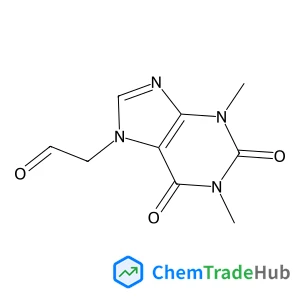
(1,3-Dimethyl-2,6-dioxo-1,2,3,6-tetrahydro-7H-purin-7-yl)acetaldehyde
CAS Number:
5614-53-9
Molecular Formula:
C9H10N4O3
P. K. Shukla, P. C. Mishra
O6-methylguanine (O6mG) is known to be a potential mutagenic modification of guanine as it mispairs with thymine in DNA and causes GC to AT transversion mutation. It is experimentally known that O6mG can be repaired to guanine by the protein O6-alkylguanine-DNA alkyltransferase (AGT), a cysteine residue being the main active site. In the present work, the mechanisms of repair of cis-O6-methylguanine (O6mG) to guanine due to its reaction with cysteine in the absence and presence of histidine and with cysteine thiolate anion were investigated theoretically using the B3LYP hybrid functional of density functional theory and the second order Møller–Plesset perturbation (MP2) theory. Reactant, intermediate and product complexes as well as transition states involved in these reactions were fully optimized at the B3LYP/6-31+G* level of theory in the gas phase. The solvent effect of water was treated using the polarizable continuum model (PCM). Single point energy calculations were performed at the B3LYP/AUG-cc-pVDZ and MP2/6-31+G* levels of theory in the gas phase and aqueous media. It is found that cysteine alone can repair the cis-O6mG to guanine, but the involvement of histidine along with cysteine lowers down the barrier energy significantly. However, when cysteine thiolate anion is used in place of cysteine, the barrier energy is strongly reduced. These results broadly support the suggestions based on experimental studies.
Meng Liu, Xinke Ouyang, Chenglong Xuan
DOI: 10.1039/D3QO01929B
Qing Sun, Jia-Jie Chen, Jia-Yi Liu, Wen-Qing Zhang, Xin Lu, Ren-Jie Song
DOI: 10.1039/D3QO01792C
Khai-Nghi Truong, Jas S. Ward, Rakesh Puttreddy, Anssi Rajala, Elias Lassila, Carsten Bolm, Kari Rissanen
DOI: 10.1039/D3QO01512B
Kanak Kanti Das, Somenath Mahato, Debraj Ghorai, Sutapa Dey, Santanu Panda
DOI: 10.1039/D3QO01838E
Depeng Duan, Lu Song
DOI: 10.1039/D3QO01370G
Zhen Liu, Mitch Mathiew, Jichao Chen, Xiangdong Yu, Dandan Shang, Javey Khiapeng Tan, Philip Wai Hong Chan, Weidong Rao
DOI: 10.1039/D3QO01655B
Yongjuan Jiao, Tao Wu, Xinyu Zhang
DOI: 10.1039/D3QO01537H
Jiahao Liu, Zhuofeng Ke
DOI: 10.1039/D3QO01777J
Meng Wang, Ze-Hong Zheng, Mu-Qiu Chen, Gu Zhan, Jie Wang, Qian-Qian Yang, Wei Huang
DOI: 10.1039/D3QO01184D
When handling 2-Methyl-2-propanyl 5-amino-2-thiophenecarboxylate (CAS: 1498311-5...
5-Bromo-1,2-dichloro-3-fluorobenzene (CAS: 1000572-93-9) is a crystalline solid ...
(2R)-2-Amino-2-(4-bromophenyl)ethanol (CAS: 354153-64-3) should be stored in a c...
Methyl 4-(aminomethyl)tetrahydro-2H-pyran-4-carboxylate hydrochloride (CAS: 3627...
1,4-Dimethyl-1H-pyrazole-5-sulfonyl chloride is primarily used as an intermediat...
Dinaphtho[1,2-b:2',1'-d]furan is generally safe when handled with appropriate pe...
The market for 7-Methyl-7,9-dihydro-1H-purine-2,6,8(3H)-trione (CAS: 612-37-3) i...
2-(4-Chlorophenyl)malonaldehyde (CAS: 205676-17-1) is a colorless or light yello...
2-Methylchrysene (CAS: 3351-32-4) is typically synthesized via the reaction of c...
N-(6-aminopyrimidin-4-yl)acetamide (CAS: 89533-23-3) is generally considered saf...

Physical Chemistry Chemical Physics (PCCP) is an international journal co-owned by 19 physical chemistry and physics societies from around the world. This journal publishes original, cutting-edge research in physical chemistry, chemical physics and biophysical chemistry. To be suitable for publication in PCCP, articles must include significant innovation and/or insight into physical chemistry; this is the most important criterion that reviewers and Editors will judge against when evaluating submissions. The journal has a broad scope and welcomes contributions spanning experiment, theory, computation and data science. Topical coverage includes spectroscopy, dynamics, kinetics, statistical mechanics, thermodynamics, electrochemistry, catalysis, surface science, quantum mechanics, quantum computing and machine learning. Interdisciplinary research areas such as polymers and soft matter, materials, nanoscience, energy, surfaces/interfaces, and biophysical chemistry are welcomed if they demonstrate significant innovation and/or insight into physical chemistry. Joined experimental/theoretical studies are particularly appreciated when complementary and based on up-to-date approaches.
![4-Chloro-N-{[4-(dimethylamino)phenyl]carbamoyl}benzenesulfonamide structure](https://static.chemtradehub.com/structs/558/5581-42-0-7dcb.webp "4-Chloro-N-{[4-(dimethylamino)phenyl]carbamoyl}benzenesulfonamide structure")





