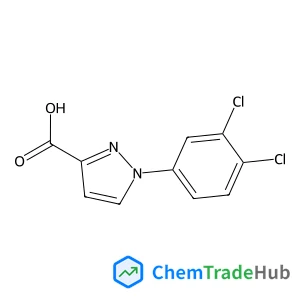
1-(3,4-Dichlorophenyl)-1H-pyrazole-3-carboxylic acid
CAS Number:
1152949-12-6
Molecular Formula:
C10H6Cl2N2O2
Zhen Liu, Mitch Mathiew, Jichao Chen, Xiangdong Yu, Dandan Shang, Javey Khiapeng Tan, Philip Wai Hong Chan, Weidong Rao
A synthetic method for the efficient preparation of a structurally diverse range of spirocyclic pyrrolidines and piperidines, which relies on the gold(I)-catalyzed spirocyclization of 1-ene-4,9- and 3-ene-1,7-diyne esters, has been developed. For substrates containing a terminal alkyne moiety, the reaction was shown to proceed via a tandem 1,2- or 1,3-acyloxy migration/Nazarov cyclization/5-exo-dig cyclization/1,5-acyl migration pathway to provide the azaspiro[4.4]nonenone ring system. In the case of substrates with an internal alkyne substituent, the reaction was found to proceed via a cascade 1,2- or 1,3-acyloxy migration/Nazarov cyclization/6-endo-dig cyclization/1,5-acyl migration pathway to give the azaspiro[4.5]decadienone derivative. The suggested spirocyclization mechanism is the first example of accessing two members of the family of compounds containing an all-carbon quaternary center from an acyclic precursor. It is also a rare instance of intramolecular trapping of a 1,3-cyclopentadienyl intermediate generated from the cycloisomerization of a 1,3-enyne ester with an appropriately placed tethered alkyne functional group. The synthetic utility of this divergent catalytic protocol was demonstrated by its applicability in the spirocyclization of all-carbon or O-tethered substrates and access to a variety of spirocyclic cyclopentane and furan derivatives. It was further exemplified by the late-stage modification of an array of structurally complex natural products and drug molecules under mild reaction conditions at room temperature.
Pedro B. Coto, Luis Serrano-Andrés, Thomas Gustavsson, Takashige Fujiwara, Edward C. Lim
DOI: 10.1039/C1CP21089K
Florian Colléaux, James M. Ball, Paul H. Wöbkenberg, Peter J. Hotchkiss, Seth R. Marder, Thomas D. Anthopoulos
DOI: 10.1039/C1CP20769E
DOI: 10.1039/C1CP20508K
Tina Ukmar, Miran Gaberšček, Franci Merzel, Aljaž Godec
DOI: 10.1039/C1CP20636B
Helga Dögg Flosadóttir, Hannes Jónsson, Snorri Th. Sigurdsson, Oddur Ingólfsson
DOI: 10.1039/C1CP21298B
Rodrigo Galindo-Murillo, Joseelyne Hernandez-Lima, Mayra González-Rendón, Lena Ruíz-Azuara, Rafael Moreno-Esparza
DOI: 10.1039/C1CP20183B
Juan Pablo Catalán
DOI: 10.1039/C1CP21380F
Roie Volkovich, Rainer Härtle, Michael Thoss, Uri Peskin
DOI: 10.1039/C1CP21161G
Ferry Prins, Ahson J. Shaikh, Jan H. van Esch, Rienk Eelkema, Herre S. J. van der Zant
DOI: 10.1039/C1CP20555B
2-Methylbenzene-1,4-diamine dihydrochloride (CAS: 615-45-2) should be stored in ...
(1S,4S)-2,5-Diazabicyclo[2.2.1]heptane dihydrobromide is generally considered sa...
(6-Chloropyridazin-3-YL)methanamine finds applications in the pharmaceutical ind...
2-Fluoro-3-methylphenol is primarily used in the synthesis of pharmaceuticals, p...
When handling 3-Methoxy-4-nitrobenzonitrile, it is important to wear appropriate...
When handling 1,3-Oxazolo[4,5-b]pyridine-2(3H)-thione (CAS: 211949-57-4), it is ...
4-Ethynylbenzamide (CAS: 90347-86-7) falls under various regulatory guidelines i...
3-(2-Ethylphenyl)-2-thioxo-4-imidazolidinone is primarily used as an intermediat...
(2-Fluoro-6-methoxyphenyl)acetic acid, also known as 4-fluoro-3-methoxybenzoic a...
Market trends for 2-[4-(Hydroxymethyl)phenoxy]ethanol (CAS: 102196-18-9) indicat...

Organic Chemistry Frontiers publishes high-quality research from across organic chemistry. Emphases are placed on studies that make significant contributions to the field of organic chemistry by reporting either new or significantly improved protocols or methodologies. Topics include, but are not limited to the following: Organic synthesis Development of synthetic methodologies Catalysis Natural products Functional organic materials Supramolecular and macromolecular chemistry Physical and computational organic chemistry
![2-Methyl-2-propanyl {3-[4-(4,4,5,5-tetramethyl-1,3,2-dioxaborolan-2-yl)phenyl]-3-oxetanyl}carbamate structure](https://static.chemtradehub.com/structs/127/1279090-25-3-1b84.webp "2-Methyl-2-propanyl {3-[4-(4,4,5,5-tetramethyl-1,3,2-dioxaborolan-2-yl)phenyl]-3-oxetanyl}carbamate structure")