


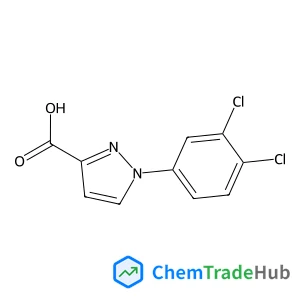
1-(3,4-Dichlorophenyl)-1H-pyrazole-3-carboxylic acid
CAS Number:
1152949-12-6
Molecular Formula:
C10H6Cl2N2O2
Depeng Duan, Lu Song
Decarboxylative cross-coupling of oxamic acids with (hetero)aryl halides has been accomplished through the synergistic merger of organic photoredox with nickel catalysis. Readily accessible oxamic acids serve as convenient starting materials that generate the key carbamoyl radicals via organic photoredox-catalyzed decarboxylation. This new, mild, and operationally simple amide synthesis protocol transforms a wide range of oxamic acids, along with (hetero)aryl halides, into the corresponding carbamides in good to excellent yields. This method is easily scalable and applicable to late-stage modification of complex molecules. Mechanistic data are consistent with the proposed reaction mechanism, in which the capture of carbamoyl radicals by ligated Ni(0) species occurs prior to the oxidative addition to an aryl electrophile.

Physical Chemistry Chemical Physics

Angewandte Chemie International Edition

Environmental Toxicology and Pharmacology

Nature Reviews Drug Discovery

Molecular Diversity

Photochemical & Photobiological Sciences

Mini-Reviews in Medicinal Chemistry

European Journal of Organic Chemistry

Foundations of Chemistry

Journal of Enzyme inhibition and Medicinal Chemistry
Christine Cézard, Frédéric Aubry, Florence Djedaïni-Pilard, François-Yves Dupradeau
DOI: 10.1039/C1CP20854C
Athi N. Naganathan
DOI: 10.1039/C1CP20964G
Yoshinobu Akinaga, Jaewoon Jung, Seiichiro Ten-no
DOI: 10.1039/C1CP21001G
Pedro B. Coto, Luis Serrano-Andrés, Thomas Gustavsson, Takashige Fujiwara, Edward C. Lim
DOI: 10.1039/C1CP21089K
Natalya Schmerl, Gunther Andersson
DOI: 10.1039/C1CP20734B
DOI: 10.1039/C1CP20508K
V. Brites, K. Franzreb, J. N. Harvey, S. G. Sayres, M. W. Ross, D. E. Blumling, A. W. Castleman, Jr., M. Hochlaf
DOI: 10.1039/C1CP21566C
Qing-Jiang Pan, Yuan-Ru Guo, Li Li, Samuel O. Odoh, Hong-Gang Fu, Hong-Xing Zhang
DOI: 10.1039/C1CP00030F
Nikolaos Bonanos, Jan Rossmeisl, Tejs Vegge
DOI: 10.1039/C1CP20406H
2-Methylbenzene-1,4-diamine dihydrochloride (CAS: 615-45-2) should be stored in ...
(1S,4S)-2,5-Diazabicyclo[2.2.1]heptane dihydrobromide is generally considered sa...
(6-Chloropyridazin-3-YL)methanamine finds applications in the pharmaceutical ind...
2-Fluoro-3-methylphenol is primarily used in the synthesis of pharmaceuticals, p...
When handling 3-Methoxy-4-nitrobenzonitrile, it is important to wear appropriate...
When handling 1,3-Oxazolo[4,5-b]pyridine-2(3H)-thione (CAS: 211949-57-4), it is ...
4-Ethynylbenzamide (CAS: 90347-86-7) falls under various regulatory guidelines i...
3-(2-Ethylphenyl)-2-thioxo-4-imidazolidinone is primarily used as an intermediat...
(2-Fluoro-6-methoxyphenyl)acetic acid, also known as 4-fluoro-3-methoxybenzoic a...
Market trends for 2-[4-(Hydroxymethyl)phenoxy]ethanol (CAS: 102196-18-9) indicat...

Organic Chemistry Frontiers publishes high-quality research from across organic chemistry. Emphases are placed on studies that make significant contributions to the field of organic chemistry by reporting either new or significantly improved protocols or methodologies. Topics include, but are not limited to the following: Organic synthesis Development of synthetic methodologies Catalysis Natural products Functional organic materials Supramolecular and macromolecular chemistry Physical and computational organic chemistry

![[(5-Methyl-1,3,4-thiadiazol-2-yl)sulfanyl]acetic acid structure](https://static.chemtradehub.com/structs/509/50918-26-8-4ce8.webp "[(5-Methyl-1,3,4-thiadiazol-2-yl)sulfanyl]acetic acid structure")




