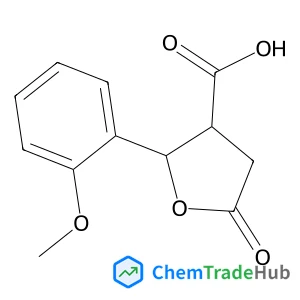
trans-2-(2-Methoxyphenyl)-5-oxotetrahydrofuran-3-carboxylic acid
CAS Number:
99226-02-5
Molecular Formula:
C12H12O5
Germano Tremiliosi-Filho, Ernesto R. Gonzalez, Antonio Berná, Enrique Herrero, Juan M. Feliu
Ethanol oxidation has been studied on stepped platinum single crystal electrodes in acid media using electrochemical and Fourier transform infrared (FTIR) techniques. The electrodes used belong to two different series of stepped surfaces: those having (111) terraces with (100) monoatomic steps and those with (111) terraces with (110) monoatomic steps. The behaviors of the two series of stepped surfaces for the oxidation of ethanol are very different. On the one hand, the presence of (100) steps on the (111) terraces provides no significant enhancement of the activity of the surfaces. On the other hand, (110) steps have a double effect on the ethanol oxidation reaction. At potentials below 0.7 V, the step catalyzes the C–C bond cleavage and also the oxidation of the adsorbed CO species formed. At higher potentials, the step is not only able to break the C–C bond, but also to catalyze the oxidation of ethanol to acetic acid and acetaldehyde. The highest catalytic activity from voltammetry for ethanol oxidation was obtained with the Pt(554) electrode.
Ke-Qiu Chen
DOI: 10.1039/C7CP07795E
Yan He, Gang Ouyang
DOI: 10.1039/C7CP08259B
David Peyrot, Mathieu G. Silly, Fabien Silly
DOI: 10.1039/C7CP06488H
Liang Xu, Shayon Bhattacharya, Damien Thompson
DOI: 10.1039/C7CP08321A
Reem Ahmed Karaballi, Soraya Merchant, Sasha R. Power, Christa L. Brosseau
DOI: 10.1039/C7CP06838G
DOI: 10.1039/C8CP91824D
Yang Wang, Xiangyun Ma, Huijie Wang, Da Chen, Keng C. Chou, Qifeng Li
DOI: 10.1039/C8CP02519C
6-(3-Fluorophenyl)picolinic acid is generally considered safe for laboratory use...
(3R)-3-Pyrrolidinol is used in the pharmaceutical industry as a precursor for dr...
When handling (4R,5R)-4,5-Diethoxycarbonyl-2,2-dimethyldioxolane (CAS: 59779-75-...
1-(6-Chloroimidazo[1,2-b]pyridazin-3-yl)ethanone is often synthesized via a mult...
The market for N-Ethyl-3,4-dimethylbenzylamine (CAS: 39180-83-1) remains steady,...
Tert-butyl 3-(pyrrolidin-1-yl)azetidine-1-carboxylate is a chemical compound wit...
1-Bromo-3-chloro-2,4-dimethoxybenzene (CAS: 1228956-93-1) falls under the classi...
The safety of 8-Bromo-2-methyl-3,4-dihydroisoquinolin-1(2H)-one (CAS: 1368622-07...
Benzyl [(3S)-2,6-dioxo-3-piperidinyl]carbamate is generally safe when handled wi...
1-{[4-(4,4,5,5-Tetramethyl-1,3,2-dioxaborolan-2-yl)phenyl]sulfonyl}pyrrolidine s...

Physical Chemistry Chemical Physics (PCCP) is an international journal co-owned by 19 physical chemistry and physics societies from around the world. This journal publishes original, cutting-edge research in physical chemistry, chemical physics and biophysical chemistry. To be suitable for publication in PCCP, articles must include significant innovation and/or insight into physical chemistry; this is the most important criterion that reviewers and Editors will judge against when evaluating submissions. The journal has a broad scope and welcomes contributions spanning experiment, theory, computation and data science. Topical coverage includes spectroscopy, dynamics, kinetics, statistical mechanics, thermodynamics, electrochemistry, catalysis, surface science, quantum mechanics, quantum computing and machine learning. Interdisciplinary research areas such as polymers and soft matter, materials, nanoscience, energy, surfaces/interfaces, and biophysical chemistry are welcomed if they demonstrate significant innovation and/or insight into physical chemistry. Joined experimental/theoretical studies are particularly appreciated when complementary and based on up-to-date approaches.