












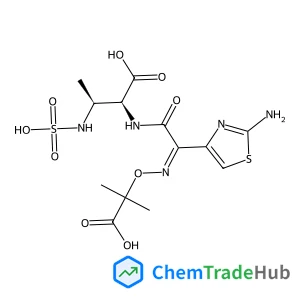
Aztreonam USP Related Compound A (Open-ring Aztreonam)
CAS Number:
87500-74-1
Molecular Formula:
C13H19N5O9S2
Reem Ahmed Karaballi, Soraya Merchant, Sasha R. Power, Christa L. Brosseau
Human diseases characterized by the uncontrolled deposition of insoluble extracellular protein aggregates are collectively referred to as amyloidoses. Such diseases include Alzheimer's, Parkinson's, Huntington's, and prion disease. In Alzheimer's disease, it is believed that amyloid-β proteins may be responsible for pore and defect formation within cellular membranes, leading to a breakdown of cellular homeostasis causing eventual neuronal death. This theory is referred to as the amyloid pore hypothesis of Alzheimer's disease. In this work, the interaction between a model amyloid-forming protein (insulin) and a biomimetic membrane was studied at the molecular level. Protein at different stages of aggregation was allowed to interact with a biomimetic membrane formed on a nanostructured substrate using Langmuir–Blodgett/Langmuir–Schaefer deposition. Electrochemical surface-enhanced Raman spectroscopy (EC-SERS) was used to monitor the molecular level changes occurring as a result of this interaction. Based on the results it was observed that oligomers and protofibrils caused the most significant membrane deterioration whilst native protein appeared to play a protective role. To the best of our knowledge, this work represents the first EC-SERS investigation of protein aggregate–biomembrane interactions, and highlights the usefulness of this tool for studying complex biomolecular interactions.
Debkumar Rana, Patrice Donfack, Vladislav Jovanov, Veit Wagner, Arnulf Materny
DOI: 10.1039/C9CP03736E
Qiang Zhang, Jichong Hou, Jianfeng Fan, Shaoping Chen, Wenhao Fan, Hua Zhang, Wenxian Wang, Yucheng Wu, Bingshe Xu
DOI: 10.1039/D0CP00266F
Bai Pan, Xianshang Meng, Yidong Xia, Haiming Lu, Hui Li
DOI: 10.1039/C9CP06989E
Karl N. Blodgett, Dewei Sun, Joshua L. Fischer, Edwin L. Sibert, III, Timothy S. Zwier
DOI: 10.1039/C9CP04556B
Li Xiang, Lu Gong, Jiawen Zhang, Ling Zhang, Wenjihao Hu, Wenda Wang, Qingye Lu, Hongbo Zeng
DOI: 10.1039/C9CP03189H
Artem B. Smolentsev, Ilya M. Magin, Vladimir V. Vyazovkin, Marina V. Parkhats, Anton V. Yadykov, Valerii Z. Shirinian
DOI: 10.1039/C9CP05744G
Misong Ju, Ouk Hyun Cho, Jaehun Lee, Mani Balamurugan, Ki Tae Nam
DOI: 10.1039/C9CP05581A
Aritra Mandal
DOI: 10.1039/C9CP04101J
Hassan Ghermezcheshme, Hesam Makki, Mohsen Mohseni, Morteza Ebrahimi, Gijsbertus de With
DOI: 10.1039/C9CP03407B
P. S. Stepanov, F. A. Selim, A. V. Bokov, O. V. Ilyukhina, G. Duplâtre
DOI: 10.1039/C9CP06105C
6-(3-Fluorophenyl)picolinic acid is generally considered safe for laboratory use...
(3R)-3-Pyrrolidinol is used in the pharmaceutical industry as a precursor for dr...
When handling (4R,5R)-4,5-Diethoxycarbonyl-2,2-dimethyldioxolane (CAS: 59779-75-...
1-(6-Chloroimidazo[1,2-b]pyridazin-3-yl)ethanone is often synthesized via a mult...
The market for N-Ethyl-3,4-dimethylbenzylamine (CAS: 39180-83-1) remains steady,...
Tert-butyl 3-(pyrrolidin-1-yl)azetidine-1-carboxylate is a chemical compound wit...
1-Bromo-3-chloro-2,4-dimethoxybenzene (CAS: 1228956-93-1) falls under the classi...
The safety of 8-Bromo-2-methyl-3,4-dihydroisoquinolin-1(2H)-one (CAS: 1368622-07...
Benzyl [(3S)-2,6-dioxo-3-piperidinyl]carbamate is generally safe when handled wi...
1-{[4-(4,4,5,5-Tetramethyl-1,3,2-dioxaborolan-2-yl)phenyl]sulfonyl}pyrrolidine s...

Physical Chemistry Chemical Physics (PCCP) is an international journal co-owned by 19 physical chemistry and physics societies from around the world. This journal publishes original, cutting-edge research in physical chemistry, chemical physics and biophysical chemistry. To be suitable for publication in PCCP, articles must include significant innovation and/or insight into physical chemistry; this is the most important criterion that reviewers and Editors will judge against when evaluating submissions. The journal has a broad scope and welcomes contributions spanning experiment, theory, computation and data science. Topical coverage includes spectroscopy, dynamics, kinetics, statistical mechanics, thermodynamics, electrochemistry, catalysis, surface science, quantum mechanics, quantum computing and machine learning. Interdisciplinary research areas such as polymers and soft matter, materials, nanoscience, energy, surfaces/interfaces, and biophysical chemistry are welcomed if they demonstrate significant innovation and/or insight into physical chemistry. Joined experimental/theoretical studies are particularly appreciated when complementary and based on up-to-date approaches.
![[4-Chloro-3-(diethylcarbamoyl)phenyl]boronic acid structure](https://static.chemtradehub.com/structs/871/871332-68-2-0e3b.webp "[4-Chloro-3-(diethylcarbamoyl)phenyl]boronic acid structure")






