












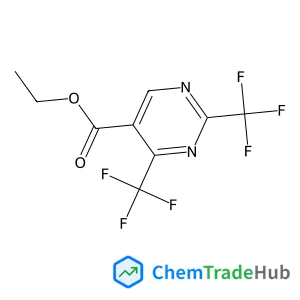
Ethyl 2,4-bis(trifluoromethyl)-5-pyrimidinecarboxylate
CAS Number:
188781-15-9
Molecular Formula:
C9H6F6N2O2
Matthew R. Hicks, Timothy R. Dafforn, Angeliki Damianoglou, Paul Wormell, Alison Rodger, Søren V. Hoffmann
We have developed synchrotron radiation linear dichroism (SRLD) to measure the insertion of peptides into lipid bilayers, significantly improving both signal-to-noise and wavelength range over existing methods. Our wavelength cut-off is currently determined by the quality of quartz in the cell, rather than the light source, with signal quality still high at the cut-off. We demonstrate the use of a lipid probe to measure the orientation of the lipid bilayers under flow and describe the way in which this can be used to further interpret SRLD data. The antibiotic peptide gramicidin is shown to exhibit drastically different kinetic and equilibrium behaviour when interacting with lipid membranes with different properties. The charge on the membrane is of interest because of differences in charge between human and bacterial membranes. For this reason we increased the negative charge on the membrane by changing the lipid composition. Increasing negative charge in the gel phase stabilises the liposomes but changes the kinetics of peptide folding. In a gel phase with no negatively charged lipids, gramicidin does not fold well and gives a small signal that indicates a change in orientation of the tryptophan side chains over time. In the fluid phase with no negatively charged lipids, there is initially >10-fold greater peptide signal relative to the gel phase indicating a highly folded and ordered gramicidin backbone. This is followed by liposome disruption. In the gel phase with negatively charged lipids the liposomes are resistant to disruption by gramicidin and exhibit different folding kinetics depending on membrane composition. In the fluid phase with negatively charged lipids there is little signal from either the peptide or the lipid probe indicating that the liposomes have been disrupted by the gramicidin in the time it takes to make the first measurement.
Simone Lazar, Ruiqing Shen, Yufeng Quan, Bethany Palen, Qingsheng Wang, Christopher J. Ellison
DOI: 10.1039/D1PY00111F
Brian J. Ree, Yusuke Satoh, Takuya Isono, Toshifumi Satoh
DOI: 10.1039/D1PY00421B
Ayano Ishida, Shunichi Fujii, Akifumi Sumida, Tasuku Kamitani, Saori Minami, Kenji Urayama, Hiroaki Imoto
DOI: 10.1039/D1PY00346A
Yongjun Men, Tobias G. Brevé, Antonia G. Denkova, Rienk Eelkema
DOI: 10.1039/D1PY00514F
Jiajun Cao, Huangtianzhi Zhu, Liqing Shangguan, Yuezhou Liu, Peiren Liu, Qi Li, Yitao Wu
DOI: 10.1039/D1PY00535A
Xiaoxu Mao, Shoukui Hu, Ke Shang, Guangwei Yang, Jinhao Yan, Chao Ma, Jun Yin
DOI: 10.1039/D1PY00128K
When handling lithium chloride hydrate (1:1:1) (CAS: 16712-20-2), it is importan...
4-(4H-1,2,4-Triazol-4-yl)piperidine is generally considered safe for use in phar...
Waste containing 1,3-Thiazole-2-carboxamide (CAS: 16733-85-0) should be collecte...
5-(Difluoromethyl)-2-fluorobenzonitrile (CAS: 934175-58-3) is subject to regulat...
Methyl 3-acetamido-2-thiophenecarboxylate can be synthesized by the reaction of ...
4-Isoquinolinecarbonitrile is a chemical compound with the CAS number 34846-65-6...
Store Methyl 1H-1,2,3-triazole-4-carboxylate (CAS: 877309-59-6) in a cool, dry p...
6-Bromo[1,3]thiazolo[5,4-b]pyridin-2-amine (CAS: 1160791-13-8) is subject to the...
(2S,3S)-2-Ammonio-3-(3,4-dihydroxyphenyl)-3-hydroxypropanoate (CAS: 23651-95-8) ...
7-Bromo-3-methyl-3,4-dihydroquinazolin-4-one is a solid with a crystalline form....

Analyst publishes analytical and bioanalytical research that reports premier fundamental discoveries and inventions, and the applications of those discoveries, unconfined by traditional discipline barriers.
![1-[4-(4-Methyl-1H-imidazol-1-yl)phenyl]ethanone structure](https://static.chemtradehub.com/structs/142/142161-53-3-7f55.webp "1-[4-(4-Methyl-1H-imidazol-1-yl)phenyl]ethanone structure")
![Ethyl 4-[8-chloro(5,5,6,6,7-~2~H_5_)-5,6-dihydro-11H-benzo[5,6]cyclohepta[1,2-b]pyridin-11-ylidene]-1-piperidinecarboxylate structure](https://static.chemtradehub.com/structs/102/1020719-57-6-37e2.webp "Ethyl 4-[8-chloro(5,5,6,6,7-~2~H_5_)-5,6-dihydro-11H-benzo[5,6]cyclohepta[1,2-b]pyridin-11-ylidene]-1-piperidinecarboxylate structure")
![(1R,5R)-3-{[(2-Methyl-2-propanyl)oxy]carbonyl}-3-azabicyclo[3.1.0]hexane-1-carboxylic acid structure](https://static.chemtradehub.com/structs/116/1165450-63-4-bfe1.webp "(1R,5R)-3-{[(2-Methyl-2-propanyl)oxy]carbonyl}-3-azabicyclo[3.1.0]hexane-1-carboxylic acid structure")



