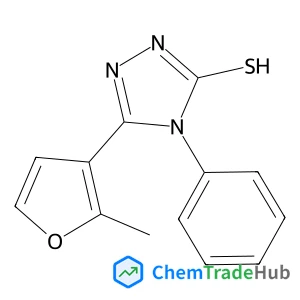
5-(2-Methyl-3-furyl)-4-phenyl-2,4-dihydro-3H-1,2,4-triazole-3-thione
CAS Number:
346464-59-3
Molecular Formula:
C13H11N3OS
Xiaoxu Mao, Shoukui Hu, Ke Shang, Guangwei Yang, Jinhao Yan, Chao Ma, Jun Yin
It has been widely accepted that covalently cross-linked nanoparticles show extended circulation time in the blood due to their large stable structures compared to free linear polyprodrugs. Herein, an efficient method, combining living radical polymerization, a ring-opening reaction, and a copper(I) catalyzed azide–alkyne cycloaddition click reaction, was employed to prepare amphiphilic polyprodrugs with a reduction-responsive camptothecin (CPT) prodrug and photothermal converted near-infrared dyes (IR780). The drug content could be regulated as needed through the monomer feed ratio. The obtained amphiphilic P[CPTM-co-GMA(-IR780/-OH)]-b-POEGMA polyprodrugs could molecularly dissolve in a good solvent and self-assembled into nanoparticles consisting of thiol-responsive P[CPTM-co-GMA(-IR780/-OH)] cores and well solvated POEGMA coronas in the selected solvent. Cross-linking of the P[CPTM-co-GMA(-IR780/-OH)] cores could be facilely achieved via the reaction between the residual hydroxyls and hexachlorocyclic triphosphonitrile (HCCP; acid sensitive and biodegradable) to form structurally stable core cross-linked (CCL) nanoparticles. DLS, TEM, UV-vis and fluorescent techniques, as well as subsequent in vitro cell experiments, confirmed that these CCL nanoparticles possessed excellent aqueous stability, high tumor micromilieu sensitivity, controlled drug release and severe cytotoxicity to HeLa cells with the aid of near-infrared light irradiation. Not only that, these CCL nanoparticles could serve as nanocarriers for loading other anti-cancer drugs (curcumin) to realize synergistic and highly effective treatment. Overall, this work provides a convenient way to produce promising intelligent, responsive and enhanced anticancer therapies.
Chahinez Abdellaoui, Volker Hermanns, Maximilian Scheurer, Andreas Dreuw, Alexander Heckel, Josef Wachtveitl
DOI: 10.1039/D1CP05292F
Cuicui Wang, Miaoting Xu, Keith T. Butler, Lee A. Burton
DOI: 10.1039/D1CP05623A
Moumita Mukherjee, Sayan Dutta, Madhusudan Ghosh, Partha Basuchowdhuri, Ayan Datta
DOI: 10.1039/D2CP01901A
Zhipeng Zheng, Yao Luo, Hua Yang, Zao Yi, Jianguo Zhang, Qianjv Song, Wenxing Yang, Chao Liu, Xianwen Wu, Pinghui Wu
DOI: 10.1039/D2CP01070D
Shankar Dutt, Christian Notthoff, Alexander Kiy, Pablo Mota-Santiago, Stephen T. Mudie, Maria E. Toimil-Molares, Yugang Wang, Patrick Kluth
DOI: 10.1039/D1CP05813D
Jing He, Bing Zheng, Ying Xie, Yin-yin Qian, Jiao Zhang, Ke Wang, Hai-tao Yu
DOI: 10.1039/D2CP00506A
Danyang Xiong, Xiaoyu Zhao, Song Luo, Lili Duan
DOI: 10.1039/D2CP00843B
Yuanyuan Sun, Ying Li, Xiaoyan Li, Yanli Zeng
DOI: 10.1039/D2CP00075J
Haodong Mei, Yujie Xia, Yiming Zhang, Yu Wu, Ying Chen, Congcong Ma, Mingran Kong, Lei Peng, Heyuan Zhu
DOI: 10.1039/D1CP05979C
Mohaddeseh Habibzadeh Mashatooki, Bahram Ghalami-Choobar
DOI: 10.1039/D1CP04006E
When handling lithium chloride hydrate (1:1:1) (CAS: 16712-20-2), it is importan...
4-(4H-1,2,4-Triazol-4-yl)piperidine is generally considered safe for use in phar...
Waste containing 1,3-Thiazole-2-carboxamide (CAS: 16733-85-0) should be collecte...
5-(Difluoromethyl)-2-fluorobenzonitrile (CAS: 934175-58-3) is subject to regulat...
Methyl 3-acetamido-2-thiophenecarboxylate can be synthesized by the reaction of ...
4-Isoquinolinecarbonitrile is a chemical compound with the CAS number 34846-65-6...
Store Methyl 1H-1,2,3-triazole-4-carboxylate (CAS: 877309-59-6) in a cool, dry p...
6-Bromo[1,3]thiazolo[5,4-b]pyridin-2-amine (CAS: 1160791-13-8) is subject to the...
(2S,3S)-2-Ammonio-3-(3,4-dihydroxyphenyl)-3-hydroxypropanoate (CAS: 23651-95-8) ...
7-Bromo-3-methyl-3,4-dihydroquinazolin-4-one is a solid with a crystalline form....

Polymer Chemistry welcomes submissions in all areas of polymer science that have a strong focus on macromolecular chemistry. Manuscripts may cover a broad range of fields, yet no direct application focus is required.
![(1R,5R)-3-{[(2-Methyl-2-propanyl)oxy]carbonyl}-3-azabicyclo[3.1.0]hexane-1-carboxylic acid structure](https://static.chemtradehub.com/structs/116/1165450-63-4-bfe1.webp "(1R,5R)-3-{[(2-Methyl-2-propanyl)oxy]carbonyl}-3-azabicyclo[3.1.0]hexane-1-carboxylic acid structure")