


Catalytic direct-type substitution reaction of α-alkylenolates: a Pd/Brønsted base-catalysed approach to the decarboxylative allylation of sulfonylimidates‡
Literature Information
Publication Date
2008-10-29
DOI
10.1039/B815845B
Impact Factor
6.222
Authors
S. B. Jennifer Kan, Ryosuke Matsubara, Florian Berthiol, Shū Kobayashi
View Original
Abstract
A mild and efficient process for the direct-type catalytic allylation of sulfonylimidates has been developed; this reaction represents the first example of Brønsted base-catalysed, in situ generation and use of α-alkylenolates in substitution reactions; the success of this methodology stems from the tunable α-proton acidity and nucleophilicity of sulfonylimidates, which could be harnessed in the realization of a broader range of catalytic direct-type reactions using ester equivalents as nucleophiles.
Recommended Journals

Journal of Saudi Chemical Society

Crystallography Reports

Journal of Natural Medicines

Russian Journal of General Chemistry

Journal of Peptide Science

Russian Journal of Organic Chemistry

Russian Journal of Coordination Chemistry

Saudi Pharmaceutical Journal

Russian Chemical Bulletin

Organic Process Research & Development
Related Literature
Oxygen-assisted reduction of Au species on Au/SiO2catalyst in room temperature CO oxidation
Zili Wu, Shenghu Zhou, Haoguo Zhu, Sheng Dai, Steven H. Overbury
2008-06-05
Communication
DOI: 10.1039/B803834A
Csp3–F bond activation by nucleophilic attack of the {Pt2S2} core assisted by non-covalent interactions
Ainara Nova, Gregori Ujaque, Pilar González-Duarte, Agustí Lledós
2008-04-29
Communication
DOI: 10.1039/B801889H
Probing the stable G-quadruplex transition using quencher-free end-stacking ethynyl pyrene–adenosine
Young Jun Seo, Il Joon Lee, Jeong Wu Yi, Byeang Hyean Kim
2007-06-18
Communication
DOI: 10.1039/B707278C
Nickel-catalyzed cross-coupling reactions of benzylic zinc reagents with aromatic bromides, chlorides and tosylates
Matthias A. Schade, Albrecht Metzger, Stephan Hug, Paul Knochel
2008-04-24
Communication
DOI: 10.1039/B803072C
Simple linear asymmetrical complexes of silver(i): NC–Ag–NH3 and Br–Ag–NH3
Ann M. Chippindale, Laura E. Head, Simon J. Hibble
2008-05-14
Communication
DOI: 10.1039/B803500H
A hierarchical self-similar structure of oriented calcite with association of an agar gel matrix: inheritance of crystal habit from nanoscale
Yuya Oaki, Shinichiro Hayashi, Hiroaki Imai
2007-04-30
Communication
DOI: 10.1039/B704129B
1,3-Diindolylureas: high affinity dihydrogen phosphate receptors
Claudia Caltagirone, Philip A. Gale, Jennifer R. Hiscock, Simon J. Brooks, Michael B. Hursthouse, Mark E. Light
2008-05-29
Communication
DOI: 10.1039/B806238B
Sulfonated N-heterocyclic carbenes for Suzuki coupling in water
Christoph Fleckenstein, Sutapa Roy, Steffen Leuthäußer, Herbert Plenio
2007-05-02
Communication
DOI: 10.1039/B703658B
Asymmetric multifunctional organocatalytic Michael addition of nitroalkanes to α,β-unsaturated ketones
Pengfei Li, Yongcan Wang, Jinxing Ye
2008-05-16
Communication
DOI: 10.1039/B804540B
You might also like
Compound Q&A
Are there alternatives to 1-(4-Chlorophenyl)-N-hydroxymethanimine (CAS: 3848-36-0) in synthesis?
When considering alternatives to 1-(4-Chlorophenyl)-N-hydroxymethanimine (CAS: 3...
3848-36-01-(4-Chlorophenyl)-N...
Compound Q&A
How should (1R,9S,10S,12S,14E,16S,19R,20R,21S,22R)-3,9,21-Trihydroxy-5,10,12,14,16,20,22-heptamethyl-23,24-dioxatetracyclo[17.3.1.1~6,9~.0~2,7~]tetracosa-2,5,7,14-tetraen-4-one (CAS: 183202-73-5) be stored?
This compound should be stored in a cool, dry place away from direct sunlight. I...
183202-73-5(1R,9S,10S,12S,14E,1...
Compound Q&A
How is 3-(4-Bromophenyl)-5-(2-fluorophenyl)-1,2,4-oxadiazole (CAS: 419553-16-5) typically synthesized?
3-(4-Bromophenyl)-5-(2-fluorophenyl)-1,2,4-oxadiazole is synthesized through a m...
419553-16-53-(4-Bromophenyl)-5-...
Compound Q&A
How is 5-Chloro-2-(4-chlorophenyl)-4-methyl-6-[3-(1-piperidinyl)propoxy]pyrimidine (CAS: 1639220-19-1) typically synthesized?
5-Chloro-2-(4-chlorophenyl)-4-methyl-6-[3-(1-piperidinyl)propoxy]pyrimidine (CAS...
1639220-19-15-Chloro-2-(4-chloro...
Compound Q&A
What industries use 2-Chloro-4-(difluoromethoxy)pyridine (CAS: 1206978-15-5)?
2-Chloro-4-(difluoromethoxy)pyridine is used in the pharmaceutical industry for ...
1206978-15-52-Chloro-4-(difluoro...
Compound Q&A
What regulatory guidelines apply to 3-Chloro-6-methylpyridazine (CAS: 1121-79-5)?
3-Chloro-6-methylpyridazine (CAS: 1121-79-5) is classified under the Globally Ha...
1121-79-53-Chloro-6-methylpyr...
Compound Q&A
Are there alternatives to Methyl 4,5-dimethyl-2-nitrobenzoate in synthesis?
Several alternatives can be used in the synthesis of Methyl 4,5-dimethyl-2-nitro...
90922-74-0Methyl 4,5-dimethyl-...
Compound Q&A
Are there alternatives to (2E,2'E)-3,3'-(1,4-Phenylene)bisacrylaldehyde in synthesis?
Alternatives to (2E,2'E)-3,3'-(1,4-Phenylene)bisacrylaldehyde include other acry...
63405-68-5(2E,2'E)-3,3'-(1,4-P...
Compound Q&A
What is 3-Amino-5-chloropyridin-2-ol hydrochloride (CAS: 1261906-29-9)?
3-Amino-5-chloropyridin-2-ol hydrochloride is an organic compound with the CAS n...
1261906-29-93-Amino-5-chloropyri...
Compound Q&A
What precautions should be taken when handling 6,7-Difluoro-2,3-dihydro-4H-chromen-4-one (CAS: 1092349-93-3)?
When handling 6,7-Difluoro-2,3-dihydro-4H-chromen-4-one, it is essential to wear...
1092349-93-36,7-Difluoro-2,3-dih...
Source Journal
Chemical Communications

CiteScore:
8.6
Self-citation Rate:
4.7%
Articles per Year:
2458
ChemComm publishes urgent research which is of outstanding significance and interest to experts in the field, while also appealing to the journal’s broad chemistry readership. Our communication format is ideally suited to short, urgent studies that are of such importance that they require accelerated publication. Our scope covers all topics in chemistry, and research at the interface of chemistry and other disciplines (such as materials science, nanoscience, physics, engineering and biology) where there is a significant novelty in the chemistry aspects. Major topic areas covered include: Analytical Chemistry Catalysis Chemical Biology and medicinal chemistry Computational Chemistry and Machine Learning Energy and sustainable chemistry Environmental Chemistry Green Chemistry Inorganic Chemistry Materials Chemistry Nanoscience Organic Chemistry Physical Chemistry Polymer Chemistry Supramolecular Chemistry
Recommended Compounds
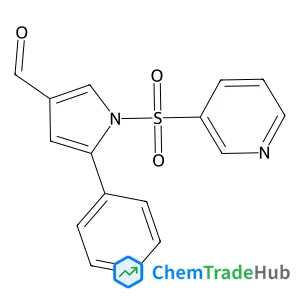
5-Phenyl-1-(pyridin-3-ylsulfonyl)-1H-pyrrole-3-carbaldehyde
CAS Number:
881676-90-0
Molecular Formula:
C16H12N2O3S

Recommended Suppliers




Disclaimer
This page provides academic journal information for reference and research purposes only. We are not affiliated with any journal publishers and do not handle publication submissions. For publication-related inquiries, please contact the respective journal publishers directly.
If you notice any inaccuracies in the information displayed, please contact us at support@chemtradehub.com. We will promptly review and address your concerns.