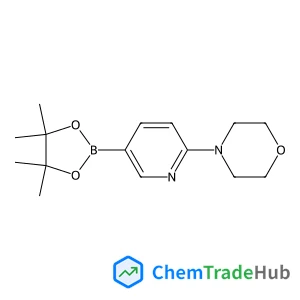
4-(5-(4,4,5,5-tetramethyl-1,3,2-dioxaborolan-2-yl)pyridin-2-yl)morpholine
CAS Number:
485799-04-0
Molecular Formula:
C15H23BN2O3
Jesús González-Vázquez, Leticia González, Elena Samoylova, Thomas Schultz
Ab initio calculations and femtosecond pump–probe ionization experiments were carried out to identify excited state relaxation processes in isolated thymine monomer and small thymine–water clusters. Three transient species with life times of ≤100 fs, 7 ps and >1 ns were observed in the experiments on gas phase thymine. The longer-lived transients were weak or absent in thymine–water clusters. Available theoretical results on thymine agree with the assignment of low-lying ππ* and nπ* excited states to the femtosecond and picosecond transients but the assignment of the third transient remains opaque. Our theoretical results seem to exclude the possibility of ground or excited state tautomerization as well as the involvement of states with πσ* character. Remaining explanations for the observed transients are: very fast intersystem crossing to the triplet manifold or the observation of transient signals from local minima on the potential energy surfaces.
Alexander Böddecker, Arisa Bodnar, Lars Schücke, Jonas Giesekus, Katja Wenselau, Ryan T. Nguyen-Smith, Timothy Oppotsch, Christian Oberste-Beulmann, Martin Muhler, Peter Awakowicz
DOI: 10.1039/D2RE00167E
Zeynep Tunalı, Bengi Özgün Öztürk
DOI: 10.1039/D2RE00058J
Qandeel Saleem, Milad Torabfam
DOI: 10.1039/D2RE00049K
Markus Schörner, Stefanie Kämmerle, Dorothea Wisser, Benjamin Baier, Martin Hartmann, Matthias Thommes, Marco Haumann
DOI: 10.1039/D2RE00143H
Jiabing Ren, Xin Ye, Xiaoyu Shi, Huixing Xu, Lanxin Wu
DOI: 10.1039/D2RE00112H
Nicolas Mattias Del Rio Fuenzalida, Eirin Alme, Frida Johanne Lundevall, Hans-René Bjørsvik
DOI: 10.1039/D2RE00071G
Shrilekha V. Sawant, Ashwin W. Patwardhan
DOI: 10.1039/D1RE00536G
Yanzhe Yu, Yonggen Lu, Xisong Cheng, Lei Han, Changling Yang
DOI: 10.1039/D2RE00060A
Debashis Panda, Vaishnavi Kulkarni, Sanjay Kumar Singh
DOI: 10.1039/D2RE00211F
(1R,3S)-1,3-Cyclopentanediol finds applications in various industries. In the ph...
When handling N'-[4-(Dimethylamino)phenyl]-N,N-dimethyl-1,4-benzenediamine, it i...
There are several alternatives to 5-(2,4-Difluorophenyl)-2-methoxypyrimidine in ...
1-(3-Methoxyphenoxy)propan-2-ol (CAS: 382141-68-6) must comply with the Globally...
Tetrodotoxin Citrate is extremely dangerous and should be handled with extreme c...
2-Methyl-2-propanyl [(1R,3S)-3-hydroxycyclopentyl]carbamate (CAS: 225641-84-9) i...
Waste containing 4-(2-Hydroxyhexafluoroisopropyl)Benzoic Acid (CAS: 16261-80-6) ...
2-Methyl-2-proanyl {(2S)-1-[(benzyloxy)amino]-3-hydroxy-3-methyl-1-oxo-2-butanyl...
Benzeneethanamine, α-ethyl-, hydrochloride (1:1) is an organic compound with the...
In the synthesis of compounds similar to 3-{(E)-[4-(Dimethylamino)phenyl]diazeny...

Physical Chemistry Chemical Physics (PCCP) is an international journal co-owned by 19 physical chemistry and physics societies from around the world. This journal publishes original, cutting-edge research in physical chemistry, chemical physics and biophysical chemistry. To be suitable for publication in PCCP, articles must include significant innovation and/or insight into physical chemistry; this is the most important criterion that reviewers and Editors will judge against when evaluating submissions. The journal has a broad scope and welcomes contributions spanning experiment, theory, computation and data science. Topical coverage includes spectroscopy, dynamics, kinetics, statistical mechanics, thermodynamics, electrochemistry, catalysis, surface science, quantum mechanics, quantum computing and machine learning. Interdisciplinary research areas such as polymers and soft matter, materials, nanoscience, energy, surfaces/interfaces, and biophysical chemistry are welcomed if they demonstrate significant innovation and/or insight into physical chemistry. Joined experimental/theoretical studies are particularly appreciated when complementary and based on up-to-date approaches.