












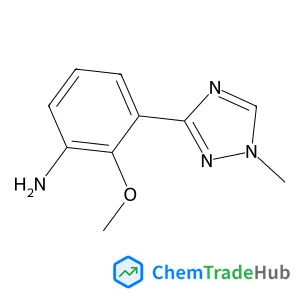
2-Methoxy-3-(1-methyl-1H-1,2,4-triazol-3-yl)aniline
CAS Number:
1609394-10-6
Molecular Formula:
C10H12N4O
Ji-Hoon Lee, Do-Hoon Hwang
A new alkoxyphenyl-substituted poly(fluorene) was synthesized to suppress the emission of long-wavelength radiation. The polymer emitted pure blue light, the characteristics of which did not change upon thermal annealing or normal operation of the EL device.
Marek Stach, Anna Chovancová, Andrea M. Misske, Igor Lacík
DOI: 10.1039/C3PY00948C
Wenhan He, Yingbing Jiang, Yang Qin
DOI: 10.1039/C3PY01396K
Li-Min Zhang, Tao Wang, Bao-Hang Han
DOI: 10.1039/C3PY00854A
Bunyamin Karagoz, Hien T. Duong, Johan S. Basuki, Cyrille Boyer
DOI: 10.1039/C3PY01306E
Christopher R. Fenoli
DOI: 10.1039/C3PY00709J
Huayi Li, Jin-Yong Dong, Youliang Hu
DOI: 10.1039/C3PY00727H
Yi Zhao, Rüdiger Berger, Katharina Landfester, Daniel Crespy
DOI: 10.1039/C3PY01096A
Yunfeng Yan, Daniel J. Siegwart
DOI: 10.1039/C3PY01474F
Daniel L. Jacobs, Benjamin R. Bunes, Helin Huang, Xiaomei Yang, Ling Zang
DOI: 10.1039/C3PY01026K
1H-Indazole-6-carbonitrile finds applications in pharmaceuticals, where it serve...
Waste containing Dioctyl (2E)-2-butenedioate (CAS: 2997-85-5) should be collecte...
Sodium [(1,2-benzoxazol-3-ylmethyl)sulfonyl]azanide is primarily used in pharmac...
Dimethyl 4-(4,4,5,5-tetramethyl-1,3,2-dioxaborolan-2-yl)-2,6-pyridinedicarboxyla...
Waste containing 2-Fluoro-6-hydrazinopyridine (CAS: 80714-39-2) should be manage...
6-Formyl-2-pyridinecarboxylic acid is an organic compound with the molecular for...
Research trends for this compound indicate a focus on its potential applications...
9H-Tribenzo[b,d,f]azepine is typically synthesized via a multi-step process invo...
1-Cyclopropyl-7-ethoxy-6-fluoro-8-methoxy-4-oxo-1,4-dihydro-3-quinolinecarboxyli...
Waste containing Methyl 3-oxo-1,2,3,4-tetrahydro-6-quinoxalinecarboxylate (CAS: ...

ChemComm publishes urgent research which is of outstanding significance and interest to experts in the field, while also appealing to the journal’s broad chemistry readership. Our communication format is ideally suited to short, urgent studies that are of such importance that they require accelerated publication. Our scope covers all topics in chemistry, and research at the interface of chemistry and other disciplines (such as materials science, nanoscience, physics, engineering and biology) where there is a significant novelty in the chemistry aspects. Major topic areas covered include: Analytical Chemistry Catalysis Chemical Biology and medicinal chemistry Computational Chemistry and Machine Learning Energy and sustainable chemistry Environmental Chemistry Green Chemistry Inorganic Chemistry Materials Chemistry Nanoscience Organic Chemistry Physical Chemistry Polymer Chemistry Supramolecular Chemistry
![4-Penten-1-yl 2-[(2-furylmethyl)(1H-imidazol-1-ylcarbonyl)amino]butanoate structure](https://static.chemtradehub.com/structs/101/101903-30-4-ac34.webp "4-Penten-1-yl 2-[(2-furylmethyl)(1H-imidazol-1-ylcarbonyl)amino]butanoate structure")


