












Separation of a diiminopyridine iron(ii) complex into rac- and meso- diastereoisomers provides evidence for a dual stereoregulation mechanism in propenepolymerization
Literature Information
Publication Date
2008-09-12
DOI
10.1039/B810381J
Impact Factor
6.222
Authors
Antonio Rodríguez-Delgado, Juan Cámpora, A. Marcos Naz, Pilar Palma, Manuel L. Reyes
View Original
Abstract
Separation of a diiminopyridine iron(II) complex into its rac- and meso- diastereoisomers provides for first time the opportunity of observing the enantiomorphic site control competing with the chain-end control mechanism in a non-metallocene catalyst system.
Related Literature
Dual fluorescence of 2-(2′-hydroxyphenyl) benzoxazole derivatives via the branched decays from the upper excited-state
Zhe Tang, Haiyun Han, Junxia Ding, Panwang Zhou
2021-11-17
Paper
DOI: 10.1039/D1CP03546K
Time-dependent quantum dynamics study of the F + C2H6 → HF + C2H5 reaction
Delu Gao, Dunyou Wang
2021-11-15
Paper
DOI: 10.1039/D1CP04212B
Outer-sphere electron transfer does not underpin B12-dependent olefinic reductive dehalogenation in anaerobes
2021-12-01
Paper
DOI: 10.1039/D1CP04632B
Remarkably high solvatochromism in the circular dichroism spectra of the polyproline-II conformation: limitations or new opportunities?
Vladimir Kubyshkin, Jochen Bürck, Oleg Babii
2021-11-22
Paper
DOI: 10.1039/D1CP04551B
Formation and properties of iodine- and acetonitrile-functionalized two-dimensional Si materials: a Density Functional Theory study
Dimitrios Kaltsas, Panagiotis Pappas, Leonidas Tsetseris
2021-12-07
Paper
DOI: 10.1039/D1CP03442A
Implementation of the interacting quantum atom energy decomposition using the CASPT2 method
Jesús Jara-Cortés, Edith Leal-Sánchez, Evelio Francisco, José A. Pérez-Pimienta, Ángel Martín Pendás, Jesús Hernández-Trujillo
2021-11-19
Paper
DOI: 10.1039/D1CP02837E
Appraising the potency of small molecule inhibitors and their graphene surface-mediated organizational attributes on uric acid–melamine clusters
Krishna Gopal Chattaraj, Sandip Paul
2021-11-29
Paper
DOI: 10.1039/D1CP03695E
Improving the analysis of biological ensembles through extended similarity measures
Liwei Chang
2021-11-29
Paper
DOI: 10.1039/D1CP04019G
Investigation into the performance decay of proton-exchange membranes based on sulfonated heterocyclic poly(aryl ether ketone)s in Fenton's reagent
Qian Liu, Shouhai Zhang, Zhaoqi Wang, Jianhua Han, Ce Song, Peiqi Xu, Xu Wang, Shaokui Fu, Xigao Jian
2021-12-13
Paper
DOI: 10.1039/D1CP04531H
The lowest-energy structure of the gold cluster Au10: planar vs. nonplanar?
Pham Vu Nhat, Nguyen Thanh Si, Nguyen Thi Nhat Hang, Minh Tho Nguyen
2021-11-30
Communication
DOI: 10.1039/D1CP04440K
You might also like
Compound Q&A
What are the main uses of 1-(3-Aminophenyl)-3-[(3R)-1-(3,3-dimethyl-2-oxobutyl)-2-oxo-5-(2-pyridinyl)-2,3-dihydro-1H-1,4-benzodiazepin-3-yl]urea (CAS: 155412-88-7)?
This compound is mainly used as an intermediate in the synthesis of antipsychoti...
155412-88-71-(3-Aminophenyl)-3-...
Compound Q&A
How should waste containing 1-(D-Ribofuranosyl)-1,4-dihydro-3-pyridinecarboxamide (CAS: 19132-12-8) be handled?
Waste containing 1-(D-Ribofuranosyl)-1,4-dihydro-3-pyridinecarboxamide (CAS: 191...
19132-12-81-(D-Ribofuranosyl)-...
Compound Q&A
What regulatory guidelines apply to 2-Methyl-2-propanyl 3-bromo-3-(hydroxymethyl)-1-azetidinecarboxylate (CAS: 2007919-81-3)?
2-Methyl-2-propanyl 3-bromo-3-(hydroxymethyl)-1-azetidinecarboxylate (CAS: 20079...
2007919-81-32-Methyl-2-propanyl ...
Compound Q&A
What is N-(4-Chloro-2-pyridinyl)acetamide (CAS: 245056-66-0)?
N-(4-Chloro-2-pyridinyl)acetamide (CAS: 245056-66-0) is a chemical compound with...
245056-66-0N-(4-Chloro-2-pyridi...
Compound Q&A
What is 5-Chloro-2-hydroxybenzoic acid (CAS: 321-14-2)?
5-Chloro-2-hydroxybenzoic acid, also known as 5-chlorosalicylic acid, is an arom...
321-14-25-Chloro-2-hydroxybe...
Compound Q&A
What precautions should be taken when handling 1,1-Dichloro-1-fluoroethane (CAS: 1717-00-6)?
When handling 1,1-Dichloro-1-fluoroethane (CAS: 1717-00-6), it is important to u...
1717-00-61,1-Dichloro-1-fluor...
Compound Q&A
What are the physical and chemical properties of Fmoc-(2S,3R)-3-phenylpyrrolidine-2-carboxylic acid (CAS: 281655-32-1)?
Fmoc-(2S,3R)-3-phenylpyrrolidine-2-carboxylic acid is a white crystalline solid ...
281655-32-1Fmoc-(2S,3R)-3-pheny...
Compound Q&A
What are the main uses of 4-Amino-5-bromo-2-pyridinecarboxylic acid (CAS: 1363381-01-4)?
4-Amino-5-bromo-2-pyridinecarboxylic acid is primarily used as a precursor in th...
1363381-01-44-Amino-5-bromo-2-py...
Compound Q&A
What precautions should be taken when handling (S)-tert-butyl 2-((2-(4-bromophenyl)-2-oxoethyl)carbamoyl)pyrrolidine-1-carboxylate (CAS: 1007881-98-2)?
Handling this compound should be done with personal protective equipment (PPE) i...
1007881-98-2(S)-tert-butyl 2-((2...
Compound Q&A
What precautions should be taken when handling 8-bromo-2,2-dimethyl-3,4-dihydro-2H-1,4-benzoxazin-3-one (CAS: 688363-73-7)?
When handling 8-bromo-2,2-dimethyl-3,4-dihydro-2H-1,4-benzoxazin-3-one, use prop...
688363-73-78-bromo-2,2-dimethyl...
Source Journal
Chemical Communications

CiteScore:
8.6
Self-citation Rate:
4.7%
Articles per Year:
2458
ChemComm publishes urgent research which is of outstanding significance and interest to experts in the field, while also appealing to the journal’s broad chemistry readership. Our communication format is ideally suited to short, urgent studies that are of such importance that they require accelerated publication. Our scope covers all topics in chemistry, and research at the interface of chemistry and other disciplines (such as materials science, nanoscience, physics, engineering and biology) where there is a significant novelty in the chemistry aspects. Major topic areas covered include: Analytical Chemistry Catalysis Chemical Biology and medicinal chemistry Computational Chemistry and Machine Learning Energy and sustainable chemistry Environmental Chemistry Green Chemistry Inorganic Chemistry Materials Chemistry Nanoscience Organic Chemistry Physical Chemistry Polymer Chemistry Supramolecular Chemistry
Recommended Compounds
![5-Methyl-4,5,6,7-tetrahydropyrazolo[1,5-a]pyrazin-2-amine structure](https://static.chemtradehub.com/structs/122/1227210-33-4-8d64.webp "5-Methyl-4,5,6,7-tetrahydropyrazolo[1,5-a]pyrazin-2-amine structure")
5-Methyl-4,5,6,7-tetrahydropyrazolo[1,5-a]pyrazin-2-amine
CAS Number:
1227210-33-4
Molecular Formula:
C7H12N4
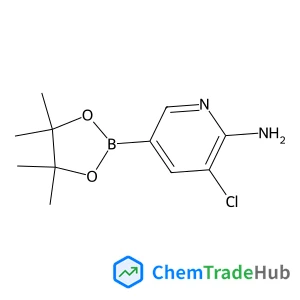
3-Chloro-5-(4,4,5,5-tetramethyl-1,3,2-dioxaborolan-2-yl)-2-pyridinamine
CAS Number:
1032758-99-8
Molecular Formula:
C11H16BClN2O2
Recommended Suppliers






Disclaimer
This page provides academic journal information for reference and research purposes only. We are not affiliated with any journal publishers and do not handle publication submissions. For publication-related inquiries, please contact the respective journal publishers directly.
If you notice any inaccuracies in the information displayed, please contact us at support@chemtradehub.com. We will promptly review and address your concerns.