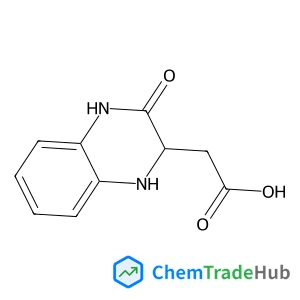
(3-Oxo-1,2,3,4-tetrahydro-2-quinoxalinyl)acetic acid
CAS Number:
136584-14-0
Molecular Formula:
C10H10N2O3
Qian Liu, Shouhai Zhang, Zhaoqi Wang, Jianhua Han, Ce Song, Peiqi Xu, Xu Wang, Shaokui Fu, Xigao Jian
Sulfonated N-heterocyclic poly(aryl ether) proton-exchange membranes have potential applications in the fuel-cell field due to their favorable proton conduction capacity and stability. This paper investigates the changes in mass and performance decay, such as proton conduction and mechanical strength, of sulfonated poly(ether ether ketone)s (SPEEKs) and three sulfonated N-heterocyclic poly(aryl ether ketone) (SPPEK, SPBPEK-P-8, and SPPEKK-P) membranes in Fenton's oxidative experiment. The SPEEK membrane exhibited the worst oxidative stability. The oxidative stability of the SPPEK membrane is enhanced due to the introduction of phthalazinone units in the chains. The SPPEKK-P and SPBPEK-P-8 membranes exhibit better radical tolerance than the SPPEK membrane, with proton conductivity retention rates of 66% and 73% for 1 h oxidative treatment, respectively. In addition, the molecular chains of SPPEKK-P and SPBPEK-P-8 exhibit relatively little disruption. The pendant benzenesulfonic groups enhance the steric effects for reducing radical attacks on the ether bonds and reduce the hydration of molecular chains. The introduction of phthalazinone units decreases the rupture points in the main chain. Therefore, the radical tolerance of the membranes is improved. These results provide a reference for the design of highly stable sulfonated heterocyclic poly(aryl ether) membranes.
DOI: 10.1039/C8CP04625E
Marcelo Goulart, Lorenz Kranabetter, Martin Kuhn, Paul Martini, Norbert Gitzl, Manuel Rainer, Johannes Postler, Paul Scheier, Andrew M. Ellis
DOI: 10.1039/C8CP01273C
Marco Smerieri, Lara Ferrighi, Silvia Nappini, Luca Vaghi, Antonio Papagni, Cristiana Di Valentin, Federica Bondino, Letizia Savio
DOI: 10.1039/C8CP04791J
Zhenzhuo Lan, Shaama Mallikarjun Sharada
DOI: 10.1039/C8CP05096A
Dessalegne A. Tsehay
DOI: 10.1039/C7CP08341F
Jianchang Xu, Shuangqing Sun, Zhikun Wang, Shiyuan Peng, Songqing Hu, Lijuan Zhang
DOI: 10.1039/C8CP00751A
Shmuel Zilberg, Amir Mizrahi, Haya Kornweitz
DOI: 10.1039/C7CP08240A
Abhay N. Singh, Harsha Devnani, Shwetambara Jha, Pravin P. Ingole
DOI: 10.1039/C8CP05170D
Marko Mladenović, Nenad Vukmirović
DOI: 10.1039/C8CP03726D
This compound is mainly used as an intermediate in the synthesis of antipsychoti...
Waste containing 1-(D-Ribofuranosyl)-1,4-dihydro-3-pyridinecarboxamide (CAS: 191...
2-Methyl-2-propanyl 3-bromo-3-(hydroxymethyl)-1-azetidinecarboxylate (CAS: 20079...
N-(4-Chloro-2-pyridinyl)acetamide (CAS: 245056-66-0) is a chemical compound with...
5-Chloro-2-hydroxybenzoic acid, also known as 5-chlorosalicylic acid, is an arom...
When handling 1,1-Dichloro-1-fluoroethane (CAS: 1717-00-6), it is important to u...
Fmoc-(2S,3R)-3-phenylpyrrolidine-2-carboxylic acid is a white crystalline solid ...
4-Amino-5-bromo-2-pyridinecarboxylic acid is primarily used as a precursor in th...
Handling this compound should be done with personal protective equipment (PPE) i...
When handling 8-bromo-2,2-dimethyl-3,4-dihydro-2H-1,4-benzoxazin-3-one, use prop...

Physical Chemistry Chemical Physics (PCCP) is an international journal co-owned by 19 physical chemistry and physics societies from around the world. This journal publishes original, cutting-edge research in physical chemistry, chemical physics and biophysical chemistry. To be suitable for publication in PCCP, articles must include significant innovation and/or insight into physical chemistry; this is the most important criterion that reviewers and Editors will judge against when evaluating submissions. The journal has a broad scope and welcomes contributions spanning experiment, theory, computation and data science. Topical coverage includes spectroscopy, dynamics, kinetics, statistical mechanics, thermodynamics, electrochemistry, catalysis, surface science, quantum mechanics, quantum computing and machine learning. Interdisciplinary research areas such as polymers and soft matter, materials, nanoscience, energy, surfaces/interfaces, and biophysical chemistry are welcomed if they demonstrate significant innovation and/or insight into physical chemistry. Joined experimental/theoretical studies are particularly appreciated when complementary and based on up-to-date approaches.