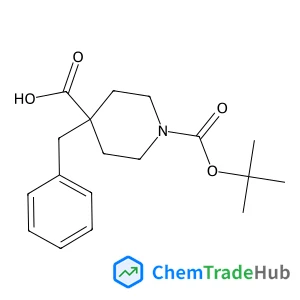
4-Benzyl-1-(tert-butoxycarbonyl)piperidine-4-carboxylic acid
CAS Number:
170838-87-6
Molecular Formula:
C18H25NO4
Pham Vu Nhat, Nguyen Thanh Si, Nguyen Thi Nhat Hang, Minh Tho Nguyen
The onset of the transition from 2D to 3D structures in pure gold clusters remains a matter of continuing debate. In this theoretical study we revisit several planar and non-planar structural motifs of the size Au10 with the aim to clarify this issue. Computations using a long-range corrected exchange–correlation functional LC-BLYP, coupled-cluster theories CCSD(T) and PNO-LCCSD(T)-F12 reveal that, at variance with previous reports on the preference of a planar elongated hexagon, both planar and nonplanar isomers of the neutral Au10 are energetically degenerated up to 300 K. Its 3D equilibrium geometry is a core–shell structure which can be built up from a trigonal prism by capping four extra Au atoms outside. A comparison to the available experimental vibrational spectra allows us to argue that both lowest-lying 2D and 3D isomers of Au10 likely coexist in the molecular beam during measurement of its FIR spectra. This result also suggests that the 2D–3D transition of neutral gold clusters occurs at the size Au10.
Rania S. Seoudi, Annette Dowd, Brian J. Smith, Adam Mechler
DOI: 10.1039/C6CP01355D
Andrea Pannwitz, Oliver S. Wenger
DOI: 10.1039/C6CP00437G
Anna Pougin, Martin Dilla
DOI: 10.1039/C5CP07148H
Rui Li, Miao Zhang, Yingru Li, Ji Chen, Bowen Yao, Mingpeng Yu, Gaoquan Shi
DOI: 10.1039/C6CP00512H
Satoko Hayashi, Yuji Sugibayashi, Waro Nakanishi
DOI: 10.1039/C5CP06062A
Niklas Nilius, Hanna Fedderwitz, Boris Groß, Claudine Noguera, Jacek Goniakowski
DOI: 10.1039/C5CP06933E
Johannes R. Klein, Oliver Flender, Mirko Scholz, Kawon Oum, Thomas Lenzer
DOI: 10.1039/C5CP07167D
Hong-Dan Peng, Jia-Mei Yang, Jing-Hui Yan, Ge-Bo Pan
DOI: 10.1039/C5CP05507E
Yeusy Hartadi, Daniel Widmann, R. Jürgen Behm
DOI: 10.1039/C5CP06888F
Oriol Lamiel-García, Jin Yong Lee, Francesc Illas
DOI: 10.1039/C6CP00912C
This compound is mainly used as an intermediate in the synthesis of antipsychoti...
Waste containing 1-(D-Ribofuranosyl)-1,4-dihydro-3-pyridinecarboxamide (CAS: 191...
2-Methyl-2-propanyl 3-bromo-3-(hydroxymethyl)-1-azetidinecarboxylate (CAS: 20079...
N-(4-Chloro-2-pyridinyl)acetamide (CAS: 245056-66-0) is a chemical compound with...
5-Chloro-2-hydroxybenzoic acid, also known as 5-chlorosalicylic acid, is an arom...
When handling 1,1-Dichloro-1-fluoroethane (CAS: 1717-00-6), it is important to u...
Fmoc-(2S,3R)-3-phenylpyrrolidine-2-carboxylic acid is a white crystalline solid ...
4-Amino-5-bromo-2-pyridinecarboxylic acid is primarily used as a precursor in th...
Handling this compound should be done with personal protective equipment (PPE) i...
When handling 8-bromo-2,2-dimethyl-3,4-dihydro-2H-1,4-benzoxazin-3-one, use prop...

Physical Chemistry Chemical Physics (PCCP) is an international journal co-owned by 19 physical chemistry and physics societies from around the world. This journal publishes original, cutting-edge research in physical chemistry, chemical physics and biophysical chemistry. To be suitable for publication in PCCP, articles must include significant innovation and/or insight into physical chemistry; this is the most important criterion that reviewers and Editors will judge against when evaluating submissions. The journal has a broad scope and welcomes contributions spanning experiment, theory, computation and data science. Topical coverage includes spectroscopy, dynamics, kinetics, statistical mechanics, thermodynamics, electrochemistry, catalysis, surface science, quantum mechanics, quantum computing and machine learning. Interdisciplinary research areas such as polymers and soft matter, materials, nanoscience, energy, surfaces/interfaces, and biophysical chemistry are welcomed if they demonstrate significant innovation and/or insight into physical chemistry. Joined experimental/theoretical studies are particularly appreciated when complementary and based on up-to-date approaches.