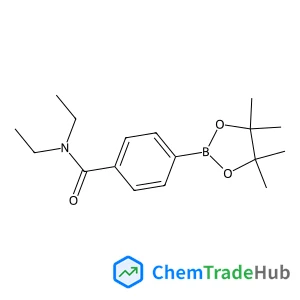
N,N-Diethyl-4-(4,4,5,5-tetramethyl-1,3,2-dioxaborolan-2-yl)benzamide
CAS Number:
325142-99-2
Molecular Formula:
C17H26BNO3
Václav Pokorný, Vojtěch Štejfa, Květoslav Růžička, Ctirad Červinka
Hydrogen bonding in liquids of the constitution isomers of heptan-1-ol mixed with 1-alkyl-3-methylimidazolium bis(trifluoromethylsulfonyl)imide ionic liquids (ILs), [Cnmim][NTf2], is investigated using both computational and experimental techniques. All-atom non-polarizable molecular-dynamics (MD) simulations predict that the hydrogen bonds gradually decay with increasing temperature. This decay is more pronounced for the branched alcohols and in the presence of the ionic liquids. The primary and linear isomer, heptan-1-ol, and its tertiary and bulky analogue 3-ethylpentan-3-ol are identified as the opposite extremes of the spectrum of hydrogen bonding stability in the bulk liquid. While neat heptan-1-ol exhibits strong hydrogen bonding at 350 K, 3-ethylpentan-3-ol is prone to hydrogen bonding decay already at 300 K. The presence of ionic liquids is found to affect the hydrogen bonding comparably as a 50 K temperature increase. Since the heat capacities of the associating liquids are very sensitive to any variation in hydrogen bonding strength and to the character of the hydrogen-bonded clusters in the bulk liquid, the calorimetric effort provides useful experimental data to confirm the results predicted by MD simulations. In this work, excess heat capacity is measured for equimolar single-phase mixtures of alcohols and ILs, and it differs largely in its sign and magnitude for individual heptanol isomers. Temperature trends of the excess heat capacities suggest that the stability of hydrogen bonding for individual heptanol isomers is temperature-shifted, based on their capability of hydrogen bonding. The predicted hierarchy of hydrogen bonding in individual alcohols and its impact on the excess heat capacity trends are qualitatively confirmed via thermodynamic modelling of the associative contribution to the excess heat capacities. These terms are found to predetermine the observed non-monotonous excess heat capacity trends.
Koangyong Hyun, Gasidit Panomsuwan
DOI: 10.1039/C5CP07739G
Xiaojun Li, Pieterjan Claes, Marko Haertelt, Peter Lievens, Ewald Janssens
DOI: 10.1039/C5CP07298K
Zhanglong Liu, Thomas M. Casey, Mandy E. Blackburn, Xi Huang, Linh Pham, Ian Mitchelle S. de Vera, Jeffrey D. Carter, Jamie L. Kear-Scott, Angelo M. Veloro, Luis Galiano, Gail E. Fanucci
DOI: 10.1039/C5CP04556H
Jin-Myoung Lim, Duho Kim, Maenghyo Cho
DOI: 10.1039/C6CP00088F
Satoko Hayashi, Yuji Sugibayashi, Waro Nakanishi
DOI: 10.1039/C5CP06062A
Benjamin W. Toulson, Jonathan P. Alaniz, J. Grant Hill, Craig Murray
DOI: 10.1039/C6CP01063F
Aurélien Bornet, Sami Jannin
DOI: 10.1039/C5CP07884A
Hong-Dan Peng, Jia-Mei Yang, Jing-Hui Yan, Ge-Bo Pan
DOI: 10.1039/C5CP05507E
Elamparuthi Ramasamy, Yohei Ishida, Vaidhyanathan Ramamurthy
DOI: 10.1039/C5CP06984J
This compound is mainly used as an intermediate in the synthesis of antipsychoti...
Waste containing 1-(D-Ribofuranosyl)-1,4-dihydro-3-pyridinecarboxamide (CAS: 191...
2-Methyl-2-propanyl 3-bromo-3-(hydroxymethyl)-1-azetidinecarboxylate (CAS: 20079...
N-(4-Chloro-2-pyridinyl)acetamide (CAS: 245056-66-0) is a chemical compound with...
5-Chloro-2-hydroxybenzoic acid, also known as 5-chlorosalicylic acid, is an arom...
When handling 1,1-Dichloro-1-fluoroethane (CAS: 1717-00-6), it is important to u...
Fmoc-(2S,3R)-3-phenylpyrrolidine-2-carboxylic acid is a white crystalline solid ...
4-Amino-5-bromo-2-pyridinecarboxylic acid is primarily used as a precursor in th...
Handling this compound should be done with personal protective equipment (PPE) i...
When handling 8-bromo-2,2-dimethyl-3,4-dihydro-2H-1,4-benzoxazin-3-one, use prop...

Physical Chemistry Chemical Physics (PCCP) is an international journal co-owned by 19 physical chemistry and physics societies from around the world. This journal publishes original, cutting-edge research in physical chemistry, chemical physics and biophysical chemistry. To be suitable for publication in PCCP, articles must include significant innovation and/or insight into physical chemistry; this is the most important criterion that reviewers and Editors will judge against when evaluating submissions. The journal has a broad scope and welcomes contributions spanning experiment, theory, computation and data science. Topical coverage includes spectroscopy, dynamics, kinetics, statistical mechanics, thermodynamics, electrochemistry, catalysis, surface science, quantum mechanics, quantum computing and machine learning. Interdisciplinary research areas such as polymers and soft matter, materials, nanoscience, energy, surfaces/interfaces, and biophysical chemistry are welcomed if they demonstrate significant innovation and/or insight into physical chemistry. Joined experimental/theoretical studies are particularly appreciated when complementary and based on up-to-date approaches.