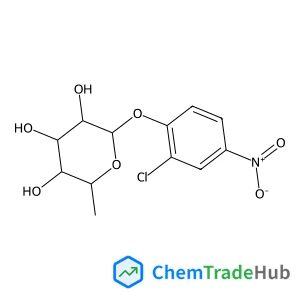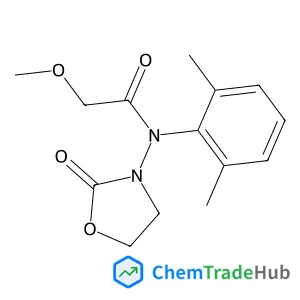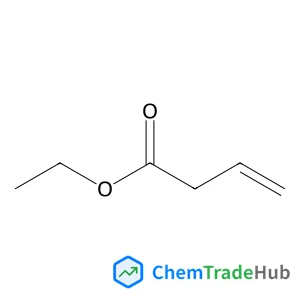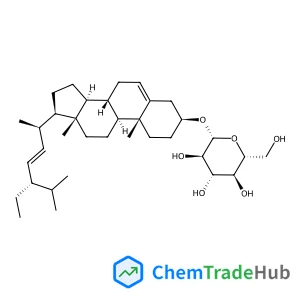
(3beta,22E)-Stigmasta-5,22-dien-3-yl beta-D-glucopyranoside
CAS Number:
19716-26-8
Molecular Formula:
C35H58O6
Karin Seidler, Peter A. Lieberzeit, Franz L. Dickert
Rapid advancements in biotechnology depend on the development of reliable sensing sytems adaptable to a variety of analytes. Molecularly imprinted polymers combined with mass-sensitive devices (10 MHz QCMs) provide a reliable and robust method to observe cell growth and allow cell specifications in real-time. Such biosensors selectively detect fermenting yeast in a complex matrix and 104cells/µl in solution correspond to an adhesion of approximately 3 × 10³cells on the sensor coating. Over a period of up to 40 hours, the growth of the microorganism at 30 °C was observed in various nutrient solutions of glucose, peptone and ammonium sulfate, thereby rendering the determination of optimum growth conditions possible. While almost no change, i.e. no cell propagation, occurred in the absence of glucose, the frequency decreases to more than 700 Hz under rich conditions. Increasing the depth of the imprints to more than 1.5 µm the yeast cells are so strongly bound that they are fixed in the material. With such gravimetric sensors, for instance osmotic effects of cells can be followed by a frequency change of 3 kHz by altering the ion strength by 0.1 M.
Mausumi Mahapatra, David C. Grinter, Fang Xu, Si Luo, Robert M. Palomino, Shyam Kattel, Iradwikanari Waluyo, Ping Liu, Dario J. Stacchiola, Sanjaya D. Senanayake
DOI: 10.1039/C8CP01614C
Shenli Zhang, Haoyan Sha, Ricardo H. R. Castro, Roland Faller
DOI: 10.1039/C8CP02010H
A. S. Dobrota, L. D. Rafailović
DOI: 10.1039/C8CP00992A
DOI: 10.1039/C7CP06554J
Dariusz W. Szczepanik, Miquel Solà, Tadeusz M. Krygowski, Halina Szatylowicz, Marcin Andrzejak, Barbara Pawełek, Justyna Dominikowska, Mercedes Kukułka, Karol Dyduch
DOI: 10.1039/C8CP01108G
Andreas Meyer, Jean Jacques Jassoy, Sebastian Spicher, Andreas Berndhäuser, Olav Schiemann
DOI: 10.1039/C8CP01276H
Nikolay A. Ogurtsov, Valery N. Bliznyuk, Andrii V. Mamykin, Oleksandr L. Kukla, Yuri P. Piryatinski, Alexander A. Pud
DOI: 10.1039/C7CP07604E
Yogajivan Rout, Rajneesh Misra, Rahul Singhal, Subhayan Biswas, Ganesh D. Sharma
DOI: 10.1039/C7CP08308D
Zuzana Limpouchová, Karel Procházka
DOI: 10.1039/C7CP08327K
When handling 2-Chloro-1,2-bis(4-methylphenyl)ethanone (CAS: 71193-32-3), it is ...
4-Ethoxy-3-(5-methyl-4-oxo-7-propyl-1,4-dihydroimidazo[5,1-f][1,2,4]triazin-2-yl...
Methyl 3-Oxo-4-Androsten-17-Carboxylate (CAS: 2681-55-2) should be stored in a c...
(R)-3-Amino-4-(3-hexylphenylamino)-4-oxobutylphosphonic acid is primarily used i...
2-Methyl-2-propanyl 3-amino-3-carbamoyl-1-azetidinecarboxylate (CAS: 1254120-14-...
There are alternative reagents that can be used in synthesis instead of (E)-4-(t...
[2-(3-Chlorophenyl)-1,3-thiazol-4-yl]methanol (CAS: 121202-20-8) is a crystallin...
The market and research trends for Methyl (2S)-[(4S)-2,2-dimethyl-1,3-dioxolan-4...
The market for 1-Bromo-2-isocyanatoethane (CAS: 42865-19-0) is driven by its use...
4-Nitro-D-phenylalanine hydrochloride (CAS: 147065-06-3) is primarily used in re...

Analyst publishes analytical and bioanalytical research that reports premier fundamental discoveries and inventions, and the applications of those discoveries, unconfined by traditional discipline barriers.