


Latent fingerprints analysis using tape-lift, Raman microscopy, and multivariate data analysis methods
Literature Information
Publication Date
2008-12-24
DOI
10.1039/B808259F
Impact Factor
4.616
Authors
Effendi Widjaja
View Original
Abstract
This paper describes the use of combined techniques, i.e. Raman spectral mapping, tape-lift, and multivariate data analysis, to extract chemical information of latent fingerprint and/or trace amounts of materials deposited in fingerprints. The tape-lift method was employed to lift trace particles, extrinsic materials, or sebum deposited on the finger of an individual after recent handling of such materials. The analysis of the tape-lifted materials was performed by Raman spectral mapping at a specific area. The collected mixture Raman spectra containing signals from lifting media and lifted materials was then deconvoluted using a powerful multivariate technique, namely band-target entropy minimization (BTEM). Three cases, i.e. a sebum-rich fingerprint after touching the forehead, a drug model comprising ibuprofen, L-arginine, and sodium bicarbonate, and an additive model comprising sucrose and aspartame were investigated. BTEM could recover all pure component spectra of both lifting media and tape-lifted materials. As such, all these test substances can be correctly identified using their unique pure Raman spectral signatures. In addition, the spatial distributions of all these identified components could also be determined. These combined three techniques hold promise as a new tool in forensic applications.
Recommended Journals

Saudi Pharmaceutical Journal

New Journal of Chemistry

Chemical Communications

Russian Journal of Organic Chemistry

Russian Journal of Applied Chemistry

Current Opinion in Colloid & Interface Science

Chemistry Education Research and Practice

Russian Journal of General Chemistry

Journal of Natural Medicines

Russian Journal of Bioorganic Chemistry
Related Literature
Nitric oxide activation by caa3 oxidoreductase from Thermus thermophilus
Takehiro Ohta, Tewfik Soulimane, Teizo Kitagawa, Constantinos Varotsis
2015-03-23
Paper
DOI: 10.1039/C5CP01013F
Electrolyte ion adsorption and charge blocking effect at the hematite/aqueous solution interface: an electrochemical impedance study using multivariate data analysis
K. Shimizu, J. Nyström, P. Geladi, B. Lindholm-Sethson, J.-F. Boily
2015-03-31
Paper
DOI: 10.1039/C4CP05927A
A THz/FTIR fingerprint of the solvated proton: evidence for Eigen structure and Zundel dynamics
Dominique Decka, Gerhard Schwaab, Martina Havenith
2015-04-10
Paper
DOI: 10.1039/C5CP01035G
Electronic structure of graphene nanoribbons doped with nitrogen atoms: a theoretical insight
A. E. Torres, S. Fomine
2015-03-16
Paper
DOI: 10.1039/C5CP00227C
Outside rules inside: the role of electron-active substituents in thiophene-based heterophenoquinones
L. Brambilla, E. Parisini, C. Castiglioni
2015-02-16
Paper
DOI: 10.1039/C4CP05748A
The role of tryptophans in the UV-B absorption of a UVR8 photoreceptor – a computational study
Qi Wu, Bolong Huang, T. A. Niehaus, Xiaojing Yang, Jun Fan, Rui-Qin Zhang
2015-03-19
Paper
DOI: 10.1039/C4CP06073C
Ion density deviations in semipermeable ionic microcapsules
Qiyun Tang, Alan R. Denton
2015-03-25
Paper
DOI: 10.1039/C5CP00974J
Electron capture dissociation and drift tube ion mobility-mass spectrometry coupled with site directed mutations provide insights into the conformational diversity of a metamorphic protein
Sophie R. Harvey, Massimiliano Porrini, Robert C. Tyler, Cait E. MacPhee, Brian F. Volkman, Perdita E. Barran
2015-03-12
Paper
DOI: 10.1039/C4CP05136J
The study of the electronic structure of some N-heterocyclic carbenes (NHCs) by variable energy photoelectron spectroscopy
Branka Kovač, Ivan Ljubić, Antti Kivimäki, Marcello Coreno, Igor Novak
2015-03-16
Paper
DOI: 10.1039/C5CP00482A
Unraveling the charge transfer/electron transport in mesoporous semiconductive TiO2 films by voltabsorptometry
Christophe Renault, Lionel Nicole, Clément Sanchez, Cyrille Costentin, Véronique Balland, Benoît Limoges
2015-03-17
Paper
DOI: 10.1039/C5CP00023H
You might also like
Compound Q&A
Is 2-(2-chloroacetamido)-3-phenylpropanoic acid (CAS: 7765-11-9) safe?
2-(2-Chloroacetamido)-3-phenylpropanoic acid (CAS: 7765-11-9) is generally consi...
7765-11-92-(2-chloroacetamido...
Compound Q&A
Is 2-(Benzyloxy)-5-bromobenzoic acid (CAS: 62176-31-2) safe?
2-(Benzyloxy)-5-bromobenzoic acid can be handled safely if appropriate precautio...
62176-31-22-(Benzyloxy)-5-brom...
Compound Q&A
What is (4-Methyl-1,2,5-oxadiazol-3-yl)methanamine hydrochloride (CAS: 1159825-48-5)?
(4-Methyl-1,2,5-oxadiazol-3-yl)methanamine hydrochloride is a chemical compound ...
1159825-48-5(4-Methyl-1,2,5-oxad...
Compound Q&A
What is 2-(5-Hexylthiophen-2-yl)-4,4,5,5-tetramethyl-1,3,2-dioxaborolane (CAS: 917985-54-7)?
2-(5-Hexylthiophen-2-yl)-4,4,5,5-tetramethyl-1,3,2-dioxaborolane (CAS: 917985-54...
917985-54-72-(5-Hexylthiophen-2...
Compound Q&A
Are there alternatives to 4-(8-Methyl-9H-1,3-dioxolo[4,5-h][2,3]benzodiazepin-5-yl)benzenamine (CAS: 102771-26-6) in synthesis?
While 4-(8-Methyl-9H-1,3-dioxolo[4,5-h][2,3]benzodiazepin-5-yl)benzenamine (CAS:...
102771-26-64-(8-Methyl-9H-1,3-d...
Compound Q&A
What is the market or research trend for tert-butyl 3-hydroxy-4,5,7,8-tetrahydro-2H-pyrazolo[3,4-d]azepine-6-carboxylate (CAS: 851376-80-2)?
The market for tert-butyl 3-hydroxy-4,5,7,8-tetrahydro-2H-pyrazolo[3,4-d]azepine...
851376-80-2tert-butyl 3-hydroxy...
Compound Q&A
How should waste containing 3,5-Diamino-1H-pyrazole-4-carbonitrile (CAS: 6844-58-2) be handled?
Waste containing 3,5-Diamino-1H-pyrazole-4-carbonitrile (CAS: 6844-58-2) should ...
6844-58-23,5-Diamino-1H-pyraz...
Compound Q&A
How is (6-Fluoro-3-pyridinyl)boronic acid (CAS: 351019-18-6) typically synthesized?
(6-Fluoro-3-pyridinyl)boronic acid can be synthesized through the reaction of 6-...
351019-18-6(6-Fluoro-3-pyridiny...
Compound Q&A
What industries use Dibenzyl carbonimidoylbiscarbamate (CAS: 10065-79-9)?
Dibenzyl carbonimidoylbiscarbamate (CAS: 10065-79-9) finds applications in vario...
10065-79-9Dibenzyl carbonimido...
Compound Q&A
What is the market or research trend for (beta,beta,2,3,4,5,6-~2~H_7_)Phenylalanine (CAS: 74228-83-4)?
The market for (beta,beta,2,3,4,5,6-~2~H_7_)Phenylalanine (CAS: 74228-83-4) is g...
74228-83-4(beta,beta,2,3,4,5,6...
Source Journal
Analyst

CiteScore:
7.8
Self-citation Rate:
5.6%
Articles per Year:
653
Analyst publishes analytical and bioanalytical research that reports premier fundamental discoveries and inventions, and the applications of those discoveries, unconfined by traditional discipline barriers.
Recommended Compounds
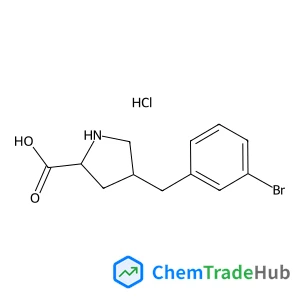
(2S,4R)-4-(3-Bromobenzyl)pyrrolidine-2-carboxylic acid hydrochloride
CAS Number:
1049734-10-2
Molecular Formula:
C12H15BrClNO2
![Ethyl ({[(2-methyl-2-propanyl)oxy]carbonyl}amino)(2-pyridinyl)acetate structure](https://static.chemtradehub.com/structs/313/313490-90-3-dd15.webp "Ethyl ({[(2-methyl-2-propanyl)oxy]carbonyl}amino)(2-pyridinyl)acetate structure")
Ethyl ({[(2-methyl-2-propanyl)oxy]carbonyl}amino)(2-pyridinyl)acetate
CAS Number:
313490-90-3
Molecular Formula:
C14H20N2O4
![19-[Chloro(dideuterio)methyl]-19-deuterio-20,20-dideuteriooxyoctatriacontane-18,21-dione structure](https://static.chemtradehub.com/structs/124/1246818-85-8-6244.webp "19-[Chloro(dideuterio)methyl]-19-deuterio-20,20-dideuteriooxyoctatriacontane-18,21-dione structure")
19-[Chloro(dideuterio)methyl]-19-deuterio-20,20-dideuteriooxyoctatriacontane-18,21-dione
CAS Number:
1246818-85-8
Molecular Formula:
C39H75ClO4
Recommended Suppliers





Disclaimer
This page provides academic journal information for reference and research purposes only. We are not affiliated with any journal publishers and do not handle publication submissions. For publication-related inquiries, please contact the respective journal publishers directly.
If you notice any inaccuracies in the information displayed, please contact us at support@chemtradehub.com. We will promptly review and address your concerns.