


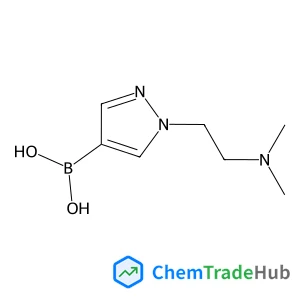
(1-(2-(Dimethylamino)ethyl)-1H-pyrazol-4-yl)boronic acid
CAS Number:
1086063-73-1
Molecular Formula:
C7H14BN3O2
A. E. Torres, S. Fomine
The electronic structure of graphene nanoribbons doped with a graphitic type of nitrogen atoms has been studied using B3LYP, B2PLYP and CAS methods. In all but one case the restricted B3LYP solutions were unstable and the CAS calculations provided evidence for the multiconfigurational nature of the ground state with contributions from two dominant configurations. The relative stability of the doped nanoribbons depends mostly on the mutual position of the dopant atoms and notably less on the position of nitrogen atoms within the nanoribbon. N-graphitic doping affects cationic states much more than anionic ones due the participation of the nitrogen atoms in the stabilization of the positive charge, resulting in a drop in ionization energies (IPs) for N-graphitic doped systems. Nitrogen atoms do not participate in the negative charge stabilization of anionic species and, therefore, the doping does not affect the electron affinities (EAs). The unrestricted B3LYP method is the method of choice for the calculation of IPs and EAs. Restricted B3LYP and B2PLYP produces unreliable results for both IPs and EAs while CAS strongly underestimates the electron affinities. This is also true for the reorganization energies where restricted B3LYP produces qualitatively incorrect results. Doping changes the reorganization energy of the nanoribbons; the hole reorganization energy is generally higher than the corresponding electron reorganization energy due to the participation of nitrogen atoms in the stabilization of the positive charge.

Russian Journal of General Chemistry

Journal of Natural Medicines

Saudi Pharmaceutical Journal

Russian Journal of Applied Chemistry

Organic Process Research & Development

Current Opinion in Solid State & Materials Science

Drug Discovery Today

Russian Chemical Bulletin

Crystallography Reports

Russian Journal of Organic Chemistry
Ning Zhang, Yuechun Song, Xuehua Ruan, Xiaoming Yan, Zhao Liu, Zhuanglin Shen, Xuemei Wu
DOI: 10.1039/C6CP03012B
Bohayra Mortazavi, Alireza Ostadhossein, Timon Rabczuk, Adri C. T. van Duin
DOI: 10.1039/C6CP03612K
Gaobo Yu, Jian Zhou
DOI: 10.1039/C6CP01478J
Claudio F. Narambuena, Fabricio O. Sanchez Varretti, Antonio J. Ramirez-Pastor
DOI: 10.1039/C6CP03924C
Ashley A. Beckstead, Yuyuan Zhang, Mattanjah S. de Vries, Bern Kohler
DOI: 10.1039/C6CP04230A
Shuichi Amino, Elvis Arguelles, Michio Okada
DOI: 10.1039/C6CP02488B
Kasper Mackeprang, Zhen-Hao Xu, Zeina Maroun, Markus Meuwly, Henrik G. Kjaergaard
DOI: 10.1039/C6CP03462D
Oleg Borodin, David L. Price, Bachir Aoun, Miguel A. González, Justin B. Hooper, Maiko Kofu, Osamu Yamamuro
DOI: 10.1039/C6CP02191C
Oleg Kostko, Tyler P. Troy, Biswajit Bandyopadhyay, Musahid Ahmed
DOI: 10.1039/C6CP04916H
DOI: 10.1039/C6CP03938C
2-(2-Chloroacetamido)-3-phenylpropanoic acid (CAS: 7765-11-9) is generally consi...
2-(Benzyloxy)-5-bromobenzoic acid can be handled safely if appropriate precautio...
(4-Methyl-1,2,5-oxadiazol-3-yl)methanamine hydrochloride is a chemical compound ...
2-(5-Hexylthiophen-2-yl)-4,4,5,5-tetramethyl-1,3,2-dioxaborolane (CAS: 917985-54...
While 4-(8-Methyl-9H-1,3-dioxolo[4,5-h][2,3]benzodiazepin-5-yl)benzenamine (CAS:...
The market for tert-butyl 3-hydroxy-4,5,7,8-tetrahydro-2H-pyrazolo[3,4-d]azepine...
Waste containing 3,5-Diamino-1H-pyrazole-4-carbonitrile (CAS: 6844-58-2) should ...
(6-Fluoro-3-pyridinyl)boronic acid can be synthesized through the reaction of 6-...
Dibenzyl carbonimidoylbiscarbamate (CAS: 10065-79-9) finds applications in vario...
The market for (beta,beta,2,3,4,5,6-~2~H_7_)Phenylalanine (CAS: 74228-83-4) is g...

Physical Chemistry Chemical Physics (PCCP) is an international journal co-owned by 19 physical chemistry and physics societies from around the world. This journal publishes original, cutting-edge research in physical chemistry, chemical physics and biophysical chemistry. To be suitable for publication in PCCP, articles must include significant innovation and/or insight into physical chemistry; this is the most important criterion that reviewers and Editors will judge against when evaluating submissions. The journal has a broad scope and welcomes contributions spanning experiment, theory, computation and data science. Topical coverage includes spectroscopy, dynamics, kinetics, statistical mechanics, thermodynamics, electrochemistry, catalysis, surface science, quantum mechanics, quantum computing and machine learning. Interdisciplinary research areas such as polymers and soft matter, materials, nanoscience, energy, surfaces/interfaces, and biophysical chemistry are welcomed if they demonstrate significant innovation and/or insight into physical chemistry. Joined experimental/theoretical studies are particularly appreciated when complementary and based on up-to-date approaches.
![2-[(E)-(2-Methoxyphenyl)diazenyl]-3-oxo-N-(2-oxo-2,3-dihydro-1H-benzimidazol-5-yl)butanamide structure](https://static.chemtradehub.com/structs/821/82199-12-0-f1d0.webp "2-[(E)-(2-Methoxyphenyl)diazenyl]-3-oxo-N-(2-oxo-2,3-dihydro-1H-benzimidazol-5-yl)butanamide structure")

![Ethyl ({[(2-methyl-2-propanyl)oxy]carbonyl}amino)(2-pyridinyl)acetate structure](https://static.chemtradehub.com/structs/313/313490-90-3-dd15.webp "Ethyl ({[(2-methyl-2-propanyl)oxy]carbonyl}amino)(2-pyridinyl)acetate structure")






