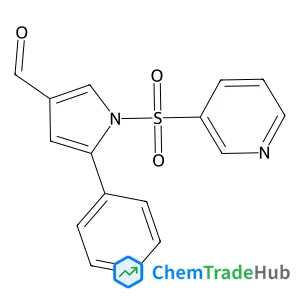
5-Phenyl-1-(pyridin-3-ylsulfonyl)-1H-pyrrole-3-carbaldehyde
CAS Number:
881676-90-0
Molecular Formula:
C16H12N2O3S
Oksana Travnikova, Svante Svensson, Denis Céolin, Zhuo Bao, Maria Novella Piancastelli
In this study linear free energy relationships (LFER) are applied to the relaxation of core-excited states in aliphatic CH3X compounds. There are at least two valence orbitals involved in Auger decay following CCH31s →σ*C–X excitation, which may as well be localized on the substituents in this series. Therefore, the observed property cannot be strictly attached to the so-called reaction center. The behavior of substituent constants in the description of core-hole processes in aliphatic compounds is also checked on C1s ionization potentials for the extended series of substituted methanes. The role of the inductive effect for both resonant Auger kinetic energies (Ek) and C1s binding energies (Ecoreb) is very important. CCH31s →σ*C–X excitation energies do not show any significant correlations with inductive substituent constants. On the contrary, Taft’s inductive parameters alone give good correlations for Ek. A simple model with ‘Z + 1’ approximation is developed to describe Ek and explain the observed correlations:Ek = Ecoreb− (Ev(Z)b + Eea(Z+1)+),where Ebv(Z) is the valence ionization potential for CH3X and Eea(Z+1)+ is the electron affinity for [NH3X]+.
Longhe Zhang, Lydia R. Cool, Chrys Wesdemiotis, R. A. Weiss, Kevin A. Cavicchi
DOI: 10.1039/C4PY90062F
Ester Abtew, Abraham J. Domb, Arijit Basu
DOI: 10.1039/C6PY00858E
Yi Xia, Rui Wang, Hui Qin, Yi Zhang, Lang Ma, Hong Tan, Zhongwei Gu
DOI: 10.1039/C4PY00870G
Shreya Roy Choudhury
DOI: 10.1039/C6PY00539J
Zhijun Ruan, Wenhui Rong, Xuejun Zhan, Qianqian Li, Zhen Li
DOI: 10.1039/C4PY00555D
Yi Zeng, Peng Li, Xinyang Liu, Tianjun Yu, Jinping Chen, Guoqiang Yang, Yi Li
DOI: 10.1039/C4PY00714J
Shotaro Ito, Raita Goseki, Takashi Ishizone
DOI: 10.1039/C4PY00584H
When considering alternatives to 1-(4-Chlorophenyl)-N-hydroxymethanimine (CAS: 3...
This compound should be stored in a cool, dry place away from direct sunlight. I...
3-(4-Bromophenyl)-5-(2-fluorophenyl)-1,2,4-oxadiazole is synthesized through a m...
5-Chloro-2-(4-chlorophenyl)-4-methyl-6-[3-(1-piperidinyl)propoxy]pyrimidine (CAS...
2-Chloro-4-(difluoromethoxy)pyridine is used in the pharmaceutical industry for ...
3-Chloro-6-methylpyridazine (CAS: 1121-79-5) is classified under the Globally Ha...
Several alternatives can be used in the synthesis of Methyl 4,5-dimethyl-2-nitro...
Alternatives to (2E,2'E)-3,3'-(1,4-Phenylene)bisacrylaldehyde include other acry...
3-Amino-5-chloropyridin-2-ol hydrochloride is an organic compound with the CAS n...
When handling 6,7-Difluoro-2,3-dihydro-4H-chromen-4-one, it is essential to wear...

Physical Chemistry Chemical Physics (PCCP) is an international journal co-owned by 19 physical chemistry and physics societies from around the world. This journal publishes original, cutting-edge research in physical chemistry, chemical physics and biophysical chemistry. To be suitable for publication in PCCP, articles must include significant innovation and/or insight into physical chemistry; this is the most important criterion that reviewers and Editors will judge against when evaluating submissions. The journal has a broad scope and welcomes contributions spanning experiment, theory, computation and data science. Topical coverage includes spectroscopy, dynamics, kinetics, statistical mechanics, thermodynamics, electrochemistry, catalysis, surface science, quantum mechanics, quantum computing and machine learning. Interdisciplinary research areas such as polymers and soft matter, materials, nanoscience, energy, surfaces/interfaces, and biophysical chemistry are welcomed if they demonstrate significant innovation and/or insight into physical chemistry. Joined experimental/theoretical studies are particularly appreciated when complementary and based on up-to-date approaches.