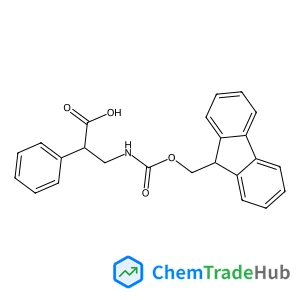
(S)-3-((((9H-Fluoren-9-yl)methoxy)carbonyl)amino)-2-phenylpropanoic acid
CAS Number:
1217663-60-9
Molecular Formula:
C24H21NO4
Shreya Roy Choudhury
Olefin cross-metathesis (CM) has been shown to be a versatile, mild, modular, and efficient approach to polysaccharide modification. One issue with regard to this approach is the susceptibility of the initial α,β-unsaturated CM derivatives to H-atom abstraction in the γ-position, followed by radical recombination that leads to insoluble, crosslinked products. In our original approach, we resolved this problem through removing the offending unsaturation by hydrogenation. In the current study, we describe a method to exploit these reactive conjugated olefins, by post-CM thiol-Michael addition, thereby appending additional functionality. CM substrates and thiols bearing various functional groups were combined and reacted, employing amine catalysis. Up to 100% conversion was achieved under proper conditions (e.g. catalyst and reaction time), with minimal side reactions observed. The combination of the two modular reactions creates versatile access to cellulose derivatives equipped with a wide diversity of functional groups.
Robert P. Lynch, Nathan Quill, Shohei Nakahara, D. Noel Buckley
DOI: 10.1039/C3CP52253A
Tetsuhiro Kudo, Hajime Ishihara
DOI: 10.1039/C3CP51969D
Mengjiao Cheng, Chao Jiang, Zhiyi Ding, Yajun Zhang, Yu Fu, Feng Shi
DOI: 10.1039/C3CP52217B
Daniel R. Albert, H. Floyd Davis
DOI: 10.1039/C3CP51930A
Murad J. Y. Tayebjee, Raphaël G. C. R. Clady, Timothy W. Schmidt
DOI: 10.1039/C3CP52609G
Masato Morita, Kaito Takahashi
DOI: 10.1039/C3CP51903A
João Pina, J. Seixas de Melo, D. Breusov, Ullrich Scherf
DOI: 10.1039/C3CP52056K
Divya Nayar, Charusita Chakravarty
DOI: 10.1039/C3CP51114F
Rita Nissim, Richard G. Compton
DOI: 10.1039/C3CP51732B
When considering alternatives to 1-(4-Chlorophenyl)-N-hydroxymethanimine (CAS: 3...
This compound should be stored in a cool, dry place away from direct sunlight. I...
3-(4-Bromophenyl)-5-(2-fluorophenyl)-1,2,4-oxadiazole is synthesized through a m...
5-Chloro-2-(4-chlorophenyl)-4-methyl-6-[3-(1-piperidinyl)propoxy]pyrimidine (CAS...
2-Chloro-4-(difluoromethoxy)pyridine is used in the pharmaceutical industry for ...
3-Chloro-6-methylpyridazine (CAS: 1121-79-5) is classified under the Globally Ha...
Several alternatives can be used in the synthesis of Methyl 4,5-dimethyl-2-nitro...
Alternatives to (2E,2'E)-3,3'-(1,4-Phenylene)bisacrylaldehyde include other acry...
3-Amino-5-chloropyridin-2-ol hydrochloride is an organic compound with the CAS n...
When handling 6,7-Difluoro-2,3-dihydro-4H-chromen-4-one, it is essential to wear...

Polymer Chemistry welcomes submissions in all areas of polymer science that have a strong focus on macromolecular chemistry. Manuscripts may cover a broad range of fields, yet no direct application focus is required.