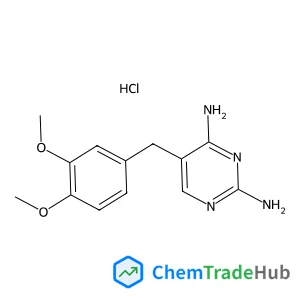
5-(3,4-Dimethoxybenzyl)-2,4-pyrimidinediamine hydrochloride (1:1)
CAS Number:
2507-23-5
Molecular Formula:
C13H17ClN4O2
Zhijun Ruan, Wenhui Rong, Xuejun Zhan, Qianqian Li, Zhen Li
For the first time, POSS moieties were introduced into an organometallic polymer to aid the formation of stable Co nanoparticles through the solid-state pyrolysis process. For comparison, its analogue without POSS groups (P1-Co) was also prepared. The results demonstrated that the introduction of POSS groups into the polymer (P2-Co) could effectively hinder cobalt nanoparticles from sintering into larger particles, even at high pyrolysis temperatures. Particularly, the silicon–oxygen cage of the POSS groups could be converted into SiOx, which covered on the surface of cobalt particles after pyrolysis. Thus, the obtained nanospheres had a unique Co@C–SiOx architecture with a much smaller and uniform size (∼8 nm), while the size of Co nanoparticles derived from P1-Co was in the range of 30 to 80 nm.

Russian Journal of Bioorganic Chemistry

Current Opinion in Colloid & Interface Science

Russian Journal of Applied Chemistry

Russian Journal of General Chemistry

Chemical Communications

Saudi Pharmaceutical Journal

Journal of Natural Medicines

Nature Medicine

Acta Materialia

Russian Journal of Coordination Chemistry
Je Hyun Bae, Yang-Rae Kim, R. Soyoung Kim, Taek Dong Chung
DOI: 10.1039/C3CP50175B
Ahmad Fahs, Guy Louarn
DOI: 10.1039/C3CP51007G
Deya Das, Seungchul Kim, Kwang-Ryeol Lee, Abhishek K. Singh
DOI: 10.1039/C3CP52891J
Muruganathan Ramanathan, Lok Kumar Shrestha, Qingmin Ji
DOI: 10.1039/C3CP50620G
Dae Sung Chung, Il Kang, Yun-Hi Kim, Soon-Ki Kwon
DOI: 10.1039/C3CP52422A
Tim B. van Driel, Jan Kehres, Kristoffer Haldrup, Dmitry Khakhulin, Klaus Bechgaard, Marco Cammarata, Michael Wulff, Thomas Just Sørensen, Martin M. Nielsen
DOI: 10.1039/C3CP50751C
Yungang Zhou, Chengfei Yang, Xia Xiang, Xiaotao Zu
DOI: 10.1039/C3CP51518D
Erik C. Neyts, Umedjon Khalilov, Bart Partoens
DOI: 10.1039/C3CP51621K
Bruce F. Milne, Patrick Norman, Fernando Nogueira, Cláudia Cardoso
DOI: 10.1039/C3CP52528G
Sarah Jaber, Pamela Nasr, Yan Xin, Fatima Sleem, Lara I. Halaoui
DOI: 10.1039/C3CP51061A
When considering alternatives to 1-(4-Chlorophenyl)-N-hydroxymethanimine (CAS: 3...
This compound should be stored in a cool, dry place away from direct sunlight. I...
3-(4-Bromophenyl)-5-(2-fluorophenyl)-1,2,4-oxadiazole is synthesized through a m...
5-Chloro-2-(4-chlorophenyl)-4-methyl-6-[3-(1-piperidinyl)propoxy]pyrimidine (CAS...
2-Chloro-4-(difluoromethoxy)pyridine is used in the pharmaceutical industry for ...
3-Chloro-6-methylpyridazine (CAS: 1121-79-5) is classified under the Globally Ha...
Several alternatives can be used in the synthesis of Methyl 4,5-dimethyl-2-nitro...
Alternatives to (2E,2'E)-3,3'-(1,4-Phenylene)bisacrylaldehyde include other acry...
3-Amino-5-chloropyridin-2-ol hydrochloride is an organic compound with the CAS n...
When handling 6,7-Difluoro-2,3-dihydro-4H-chromen-4-one, it is essential to wear...

Polymer Chemistry welcomes submissions in all areas of polymer science that have a strong focus on macromolecular chemistry. Manuscripts may cover a broad range of fields, yet no direct application focus is required.