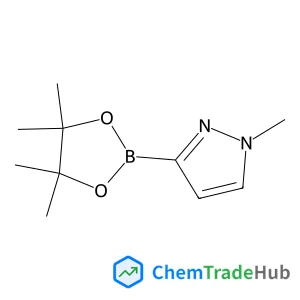
1-Methyl-3-(4,4,5,5-tetramethyl-1,3,2-dioxaborolan-2-yl)-1H-pyrazole
CAS Number:
1020174-04-2
Molecular Formula:
C10H17BN2O2
Denis Damiron, Thierry Hamaide, Jean-Pierre Pascault, Etienne Fleury, Eric Drockenmuller
A novel step growth polymerization A–B strategy based on the click chemistry polyaddition of tailor-made α-azide-ω-alkyne low molar mass monomers was developed, leading to polytriazole (co)polymers with tunable structures and properties.
Yan-E Liu, Ye Zhou, Xiao-Yu Li, Jun Yao, Qiu-Xia Li, Quan-Qing Xu, Rong-Rong Zhu, Ai-Xin Zhu
DOI: 10.1039/D3NJ03489E
Gurjaspreet Singh, Sushma, Priyanka, Anita Devi, Tamana, Harshbir Kaur, Mithun, Jandeep Singh, Gurleen Singh
DOI: 10.1039/D3NJ03436D
Chang Shu, Yadong Chen, Zhenzhen Zhang, Yuqing Lei, Jiajia Xu, Weiwei Lao, Qingping Xi, Qiang Sun, Xiaojun Li, Hongbing Liao, Qiaojie Luo, Xiaodong Li
DOI: 10.1039/D3TB02083E
K. Scanda, Y. Avila, L. Sánchez, R. Mojica, M. González, B. D. Moreno, Manuel Avila, E. Reguera
DOI: 10.1039/D3NJ04638A
Yan Li, Lina Geng, Zhiyi Song, Zhiqiang Zhang
DOI: 10.1039/D3NJ04532C
Khushbu Rajput, Vishal Singh, Arsala Kamal, Himanshu Kumar Singh, Sundaram Singh, Vandana Srivastava
DOI: 10.1039/D3NJ04374F
Pramod A. Koyale, Swapnajit V. Mulik, Yash G. Kapdi, Saurabh S. Soni, Sagar D. Delekar
DOI: 10.1039/D3NJ04205G
Qiaolin Guo, Xiang Liu, Changwang Ke, Xiaofei Yang
DOI: 10.1039/D3NJ04235A
ShiQuan Wu, Li Li, QiQi Liang, HuaXu Gao, TianYu Tang, YanLin Tang
DOI: 10.1039/D3NJ02866F
Weiping Wang, Fengxiao Li, Jiaqi Fan, Shuo Gan, Jiaming Zhang, Tianhong Zhang
DOI: 10.1039/D3NJ04120D
When handling 4-(2-Furylmethyl)thiomorpholine 1,1-dioxide (CAS: 79206-94-3), it ...
When handling 4-Chloro-N-[2-(4-morpholinyl)ethyl]benzamide (CAS: 71320-77-9), it...
Waste containing this compound (CAS: 62921-74-8) should be handled according to ...
Waste containing (S)-Methyl 2-amino-3-cyclohexylpropanoate should be collected i...
This compound can be synthesized using a multi-step process involving the conjug...
There are several alternatives to (2E)-3-(3,4-Dichlorophenyl)acrylic acid in syn...
Ethyl 6-(2-nitrophenyl)imidazo[2,1-b][1,3]thiazole-3-carboxylate (CAS: 925437-84...
Waste containing 2-(1,3-Thiazol-2-yl)ethanamine (CAS: 18453-07-1) should be coll...
Methyl 5-iodo-2-methylbenzoate can be synthesized through the iodination of meth...
5-Chloro[1,2,4]triazolo[1,5-a]pyridine is commonly synthesized via the condensat...

ChemComm publishes urgent research which is of outstanding significance and interest to experts in the field, while also appealing to the journal’s broad chemistry readership. Our communication format is ideally suited to short, urgent studies that are of such importance that they require accelerated publication. Our scope covers all topics in chemistry, and research at the interface of chemistry and other disciplines (such as materials science, nanoscience, physics, engineering and biology) where there is a significant novelty in the chemistry aspects. Major topic areas covered include: Analytical Chemistry Catalysis Chemical Biology and medicinal chemistry Computational Chemistry and Machine Learning Energy and sustainable chemistry Environmental Chemistry Green Chemistry Inorganic Chemistry Materials Chemistry Nanoscience Organic Chemistry Physical Chemistry Polymer Chemistry Supramolecular Chemistry