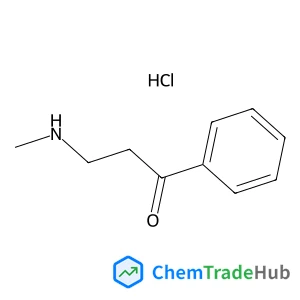
3-(Methylamino)-1-phenyl-1-propanone hydrochloride (1:1)
CAS Number:
2538-50-3
Molecular Formula:
C10H14ClNO
Weiping Wang, Fengxiao Li, Jiaqi Fan, Shuo Gan, Jiaming Zhang, Tianhong Zhang
A novel leucine carbamate prodrug (3-L) has been synthesized to improve the low oral bioavailability of cycloicaritin. To assess the pharmacokinetic properties of the prodrug, a selective, sensitive and reliable liquid chromatography-tandem mass spectrometry (LC–MS/MS) method for the simultaneous determination of cycloicaritin and its carbamate prodrug 3-L in rat plasma with daidzein as internal standard was developed and validated. Ethanoic acid was added to plasma samples to maintain the stability of the prodrug. The samples were prepared employing a liquid–liquid extraction (LLE) method using tert-butyl methyl ether in a low plasma sample volume of 25 μL, and then separated on an ACE Excel 2 C18-Amide column (50 mm × 2.1 mm, 2 μm) by gradient elution at a flow rate of 0.4 mL min−1. A triple quadrupole tandem mass spectrometer system with a positive ESI interface was used for quantification in multiple reaction monitoring (MRM) mode. Cycloicaritin and 3-L both showed excellent linearity over the concentration range of 1–2000 ng mL−1 (r ≥ 0.995), with a lower limit of quantification of 1 ng mL−1. The accuracy varied from −5.2% to 14% for all analytes, and the intra- and inter-day precision was less than 14% across quality control levels. The method described herein was successfully applied to the pharmacokinetic study of orally administered 3-L in rats.
Saurabh Singh, Mohita Upadhyay, Jyoti Sharma, Shalini Gupta, Perumal Vivekanandan, Ravikrishnan Elangovan
DOI: 10.1039/C6AN00291A
Golbarg Mohammadi Roozbahani, Youwen Zhang, Xiaohan Chen, Mona Hoseini Soflaee, Xiyun Guan
DOI: 10.1039/C9AN01784D
Bingbing Gao, Xin Li, Yaqiong Yang, Jianlin Chu, Bingfang He
DOI: 10.1039/C9AN01275C
Nirmal Goswami, Huang-Hao Yang, Jianping Xie
DOI: 10.1039/C6AN00773B
Bao-Ying Wen, Xi Jin, Yue Li, Ya-Hao Wang, Chao-Yu Li, Miao-Miao Liang, Rajapandiyan Panneerselvam, Qing-Chi Xu, De-Yin Wu, Zhi-Lin Yang, Jian-Feng Li, Zhong-Qun Tian
DOI: 10.1039/C6AN90033J
Liqing Gu, Renã A. S. Robinson
DOI: 10.1039/C6AN00417B
Timothy P. Cleland, G. Asher Newsome, R. Eric Hollinger
DOI: 10.1039/C9AN01557D
Qi Kang, Dazhong Shen, Yunqing Wang
DOI: 10.1039/C9AN01694E
Alain Wuethrich, Aswin Raj Rajkumar, Karthik Balaji Shanmugasundaram, Kamil K. Reza, Shuvashis Dey, Christopher B. Howard
DOI: 10.1039/C9AN01450K
When handling 4-(2-Furylmethyl)thiomorpholine 1,1-dioxide (CAS: 79206-94-3), it ...
When handling 4-Chloro-N-[2-(4-morpholinyl)ethyl]benzamide (CAS: 71320-77-9), it...
Waste containing this compound (CAS: 62921-74-8) should be handled according to ...
Waste containing (S)-Methyl 2-amino-3-cyclohexylpropanoate should be collected i...
This compound can be synthesized using a multi-step process involving the conjug...
There are several alternatives to (2E)-3-(3,4-Dichlorophenyl)acrylic acid in syn...
Ethyl 6-(2-nitrophenyl)imidazo[2,1-b][1,3]thiazole-3-carboxylate (CAS: 925437-84...
Waste containing 2-(1,3-Thiazol-2-yl)ethanamine (CAS: 18453-07-1) should be coll...
Methyl 5-iodo-2-methylbenzoate can be synthesized through the iodination of meth...
5-Chloro[1,2,4]triazolo[1,5-a]pyridine is commonly synthesized via the condensat...

NJC (New Journal of Chemistry) is a broad-based primary journal encompassing all branches of chemistry and its sub-disciplines. It contains full research articles, communications, perspectives and focus articles. This well-established journal, owned by the Centre National de la Recherche Scientifique (CNRS) of France, has been co-published with the Royal Society of Chemistry since January 1998. NJC is the forum for the publication of high-quality, original and significant work that opens new directions in chemistry or other scientific disciplines. In addition to having a significant chemical component, work published in NJC must demonstrate that it will have an impact on areas of research other than that of the reported work.