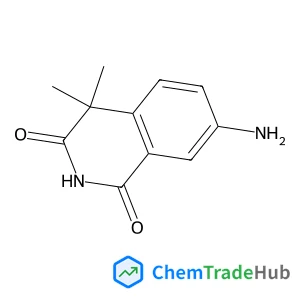
1,3(2H,4H)-Isoquinolinedione, 7-amino-4,4-dimethyl-
CAS Number:
14576-22-8
Molecular Formula:
C11H12N2O2
Dattatraya H. Dethe, David Y.-K. Chen
Total syntheses of the thiopeptide antibiotics amythiamicins A, B and C are reported.
Ruixue Chang, Heng An, Xu Li, Ruyi Zhou, Jianglei Qin, Yuelan Tian, Kuilin Deng
DOI: 10.1039/C6PY02122K
Gérald Lopez, Marc Guerre, Bruno Améduri, Jean-Pierre Habas, Vincent Ladmiral
DOI: 10.1039/C7PY00580F
Bin Li, Xiu-jun Liu, Liang Li, Sheng-hua Zhang, Yi Li, Dian-dong Li, Yong-su Zhen
DOI: 10.1039/C4PY00532E
DOI: 10.1039/C4PY00829D
Nicholas Ballard, Miren Aguirre, Alexandre Simula, Jose R. Leiza, José M. Asua
DOI: 10.1039/C7PY00067G
Kai Zhang, Jiyu Fan, Michael J. Monteiro, Zhongfan Jia
DOI: 10.1039/C7PY00151G
Chen Gao, Liwei Wang, Xiaoyu Li
DOI: 10.1039/C4PY00389F
T. Suzuki, T. Moriya, R. Endo, N. Iwasaki
DOI: 10.1039/C6PY02036D
Feiyan Zhu, Yongri Liang, Fuxin Liang, Qian Wang, Jiaoli Li, Zhibo Li, Zhenzhong Yang
DOI: 10.1039/C4PY00686K
Wei Wu, Qiujing Zhang, Jiantao Wang, Miao Chen, Shuai Li, Zaifu Lin, Jianshu Li
DOI: 10.1039/C4PY00575A
4-Nitrophenyl phosphate disodium salt hexahydrate is primarily used as a substra...
2-(Trifluoromethyl)-1,3-oxazole-4-carboxylic Acid (CAS: 1060816-01-4) is widely ...
2-Fluoro-4-biphenylcarboxylic acid should be stored in a cool, dry place at room...
Prednisolone-21-Carboxylic Acid is primarily used in the pharmaceutical industry...
4-(Hydrazinomethyl)-1,2,3-benzenetriol (CAS: 3614-72-0) should be stored in a co...
4-Amino-1-methyl-1H-pyrazole-5-carboxylic acid hydrochloride (CAS: 92534-70-8) i...
Dehydropachymic acid (CAS: 77012-31-8) is regulated by various agencies. It fall...
The market and research trends for 6-[(2,2-Dimethylpropanoyl)amino]nicotinic aci...
1,10-Phenanthroline-2,9-dicarbaldehyde should be stored in a cool, dry place awa...
5-Carbamoyl-11-oxo-10,11-dihydro-5H-dibenzo[b,f]azepin-10-yl acetate can be synt...

ChemComm publishes urgent research which is of outstanding significance and interest to experts in the field, while also appealing to the journal’s broad chemistry readership. Our communication format is ideally suited to short, urgent studies that are of such importance that they require accelerated publication. Our scope covers all topics in chemistry, and research at the interface of chemistry and other disciplines (such as materials science, nanoscience, physics, engineering and biology) where there is a significant novelty in the chemistry aspects. Major topic areas covered include: Analytical Chemistry Catalysis Chemical Biology and medicinal chemistry Computational Chemistry and Machine Learning Energy and sustainable chemistry Environmental Chemistry Green Chemistry Inorganic Chemistry Materials Chemistry Nanoscience Organic Chemistry Physical Chemistry Polymer Chemistry Supramolecular Chemistry