


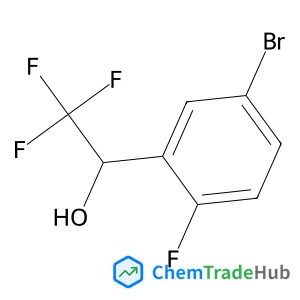
1-(5-Bromo-2-fluorophenyl)-2,2,2-trifluoroethanol
CAS Number:
1039827-16-1
Molecular Formula:
C8H5BrF4O
Devaraj Ramasamy, Narendar Nasani, Ana D. Brandão, Domingo Pérez Coll, Duncan P. Fagg
The current work demonstrates how tailoring the transport properties of thin ceria-based buffer layers in solid oxide fuel or electrolyser cells can provide the necessary phase stability against chemical interaction at the electrolyte/electrode interface, while also providing radical improvements in the electrochemical performance of the oxygen electrode. Half cells of Ce0.8R0.2O2−δ + 2 mol% Co buffer layers (where R = Gd, Pr) with Nd2NiO4+δ electrodes were fabricated by spin coating on dense YSZ electrolyte supports. Dramatic decreases in polarization resistance, Rp, of up to an order of magnitude, could be achieved in the order, Pr ≪ Gd < no buffer layer. The current article shows how this improvement can be related to increased levels of ambipolar conductivity in the mixed conducting buffer layer, which provides an additional parallel path for electrochemical reaction. This is an important breakthrough as it shows how electrode polarization resistance can be substantially improved, in otherwise identical electrochemical cells, solely by tailoring the transport properties of thin intermediate buffer layers.

Organic Process Research & Development

Chemical Communications

Journal of Peptide Science

Russian Journal of Organic Chemistry

Russian Chemical Bulletin

Journal of Natural Medicines

Russian Journal of Applied Chemistry

Russian Journal of Coordination Chemistry

Chemistry Education Research and Practice

New Journal of Chemistry
Moirangthem Kiran Singh, Him Shweta, Mohammad Firoz Khan, Sobhan Sen
DOI: 10.1039/C6CP01201A
Ximena Zarate, Francisca Claveria-Cadiz, David Arias-Olivares, Angela Rodriguez-Serrano, Natalia Inostroza, Eduardo Schott
DOI: 10.1039/C6CP04662B
Mei-Yan Tse, Jianhua Hao
DOI: 10.1039/C6CP02236G
Sujeet Dutta, Ronan Lefort, Denis Morineau, Ramona Mhanna, Odile Merdrignac-Conanec, Arnaud Saint-Jalmes, Théo Leclercq
DOI: 10.1039/C6CP01587E
Xiangze Zeng, Bin Li, Qin Qiao, Lizhe Zhu, Zhong-Yuan Lu
DOI: 10.1039/C6CP01808D
Muhammad Ali Hashmi
DOI: 10.1039/C6CP04828E
Gaobo Yu, Jian Zhou
DOI: 10.1039/C6CP01478J
David Shai Ellis, Hen Dotan, Avner Rothschild
DOI: 10.1039/C6CP04683E
Chul Ho Park, Sung Jo Kwak, Joo-Youn Nam, Moon Seok Jang, Jung-Hyun Lee
DOI: 10.1039/C6CP03939A
2-(2-Chloroacetamido)-3-phenylpropanoic acid (CAS: 7765-11-9) is generally consi...
2-(Benzyloxy)-5-bromobenzoic acid can be handled safely if appropriate precautio...
(4-Methyl-1,2,5-oxadiazol-3-yl)methanamine hydrochloride is a chemical compound ...
2-(5-Hexylthiophen-2-yl)-4,4,5,5-tetramethyl-1,3,2-dioxaborolane (CAS: 917985-54...
While 4-(8-Methyl-9H-1,3-dioxolo[4,5-h][2,3]benzodiazepin-5-yl)benzenamine (CAS:...
The market for tert-butyl 3-hydroxy-4,5,7,8-tetrahydro-2H-pyrazolo[3,4-d]azepine...
Waste containing 3,5-Diamino-1H-pyrazole-4-carbonitrile (CAS: 6844-58-2) should ...
(6-Fluoro-3-pyridinyl)boronic acid can be synthesized through the reaction of 6-...
Dibenzyl carbonimidoylbiscarbamate (CAS: 10065-79-9) finds applications in vario...
The market for (beta,beta,2,3,4,5,6-~2~H_7_)Phenylalanine (CAS: 74228-83-4) is g...

Physical Chemistry Chemical Physics (PCCP) is an international journal co-owned by 19 physical chemistry and physics societies from around the world. This journal publishes original, cutting-edge research in physical chemistry, chemical physics and biophysical chemistry. To be suitable for publication in PCCP, articles must include significant innovation and/or insight into physical chemistry; this is the most important criterion that reviewers and Editors will judge against when evaluating submissions. The journal has a broad scope and welcomes contributions spanning experiment, theory, computation and data science. Topical coverage includes spectroscopy, dynamics, kinetics, statistical mechanics, thermodynamics, electrochemistry, catalysis, surface science, quantum mechanics, quantum computing and machine learning. Interdisciplinary research areas such as polymers and soft matter, materials, nanoscience, energy, surfaces/interfaces, and biophysical chemistry are welcomed if they demonstrate significant innovation and/or insight into physical chemistry. Joined experimental/theoretical studies are particularly appreciated when complementary and based on up-to-date approaches.
![Heptadecanoic Acid 3-[2-[4-(6-Fluoro-1,2-benzisoxazol-3-yl)-1-piperidinyl]ethyl]-6,7,8,9-tetrahydro-2-methyl-4-oxo-4H-pyrido[1,2-a]pyrimidin-9-yl Ester structure](https://static.chemtradehub.com/structs/140/1404053-62-8-9da4.webp "Heptadecanoic Acid 3-[2-[4-(6-Fluoro-1,2-benzisoxazol-3-yl)-1-piperidinyl]ethyl]-6,7,8,9-tetrahydro-2-methyl-4-oxo-4H-pyrido[1,2-a]pyrimidin-9-yl Ester structure")
![3-[4-(difluoromethoxy)phenyl]-2-({[(9H-fluoren-9-yl)methoxy]carbonyl}amino)propanoic acid structure](https://static.chemtradehub.com/structs/149/1496564-27-2-952e.webp "3-[4-(difluoromethoxy)phenyl]-2-({[(9H-fluoren-9-yl)methoxy]carbonyl}amino)propanoic acid structure")





