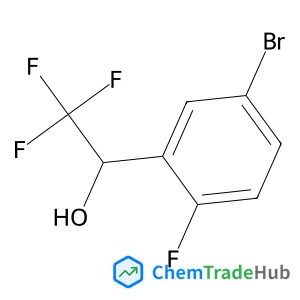
1-(5-Bromo-2-fluorophenyl)-2,2,2-trifluoroethanol
CAS Number:
1039827-16-1
Molecular Formula:
C8H5BrF4O
Sergei Izvekov, Betsy M. Rice
In this work we demonstrate from first principles that the shear frictions describing dissipative forces in the direction normal to the vector connecting the coarse-grained (CG) particles in dissipative particle dynamics (DPD) could be dominant for certain real molecular liquids at high-resolution coarse-graining. This is in contrast to previous works on bottom-up DPD modeling and indicates that such liquids cannot be simulated accurately using the conventional form of DPD which relies only on frictions in the radial direction. Specifically, we describe the development of fully bottom-up CG models for liquid hexahydro-1,3,5-trinitro-s-triazine (RDX) which are incorporated into the DPD method. Consistent with the microscopic foundation of DPD dynamics, the conservative part of the DPD models is obtained by the multi-scale coarse-graining (MS-CG) approach, which implements the pairwise decomposition of the atomistic potential of mean force (PMF) in CG coordinates. The radial and shear distant-dependent friction coefficients in a parameter-free form are derived systematically from microscopic velocity and force correlation data along system trajectories using a recently proposed approach [J. Chem. Phys., 2014, 140, 104104]. The shear dissipative forces for the reported system appear to be dominant. We discuss the implications of dominant shear dissipation on dynamical and transport properties of CG liquids such as diffusion and viscosity as revealed by simulations of liquid RDX using the new MS-CG/DPD models.
Claudia Caddeo, Claudio Melis, Maria Ilenia Saba, Alessio Filippetti, Luciano Colombo, Alessandro Mattoni
DOI: 10.1039/C6CP04246E
Kasper Mackeprang, Zhen-Hao Xu, Zeina Maroun, Markus Meuwly, Henrik G. Kjaergaard
DOI: 10.1039/C6CP03462D
Gaobo Yu, Jian Zhou
DOI: 10.1039/C6CP01478J
Vasileios K. Michalis, Ioannis N. Tsimpanogiannis, Athanassios K. Stubos, Ioannis G. Economou
DOI: 10.1039/C6CP04647A
Aiyi Dong, Qiang Fu, Hao Wu, Mingming Wei, Xinhe Bao
DOI: 10.1039/C6CP03660K
Sujeet Dutta, Ronan Lefort, Denis Morineau, Ramona Mhanna, Odile Merdrignac-Conanec, Arnaud Saint-Jalmes, Théo Leclercq
DOI: 10.1039/C6CP01587E
Mrinal Ghosh, Shaibal Banerjee, Md Abdul Shafeeuulla Khan, Nirmala Sikder, Arun Kanti Sikder
DOI: 10.1039/C6CP02185A
Yanli Zeng, Xiaoyan Li, Zheng Sun, Lingpeng Meng
DOI: 10.1039/C6CP03713E
Wai Kit Tang, Han Zhang, Chi-Kit Siu
DOI: 10.1039/C6CP03324E
Ramachandran Rakhi, Cherumuttathu H. Suresh
DOI: 10.1039/C6CP03723B
2-(2-Chloroacetamido)-3-phenylpropanoic acid (CAS: 7765-11-9) is generally consi...
2-(Benzyloxy)-5-bromobenzoic acid can be handled safely if appropriate precautio...
(4-Methyl-1,2,5-oxadiazol-3-yl)methanamine hydrochloride is a chemical compound ...
2-(5-Hexylthiophen-2-yl)-4,4,5,5-tetramethyl-1,3,2-dioxaborolane (CAS: 917985-54...
While 4-(8-Methyl-9H-1,3-dioxolo[4,5-h][2,3]benzodiazepin-5-yl)benzenamine (CAS:...
The market for tert-butyl 3-hydroxy-4,5,7,8-tetrahydro-2H-pyrazolo[3,4-d]azepine...
Waste containing 3,5-Diamino-1H-pyrazole-4-carbonitrile (CAS: 6844-58-2) should ...
(6-Fluoro-3-pyridinyl)boronic acid can be synthesized through the reaction of 6-...
Dibenzyl carbonimidoylbiscarbamate (CAS: 10065-79-9) finds applications in vario...
The market for (beta,beta,2,3,4,5,6-~2~H_7_)Phenylalanine (CAS: 74228-83-4) is g...

Physical Chemistry Chemical Physics (PCCP) is an international journal co-owned by 19 physical chemistry and physics societies from around the world. This journal publishes original, cutting-edge research in physical chemistry, chemical physics and biophysical chemistry. To be suitable for publication in PCCP, articles must include significant innovation and/or insight into physical chemistry; this is the most important criterion that reviewers and Editors will judge against when evaluating submissions. The journal has a broad scope and welcomes contributions spanning experiment, theory, computation and data science. Topical coverage includes spectroscopy, dynamics, kinetics, statistical mechanics, thermodynamics, electrochemistry, catalysis, surface science, quantum mechanics, quantum computing and machine learning. Interdisciplinary research areas such as polymers and soft matter, materials, nanoscience, energy, surfaces/interfaces, and biophysical chemistry are welcomed if they demonstrate significant innovation and/or insight into physical chemistry. Joined experimental/theoretical studies are particularly appreciated when complementary and based on up-to-date approaches.
![Ethyl thieno[3,2-f]quinoline-2-carboxylate structure](https://static.chemtradehub.com/structs/299/29948-26-3-f62b.webp "Ethyl thieno[3,2-f]quinoline-2-carboxylate structure")
![(1S)-1,5-Anhydro-2-O-alpha-L-arabinopyranosyl-1-[5-hydroxy-7-({6-O-[3-(4-hydroxy-3-methoxyphenyl)propanoyl]-beta-D-glucopyranosyl}oxy)-2-(4-hydroxyphenyl)-4-oxo-4H-chromen-6-yl]-D-glucitol structure](https://static.chemtradehub.com/structs/225/2252345-81-4-bcff.webp "(1S)-1,5-Anhydro-2-O-alpha-L-arabinopyranosyl-1-[5-hydroxy-7-({6-O-[3-(4-hydroxy-3-methoxyphenyl)propanoyl]-beta-D-glucopyranosyl}oxy)-2-(4-hydroxyphenyl)-4-oxo-4H-chromen-6-yl]-D-glucitol structure")