












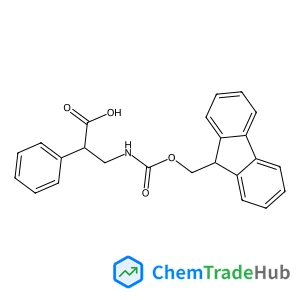
(S)-3-((((9H-Fluoren-9-yl)methoxy)carbonyl)amino)-2-phenylpropanoic acid
CAS Number:
1217663-60-9
Molecular Formula:
C24H21NO4
The first page of this article is displayed as the abstract.
Qian Cheng, Shengke Li, Chen Sun, Ludan Yue, Ruibing Wang
DOI: 10.1039/C8QM00460A
Pengfei Ju, Jian Hu, Fei Li, Youwen Cao, Lei Li, Dongjian Shi, Ying Hao, Mingzu Zhang, Jinlin He, Peihong Ni
DOI: 10.1039/C8TB01566J
B. P. Vinayan, Rupali Nagar, S. Ramaprabhu
DOI: 10.1039/C3TA12016C
Alexandre Simula, Fernando Ruipérez, Nicholas Ballard, José R. Leiza, José M. Asua
DOI: 10.1039/C8PY00900G
Rachael E. H. Miles, Jim S. Walker, Daniel R. Burnham, Jonathan P. Reid
DOI: 10.1039/C2CP23999J
Suresh Kumar Vasa, Petra Rovó, Karin Giller, Stefan Becker, Rasmus Linser
DOI: 10.1039/C5CP06601H
Alexander Weigel, Matthias Pfaffe, Mohsen Sajadi, Rainer Mahrwald, Roberto Improta, Vincenzo Barone, Dario Polli, Giulio Cerullo, Nikolaus P. Ernsting, Fabrizio Santoro
DOI: 10.1039/C2CP41522D
Malay Pramanik, Asim Bhaumik
DOI: 10.1039/C3TA12476B
When considering alternatives to 1-(4-Chlorophenyl)-N-hydroxymethanimine (CAS: 3...
This compound should be stored in a cool, dry place away from direct sunlight. I...
3-(4-Bromophenyl)-5-(2-fluorophenyl)-1,2,4-oxadiazole is synthesized through a m...
5-Chloro-2-(4-chlorophenyl)-4-methyl-6-[3-(1-piperidinyl)propoxy]pyrimidine (CAS...
2-Chloro-4-(difluoromethoxy)pyridine is used in the pharmaceutical industry for ...
3-Chloro-6-methylpyridazine (CAS: 1121-79-5) is classified under the Globally Ha...
Several alternatives can be used in the synthesis of Methyl 4,5-dimethyl-2-nitro...
Alternatives to (2E,2'E)-3,3'-(1,4-Phenylene)bisacrylaldehyde include other acry...
3-Amino-5-chloropyridin-2-ol hydrochloride is an organic compound with the CAS n...
When handling 6,7-Difluoro-2,3-dihydro-4H-chromen-4-one, it is essential to wear...

Physical Chemistry Chemical Physics (PCCP) is an international journal co-owned by 19 physical chemistry and physics societies from around the world. This journal publishes original, cutting-edge research in physical chemistry, chemical physics and biophysical chemistry. To be suitable for publication in PCCP, articles must include significant innovation and/or insight into physical chemistry; this is the most important criterion that reviewers and Editors will judge against when evaluating submissions. The journal has a broad scope and welcomes contributions spanning experiment, theory, computation and data science. Topical coverage includes spectroscopy, dynamics, kinetics, statistical mechanics, thermodynamics, electrochemistry, catalysis, surface science, quantum mechanics, quantum computing and machine learning. Interdisciplinary research areas such as polymers and soft matter, materials, nanoscience, energy, surfaces/interfaces, and biophysical chemistry are welcomed if they demonstrate significant innovation and/or insight into physical chemistry. Joined experimental/theoretical studies are particularly appreciated when complementary and based on up-to-date approaches.
![6-Bromo-2,3-dihydro-1H-pyrido[2,3-b][1,4]oxazine structure](https://static.chemtradehub.com/structs/120/1203499-17-5-b4d1.webp "6-Bromo-2,3-dihydro-1H-pyrido[2,3-b][1,4]oxazine structure")
![4-[(3-Chloro-2-fluorophenyl)amino]-7-methoxy-6-quinazolinyl acetate structure](https://static.chemtradehub.com/structs/740/740081-22-5-f58f.webp "4-[(3-Chloro-2-fluorophenyl)amino]-7-methoxy-6-quinazolinyl acetate structure")





