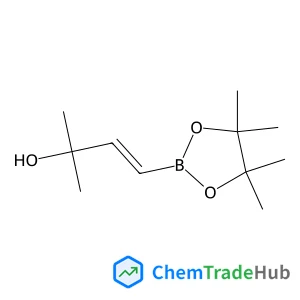
(E)-2-methyl-4-(4,4,5,5-tetramethyl-1,3,2-dioxaborolan-2-yl)but-3-en-2-ol
CAS Number:
581802-26-8
Molecular Formula:
C11H21BO3
Anindya Sundar Patra, Gaurangi Gogoi, Ranjan Kumar Sahu, Mohammad Qureshi
To the best of our knowledge this is the first report in which ruthenium doped polycrystalline lanthanum manganite, LaMn1−xRuxO3 (x = 0.0–0.4), having high efficacy for oxygen production from water without the use of any sacrificial reagent or co-catalyst and as an efficient photocatalyst for dye degradation is reported. Ruthenium doping alters the crystal structure of the parent LaMnO3 (LMO) due to the induced chemical pressure of the larger Ru4+ ion, which facilitates a bond angle of 180° in the Mn3+–O–Mn4+ plane resulting in the easy extraction of a photo-generated charge carrier population leading to enhanced photocatalytic activity. Rietveld refinements reveal that the parent compound LMO crystallizes in the rhombohedral phase, while upon an increase in the doping concentration of ruthenium, the phase of the compounds changes from the rhombohedral to the cubic phase. The percentage contribution of each phase has been estimated using the sixth-order polynomial and pseudo-Voigt function. Typically, all the compositions, LaMn1−xRuxO3 (x = 0.0–0.4), were prepared by a conventional solid state route and studied for their photocatalytic activity. The synthesized compounds were investigated by powder X-ray diffraction (PXRD), UV-visible diffuse reflectance spectroscopy (DRS), Fourier transform infrared spectroscopy (FTIR), field emission scanning electron microscopy (FESEM), energy-dispersive X-ray spectroscopy (EDX) and X-ray photoelectron spectroscopy (XPS) analysis. The structure–property correlation of the compound is presented based on Rietveld refinement combined with the experimental data. The as-prepared compounds show efficient photocatalytic oxygen gas production from water without the use of any co-catalyst or sacrificial reagents. Among the five compositions, LaMn0.7Ru0.3O3 shows the highest O2 production efficiency (4.73 mmol g−1 h−1) with an apparent quantum yield (AQY) of 7.43%. These ruthenium doped compositions also exhibit superior dye degradation properties, studied by taking the industrial dye methyl orange (MO) as the model compound.
Jonas W. Perez, Frederick R. Haselton, David W. Wright
DOI: 10.1039/B904191E
Torsten Mayr, Tobias Abel, Barbara Enko, Sergey Borisov, Christian Konrad, Stefan Köstler, Bernhard Lamprecht, Stefan Sax, Emil J. W. List, Ingo Klimant
DOI: 10.1039/B904536H
Yuze Sun, Jing Liu, Greg Frye-Mason, Shiou-jyh Ja, Aaron K. Thompson, Xudong Fan
DOI: 10.1039/B900050J
Sang-Jin Park
DOI: 10.1039/B805355C
Xiaoding Lou, Jingui Qin, Zhen Li
DOI: 10.1039/B903076J
Yafeng Wu, Songqin Liu
DOI: 10.1039/B812642A
Hei-Leung Pang, Pak-Ho Chan, Zhi-Shu Huang, Lian-Quan Gu, Kwok-Yin Wong
DOI: 10.1039/B805346D
Nicoletta Nicolaou, Royston Goodacre
DOI: 10.1039/B804439B
Guixin Li, Hongyan Nan, Xingwang Zheng
DOI: 10.1039/B816226C
When considering alternatives to 1-(4-Chlorophenyl)-N-hydroxymethanimine (CAS: 3...
This compound should be stored in a cool, dry place away from direct sunlight. I...
3-(4-Bromophenyl)-5-(2-fluorophenyl)-1,2,4-oxadiazole is synthesized through a m...
5-Chloro-2-(4-chlorophenyl)-4-methyl-6-[3-(1-piperidinyl)propoxy]pyrimidine (CAS...
2-Chloro-4-(difluoromethoxy)pyridine is used in the pharmaceutical industry for ...
3-Chloro-6-methylpyridazine (CAS: 1121-79-5) is classified under the Globally Ha...
Several alternatives can be used in the synthesis of Methyl 4,5-dimethyl-2-nitro...
Alternatives to (2E,2'E)-3,3'-(1,4-Phenylene)bisacrylaldehyde include other acry...
3-Amino-5-chloropyridin-2-ol hydrochloride is an organic compound with the CAS n...
When handling 6,7-Difluoro-2,3-dihydro-4H-chromen-4-one, it is essential to wear...

Physical Chemistry Chemical Physics (PCCP) is an international journal co-owned by 19 physical chemistry and physics societies from around the world. This journal publishes original, cutting-edge research in physical chemistry, chemical physics and biophysical chemistry. To be suitable for publication in PCCP, articles must include significant innovation and/or insight into physical chemistry; this is the most important criterion that reviewers and Editors will judge against when evaluating submissions. The journal has a broad scope and welcomes contributions spanning experiment, theory, computation and data science. Topical coverage includes spectroscopy, dynamics, kinetics, statistical mechanics, thermodynamics, electrochemistry, catalysis, surface science, quantum mechanics, quantum computing and machine learning. Interdisciplinary research areas such as polymers and soft matter, materials, nanoscience, energy, surfaces/interfaces, and biophysical chemistry are welcomed if they demonstrate significant innovation and/or insight into physical chemistry. Joined experimental/theoretical studies are particularly appreciated when complementary and based on up-to-date approaches.