












DNA that is dispersed in the liquid crystalline phases of phospholipids is actively transcribed
Literature Information
Publication Date
2008-04-08
DOI
10.1039/B801199K
Impact Factor
6.222
Authors
Josephine Corsi, Marcus K. Dymond, Oscar Ces, Joscha Muck, Daniele Zink, George S. Attard
View Original
Abstract
We report that a 4.3 kbp linearised T7 DNA plasmid is actively transcribed when it is dispersed in the hexagonal liquid crystalline phase of dioleoylphosphoethanolamine (DOPE).
Related Literature
Transition metal-catalyzed C–H bond functionalizations by the use of diverse directing groups
Zhengkai Chen, Binjie Wang, Jitan Zhang, Wenlong Yu, Zhanxiang Liu
2015-06-03
Review Article
DOI: 10.1039/C5QO00004A
Approach to the synthesis of the C1–C11 and C14–C18 portion of Leucascandrolide A‡
T. J. Hunter, J. Zheng, G. A. O'Doherty
2016-07-12
Research Article
DOI: 10.1039/C6QO00284F
Iridium(iii)- and rhodium(iii)-catalyzed coupling of anilines with α-diazoesters via chelation-assisted C–H activation
Cheng-Ling Pan, Xingwei Li
2015-11-17
Research Article
DOI: 10.1039/C5QO00316D
Mechanism, catalysis and predictions of 1,3,2-diazaphospholenes: theoretical insight into highly polarized P–X bonds
Liu Leo Liu, Yile Wu, Peng Chen, Chinglin Chan, Ji Xu, Jun Zhu, Yufen Zhao
2016-02-09
Research Article
DOI: 10.1039/C6QO00002A
Copper-catalyzed direct decarboxylative hydrosulfonylation of aryl propiolic acids with sulfonylhydrazides leading to vinylsulfones
Siyu Li, Xiang Li, Fan Yang, Yangjie Wu
2015-07-10
Research Article
DOI: 10.1039/C5QO00212E
Magnetically separable nano-copper catalyzed unprecedented stereoselective synthesis of E-vinyl sulfones from tosylmethyl isocyanide and alkynes: TosMIC as a source of the sulfonyl group
Mandalaparthi Phanindrudu, Dipak Kumar Tiwari, B. Sridhar, Pravin R. Likhar, Dharmendra Kumar Tiwari
2016-03-30
Research Article
DOI: 10.1039/C6QO00063K
Pincer CNC bis-N-heterocyclic carbenes: robust ligands for palladium-catalysed Suzuki–Miyaura arylation of bromoanthracene and related substrates
V. M. Zende, C. Schulzke, A. R. Kapdi
2015-09-02
Research Article
DOI: 10.1039/C5QO00236B
A versatile strategy for difunctionalization of carbon–carbon multiple bonds by photoredox catalysis
Takashi Koike, Munetaka Akita
2016-05-31
Chemistry Frontiers
DOI: 10.1039/C6QO00139D
Gold(i) catalyzed [1,3] O → C rearrangement of benzylvinyl ethers
Chandrababu Naidu Kona, Mahesh N. Patil, Chepuri V. Ramana
2016-01-26
Research Article
DOI: 10.1039/C5QO00397K
You might also like
Compound Q&A
How should waste containing (6-Bromo-2-naphthyl)oxy](dimethyl)(2-methyl-2-propanyl)silane be handled?
Waste containing (6-Bromo-2-naphthyl)oxy](dimethyl)(2-methyl-2-propanyl)silane (...
100751-65-3[(6-Bromo-2-naphthyl...
Compound Q&A
How is 7-Fluoro-4-isoquinolinecarboxylic acid (CAS: 1841081-40-0) typically synthesized?
7-Fluoro-4-isoquinolinecarboxylic acid can be synthesized via a multi-step proce...
1841081-40-07-Fluoro-4-isoquinol...
Compound Q&A
What are the physical and chemical properties of 2,3,5,6-Tetrabromothieno[3,2-b]thiophene (CAS: 124638-53-5)?
2,3,5,6-Tetrabromothieno[3,2-b]thiophene is a crystalline compound with a high m...
124638-53-52,3,5,6-Tetrabromoth...
Compound Q&A
Is 1-[4-(Benzylamino)-7,8-dihydro-5H-pyrano[4,3-d]pyrimidin-2-yl]-2-methyl-1H-indole-4-carboxamide (CAS: 1542705-92-9) safe?
1-[4-(Benzylamino)-7,8-dihydro-5H-pyrano[4,3-d]pyrimidin-2-yl]-2-methyl-1H-indol...
1542705-92-91-[4-(Benzylamino)-7...
Compound Q&A
What is the market or research trend for imidazo[5,1-d]-1,2,3,5-tetrazine-8-carboxylic acid, 3,4-dihydro-3-methyl-4-oxo- (CAS: 113942-30-6)?
The market for imidazo[5,1-d]-1,2,3,5-tetrazine-8-carboxylic acid, 3,4-dihydro-3...
113942-30-6Imidazo[5,1-d]-1,2,3...
Compound Q&A
What is 3-(Triisopropylsilyl)propiolaldehyde (CAS: 163271-80-5)?
3-(Triisopropylsilyl)propiolaldehyde is a synthetic organic compound with the CA...
163271-80-53-(Triisopropylsilyl...
Compound Q&A
What regulatory guidelines apply to 6-Nitro-2H-1,4-benzoxazin-3(4H)-one (CAS: 81721-87-1)?
6-Nitro-2H-1,4-benzoxazin-3(4H)-one (CAS: 81721-87-1) is subject to various regu...
81721-87-16-Nitro-2H-1,4-benzo...
Compound Q&A
How should waste containing (3-Fluorophenyl)(4-{[(2-methyl-2-propanyl)oxy]carbonyl}-1-piperazinyl)acetic acid (CAS: 885272-91-3) be handled?
Waste containing (3-Fluorophenyl)(4-{[(2-methyl-2-propanyl)oxy]carbonyl}-1-piper...
885272-91-3(3-Fluorophenyl)(4-{...
Compound Q&A
What are the physical and chemical properties of N,N'-4,4'-Biphenyldiyldiisonicotinamide (CAS: 55119-40-9)?
N,N'-4,4'-Biphenyldiyldiisonicotinamide is a white crystalline solid with a mole...
55119-40-9N,N'-4,4'-Biphenyldi...
Compound Q&A
What industries use 6-Bromo-8-fluoro-2-quinazolinol (CAS: 1036756-15-6)?
6-Bromo-8-fluoro-2-quinazolinol is primarily used in the pharmaceutical industry...
1036756-15-66-Bromo-8-fluoro-2-q...
Source Journal
Chemical Communications

CiteScore:
8.6
Self-citation Rate:
4.7%
Articles per Year:
2458
ChemComm publishes urgent research which is of outstanding significance and interest to experts in the field, while also appealing to the journal’s broad chemistry readership. Our communication format is ideally suited to short, urgent studies that are of such importance that they require accelerated publication. Our scope covers all topics in chemistry, and research at the interface of chemistry and other disciplines (such as materials science, nanoscience, physics, engineering and biology) where there is a significant novelty in the chemistry aspects. Major topic areas covered include: Analytical Chemistry Catalysis Chemical Biology and medicinal chemistry Computational Chemistry and Machine Learning Energy and sustainable chemistry Environmental Chemistry Green Chemistry Inorganic Chemistry Materials Chemistry Nanoscience Organic Chemistry Physical Chemistry Polymer Chemistry Supramolecular Chemistry
Recommended Compounds
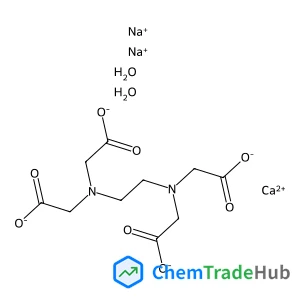
EthylenediaminetetraaceticacidcalciumDisodiumsalthydrate
CAS Number:
23411-34-9
Molecular Formula:
C10H16CaN2Na2O10
Recommended Suppliers



Disclaimer
This page provides academic journal information for reference and research purposes only. We are not affiliated with any journal publishers and do not handle publication submissions. For publication-related inquiries, please contact the respective journal publishers directly.
If you notice any inaccuracies in the information displayed, please contact us at support@chemtradehub.com. We will promptly review and address your concerns.