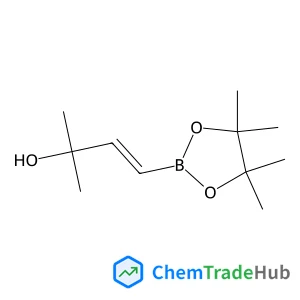
(E)-2-methyl-4-(4,4,5,5-tetramethyl-1,3,2-dioxaborolan-2-yl)but-3-en-2-ol
CAS Number:
581802-26-8
Molecular Formula:
C11H21BO3
Chengbao Ni, Bobby D. Ellis, James C. Fettinger, Gary J. Long, Philip P. Power
Two univalent transition metal complexes, (µ-η6:η6-C7H8){MnAr*-3,5-Pri2}2 (1) and (η6-C6H6)FeAr*-3,5-Pri2 (2) (Ar*-3,5-Pri2 = C6H-2,6-(C6H2-2,4,6-Pri3)2-3,5-Pri2), that have η6 arene coordination were synthesized by reduction of the corresponding metal halides. The complexes are thermally stable in contrast to the corresponding Cr(I) complexes of benzene or toluene which decompose at room temperature.
Mathias Schnippering, Alain Zahn, Shi-Xia Liu, Christian Leumann, Silvio Decurtins, David J. Fermín
DOI: 10.1039/B907847A
Neena S. John, Camilla Scherb, Maryiam Shöâeè, Michael W. Anderson, Martin P. Attfield, Thomas Bein
DOI: 10.1039/B908299A
Per Restorp, Orion B. Berryman, Aaron C. Sather, Dariush Ajami, Julius Rebek Jr.
DOI: 10.1039/B914171E
Kazutaka Seki, Rongmin Yu, Yumi Yamazaki, Yasuhiro Yamashita, Shū Kobayashi
DOI: 10.1039/B914271C
Honglin Li, Jiangli Fan, Jingyun Wang, Maozhong Tian, Jianjun Du, Shiguo Sun, Pingping Sun, Xiaojun Peng
DOI: 10.1039/B907511A
Mikiko Sodeoka, Yoshitaka Hamashima
DOI: 10.1039/B911015A
James W. Ogle, Stephen A. Miller
DOI: 10.1039/B914732B
Shigeru Matsuoka, Masayuki Inoue
DOI: 10.1039/B910230B
João Carlos R. Reis, Gérard Douhéret, Michael I. Davis, Inger Johanne Fjellanger, Harald Høiland
DOI: 10.1039/B713806G
When considering alternatives to 1-(4-Chlorophenyl)-N-hydroxymethanimine (CAS: 3...
This compound should be stored in a cool, dry place away from direct sunlight. I...
3-(4-Bromophenyl)-5-(2-fluorophenyl)-1,2,4-oxadiazole is synthesized through a m...
5-Chloro-2-(4-chlorophenyl)-4-methyl-6-[3-(1-piperidinyl)propoxy]pyrimidine (CAS...
2-Chloro-4-(difluoromethoxy)pyridine is used in the pharmaceutical industry for ...
3-Chloro-6-methylpyridazine (CAS: 1121-79-5) is classified under the Globally Ha...
Several alternatives can be used in the synthesis of Methyl 4,5-dimethyl-2-nitro...
Alternatives to (2E,2'E)-3,3'-(1,4-Phenylene)bisacrylaldehyde include other acry...
3-Amino-5-chloropyridin-2-ol hydrochloride is an organic compound with the CAS n...
When handling 6,7-Difluoro-2,3-dihydro-4H-chromen-4-one, it is essential to wear...

ChemComm publishes urgent research which is of outstanding significance and interest to experts in the field, while also appealing to the journal’s broad chemistry readership. Our communication format is ideally suited to short, urgent studies that are of such importance that they require accelerated publication. Our scope covers all topics in chemistry, and research at the interface of chemistry and other disciplines (such as materials science, nanoscience, physics, engineering and biology) where there is a significant novelty in the chemistry aspects. Major topic areas covered include: Analytical Chemistry Catalysis Chemical Biology and medicinal chemistry Computational Chemistry and Machine Learning Energy and sustainable chemistry Environmental Chemistry Green Chemistry Inorganic Chemistry Materials Chemistry Nanoscience Organic Chemistry Physical Chemistry Polymer Chemistry Supramolecular Chemistry