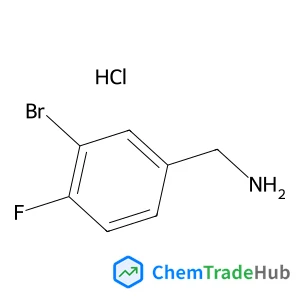
1-(3-Bromo-4-fluorophenyl)methanamine hydrochloride (1:1)
CAS Number:
202865-68-7
Molecular Formula:
C7H8BrClFN
Shigeru Matsuoka, Masayuki Inoue
Many natural products have molecular targets that are non-crystalline and insoluble biological matrices, such as proteins embedded in lipid membrane, cell membranes, and cell walls. To understand the action mechanisms, it is essential to determine the binding structure with atomic-level resolution. For structural studies of biological solids, high resolution distance measurements using solid-state nuclear magnetic resonance (NMR) are indispensable techniques, of which rotational-echo double-resonance (REDOR) is one of the most widely used methods. This feature article introduces the basic concepts of REDORNMR and its application to the structural study of natural products in biological matrices.
James Garner, Katrina A. Jolliffe, Margaret M. Harding, Richard J. Payne
DOI: 10.1039/B918021D
Md. Badruz Zaman, David Bardelang, Xiaohua Wu, Dashan Wang, James C. Margeson, Donald M. Leek, John A. Ripmeester, Christopher I. Ratcliffe, Quan Lin, Bai Yang, Kui Yu
DOI: 10.1039/B913914A
Ayellet L. Zelikoff, Jacob Kopilov, Israel Goldberg, Geoffrey W. Coates, Moshe Kol
DOI: 10.1039/B915211C
Mandi Tsoi, Trinh T. Do, Vicky J. Tang, Joseph A. Aguilera, Jamie R. Milligan
DOI: 10.1039/B922749K
Ilaria Proietti Silvestri, Fikre Andemarian, George N. Khairallah, Su Wan Yap, Tim Quach, Sammi Tsegay, Craig M. Williams, Richard A. J. O'Hair, Paul S. Donnelly, Spencer J. Williams
DOI: 10.1039/C1OB05360D
Hao-Wei Shih, Kuo-Ting Chen, Shao-Kang Chen, Chia-Ying Huang, Ting-Jen R Cheng, Che Ma, Chi-Huey Wong, Wei-Chieh Cheng
DOI: 10.1039/C000622J
Mrinmoyee Basu, Suresh Sarkar, Surojit Pande, Subhra Jana, Arun Kumar Sinha, Sougata Sarkar, Mukul Pradhan, Anjali Pal, Tarasankar Pal
DOI: 10.1039/B905718H
Binbin Zhou, Mark S. Denning, Thomas A. D. Chapman, John E. McGrady, Jose M. Goicoechea
DOI: 10.1039/B917185A
Jingjin Chen, Guoqin Fan, Yuanhong Liu
DOI: 10.1039/C0OB00344A
(1R,3S)-1,3-Cyclopentanediol finds applications in various industries. In the ph...
When handling N'-[4-(Dimethylamino)phenyl]-N,N-dimethyl-1,4-benzenediamine, it i...
There are several alternatives to 5-(2,4-Difluorophenyl)-2-methoxypyrimidine in ...
1-(3-Methoxyphenoxy)propan-2-ol (CAS: 382141-68-6) must comply with the Globally...
Tetrodotoxin Citrate is extremely dangerous and should be handled with extreme c...
2-Methyl-2-propanyl [(1R,3S)-3-hydroxycyclopentyl]carbamate (CAS: 225641-84-9) i...
Waste containing 4-(2-Hydroxyhexafluoroisopropyl)Benzoic Acid (CAS: 16261-80-6) ...
2-Methyl-2-proanyl {(2S)-1-[(benzyloxy)amino]-3-hydroxy-3-methyl-1-oxo-2-butanyl...
Benzeneethanamine, α-ethyl-, hydrochloride (1:1) is an organic compound with the...
In the synthesis of compounds similar to 3-{(E)-[4-(Dimethylamino)phenyl]diazeny...

ChemComm publishes urgent research which is of outstanding significance and interest to experts in the field, while also appealing to the journal’s broad chemistry readership. Our communication format is ideally suited to short, urgent studies that are of such importance that they require accelerated publication. Our scope covers all topics in chemistry, and research at the interface of chemistry and other disciplines (such as materials science, nanoscience, physics, engineering and biology) where there is a significant novelty in the chemistry aspects. Major topic areas covered include: Analytical Chemistry Catalysis Chemical Biology and medicinal chemistry Computational Chemistry and Machine Learning Energy and sustainable chemistry Environmental Chemistry Green Chemistry Inorganic Chemistry Materials Chemistry Nanoscience Organic Chemistry Physical Chemistry Polymer Chemistry Supramolecular Chemistry
![4-[(3-Chloro-2-fluorophenyl)amino]-7-methoxy-6-quinazolinyl acetate structure](https://static.chemtradehub.com/structs/740/740081-22-5-f58f.webp "4-[(3-Chloro-2-fluorophenyl)amino]-7-methoxy-6-quinazolinyl acetate structure")