












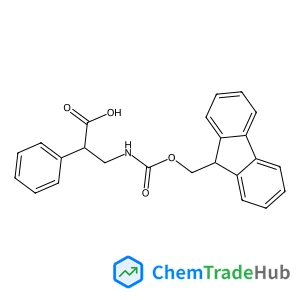
(S)-3-((((9H-Fluoren-9-yl)methoxy)carbonyl)amino)-2-phenylpropanoic acid
CAS Number:
1217663-60-9
Molecular Formula:
C24H21NO4
Neena S. John, Camilla Scherb, Maryiam Shöâeè, Michael W. Anderson, Martin P. Attfield, Thomas Bein
In situ atomic force microscopy was used to directly investigate the growth processes of the oriented metal–organic framework HKUST-1 grown on self-assembled monolayers on gold.
Yupeng Wang, Zhijian Luo, Dongfang Zhou, Xuefeng Wang
DOI: 10.1039/D1BM00087J
Kathleen Moyer, Nora Ait Boucherbil, Murtaza Zohair, Janna Eaves-Rathert, Cary L. Pint
DOI: 10.1039/D0SE00263A
Chi-You Liu, Elise Y. Li
DOI: 10.1039/C9SE01289C
DOI: 10.1039/AN8992400178
M. V. Balarama Krishna, A. C. Sahayam, D. Karunasagar
DOI: 10.1039/C1AY05624G
Guotai Sun, Jian-Wen Shi, Yajun Zou, Siman Mao, Dandan Ma, Yixuan Lv, Lvwei Sun, Zhihui Li, Yonghong Cheng
DOI: 10.1039/D0SE00249F
Jie Zhang, Conghui Si, Tianyi Kou, Jianfeng Wang, Zhonghua Zhang
DOI: 10.1039/C9SE01312A
(1R,3S)-1,3-Cyclopentanediol finds applications in various industries. In the ph...
When handling N'-[4-(Dimethylamino)phenyl]-N,N-dimethyl-1,4-benzenediamine, it i...
There are several alternatives to 5-(2,4-Difluorophenyl)-2-methoxypyrimidine in ...
1-(3-Methoxyphenoxy)propan-2-ol (CAS: 382141-68-6) must comply with the Globally...
Tetrodotoxin Citrate is extremely dangerous and should be handled with extreme c...
2-Methyl-2-propanyl [(1R,3S)-3-hydroxycyclopentyl]carbamate (CAS: 225641-84-9) i...
Waste containing 4-(2-Hydroxyhexafluoroisopropyl)Benzoic Acid (CAS: 16261-80-6) ...
2-Methyl-2-proanyl {(2S)-1-[(benzyloxy)amino]-3-hydroxy-3-methyl-1-oxo-2-butanyl...
Benzeneethanamine, α-ethyl-, hydrochloride (1:1) is an organic compound with the...
In the synthesis of compounds similar to 3-{(E)-[4-(Dimethylamino)phenyl]diazeny...

ChemComm publishes urgent research which is of outstanding significance and interest to experts in the field, while also appealing to the journal’s broad chemistry readership. Our communication format is ideally suited to short, urgent studies that are of such importance that they require accelerated publication. Our scope covers all topics in chemistry, and research at the interface of chemistry and other disciplines (such as materials science, nanoscience, physics, engineering and biology) where there is a significant novelty in the chemistry aspects. Major topic areas covered include: Analytical Chemistry Catalysis Chemical Biology and medicinal chemistry Computational Chemistry and Machine Learning Energy and sustainable chemistry Environmental Chemistry Green Chemistry Inorganic Chemistry Materials Chemistry Nanoscience Organic Chemistry Physical Chemistry Polymer Chemistry Supramolecular Chemistry
![[4-(Isobutyrylamino)phenyl]boronic acid structure](https://static.chemtradehub.com/structs/874/874219-50-8-6ab5.webp "[4-(Isobutyrylamino)phenyl]boronic acid structure")
![2-{[(1R,2S)-2-Aminocyclohexyl]amino}-4-{[3-(2H-1,2,3-triazol-2-yl)phenyl]amino}-5-pyrimidinecarboxamide structure](https://static.chemtradehub.com/structs/137/1370261-96-3-40df.webp "2-{[(1R,2S)-2-Aminocyclohexyl]amino}-4-{[3-(2H-1,2,3-triazol-2-yl)phenyl]amino}-5-pyrimidinecarboxamide structure")



