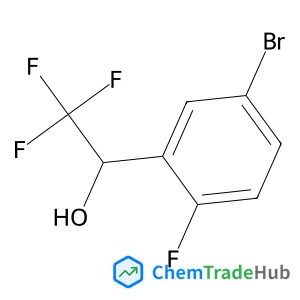
1-(5-Bromo-2-fluorophenyl)-2,2,2-trifluoroethanol
CAS Number:
1039827-16-1
Molecular Formula:
C8H5BrF4O
Pablo Lozano-Sanchez, Joanne M. Elliott
Using the technique of liquid crystal templating a rotating disc electrode (RDE) was modified with a high surface area mesoporous platinum film. The surface area of the electrode was characterised by acid voltammetry, and found to be very high (ca. 86 cm2). Acid characterisation of the electrode produced distorted voltammograms was interpreted as being due to the extremely large surface area which produced a combination of effects such as localised pH change within the pore environment and also ohmic drop effects. Acid voltammetry in the presence of two different types of surfactant, namely Tween 20 and Triton X-100, suggested antifouling properties associated with the mesoporous deposit. Further analysis of the modified electrode using a redox couple in solution showed typical RDE behaviour although extra capacitive currents were observed due to the large surface area of the electrode. The phenomenon of underpotential deposition was exploited for the purpose of anodic stripping voltammetry and results were compared with data collected for microelectrodes. Underpotential deposition of metal ions at the mesoporous RDE was found to be similar to that at conventional platinum electrodes and mesoporous microelectrodes although the rate of surface coverage was found to be slower at a mesoporous RDE. It was found that a mesoporous RDE forms a suitable system for quantification of silver ions in solution.

Russian Journal of General Chemistry

Nature Medicine

Current Opinion in Colloid & Interface Science

Saudi Pharmaceutical Journal

New Journal of Chemistry

Current Opinion in Solid State & Materials Science

Journal of Peptide Science

Journal of Saudi Chemical Society

Chemistry Education Research and Practice

Russian Journal of Applied Chemistry
Alexander Lüken, Martin Muhler, Jennifer Strunk
DOI: 10.1039/C4CP05423G
Qi Wu, Bolong Huang, T. A. Niehaus, Xiaojing Yang, Jun Fan, Rui-Qin Zhang
DOI: 10.1039/C4CP06073C
Dimitris Zaouris, Andreas Kartakoullis, Pavle Glodic, Peter C. Samartzis, Helgi Rafn Hróðmarsson, Ágúst Kvaran
DOI: 10.1039/C5CP00748H
L. Brambilla, E. Parisini, C. Castiglioni
DOI: 10.1039/C4CP05748A
DOI: 10.1039/C5CP01428J
Hany A. El-Sayed, Corie A. Horwood, Ebenezer Owusu-Ansah, Yujun J. Shi, Viola I. Birss
DOI: 10.1039/C5CP00924C
Qian Zhang, Jia-Jia Chen, Xue-Yin Wang, Cheng Yang, Ming-Sen Zheng, Quan-Feng Dong
DOI: 10.1039/C5CP00799B
Gong Chen, Xian Kong, Jingying Zhu, Diannan Lu, Zheng Liu
DOI: 10.1039/C5CP00418G
Pavlin D. Mitev, Anders Eriksson, Jean-François Boily, Kersti Hermansson
DOI: 10.1039/C5CP00390C
Declan Williams, Junfang Zhao, Stefanie Mädler, Yating Wang, Irine S. Saminathan, Alan C. Hopkinson
DOI: 10.1039/C5CP00178A
2-(2-Chloroacetamido)-3-phenylpropanoic acid (CAS: 7765-11-9) is generally consi...
2-(Benzyloxy)-5-bromobenzoic acid can be handled safely if appropriate precautio...
(4-Methyl-1,2,5-oxadiazol-3-yl)methanamine hydrochloride is a chemical compound ...
2-(5-Hexylthiophen-2-yl)-4,4,5,5-tetramethyl-1,3,2-dioxaborolane (CAS: 917985-54...
While 4-(8-Methyl-9H-1,3-dioxolo[4,5-h][2,3]benzodiazepin-5-yl)benzenamine (CAS:...
The market for tert-butyl 3-hydroxy-4,5,7,8-tetrahydro-2H-pyrazolo[3,4-d]azepine...
Waste containing 3,5-Diamino-1H-pyrazole-4-carbonitrile (CAS: 6844-58-2) should ...
(6-Fluoro-3-pyridinyl)boronic acid can be synthesized through the reaction of 6-...
Dibenzyl carbonimidoylbiscarbamate (CAS: 10065-79-9) finds applications in vario...
The market for (beta,beta,2,3,4,5,6-~2~H_7_)Phenylalanine (CAS: 74228-83-4) is g...

Analyst publishes analytical and bioanalytical research that reports premier fundamental discoveries and inventions, and the applications of those discoveries, unconfined by traditional discipline barriers.